Voter Turnout Improvement Programs: A Strategic Framework for 2026

Throwing millions of dollars at a last-minute get-out-the-vote campaign is often less effective than a single year of steady, principled community engagement. You likely recognize the persistent frustration of watching engagement stall despite significant financial investment in voter turnout improvement programs. You've seen how structural barriers can prevent willing participants from reaching the ballot box, and you know the limitations of a strategy that only activates weeks before an election. It's a common struggle to move beyond the reactive nature of the cycle and toward a cohesive, long-term vision.
Building these initiatives requires more than just digital ads or seasonal door-knocking; it demands a foundation of trust and organizational integrity. This article provides the professional strategies and community-driven frameworks necessary to create sustainable, high-impact initiatives for the 2026 cycle. We'll outline a scalable roadmap for engagement that focuses on increasing civic literacy and achieving measurable improvements in participation rates. By blending legislative advocacy with human-centric mobilization, you can transform how your community interacts with the democratic process and ensure every voice is heard.
Table of Contents
What Is a Voter Turnout Improvement Program?
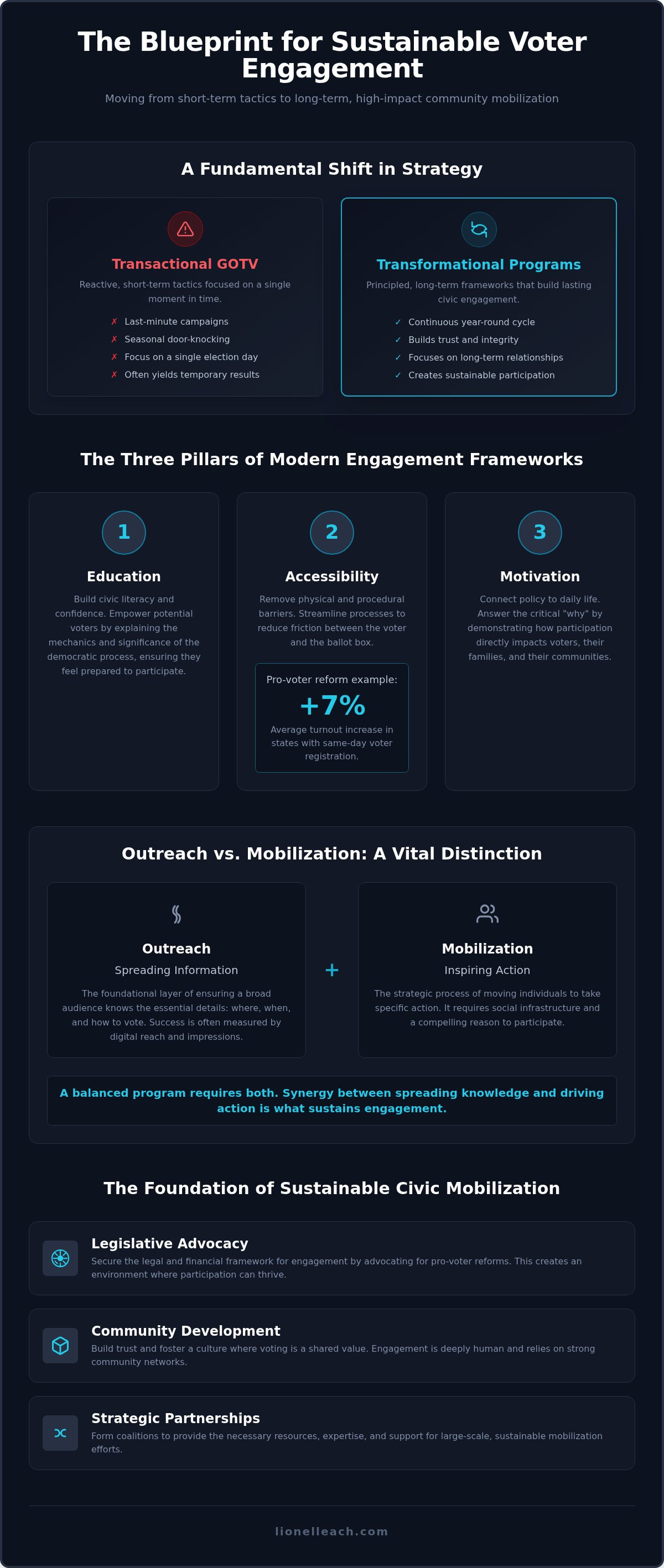
A voter turnout improvement program is far more than a collection of sporadic emails or digital advertisements sent in the final weeks of an election. It's a systematic, principled framework designed to increase civic participation through a deliberate blend of education, accessibility, and mobilization. While voter turnout is often viewed through the narrow lens of election-day numbers, a professional program treats it as a continuous cycle of engagement. This approach represents a fundamental shift from transactional get-out-the-vote (GOTV) tactics to transformational civic engagement. Transactional efforts focus on a single moment in time; transformational programs focus on building a lasting relationship between the citizen and the democratic process.
Professional strategy is the differentiator when attempting to move the needle on national participation rates. Engagement doesn't happen in a vacuum. It requires navigating complex government structures and understanding the human element of mobilization. Organizational leadership serves as the cornerstone of this process. Leaders must foster a culture where voting isn't just an obligation, but a shared value rooted in community integrity. When leadership prioritizes long-term impact over fleeting trends, they create an environment where voter turnout improvement programs can truly thrive.
Components of Modern Engagement Frameworks
Effective frameworks are built on three essential pillars that work in tandem to support the voter. Educational initiatives build the civic literacy and confidence voters need to feel empowered. Without understanding the mechanics and significance of the process, many potential voters remain on the sidelines. Accessibility programs work to remove the physical and procedural barriers that create friction. For example, data shows that states offering same-day registration consistently see higher participation, often averaging a 7% increase in turnout. Finally, motivational strategies must connect policy outcomes to a voter's daily life, answering the critical question of why their specific participation matters to their family and neighborhood.
The Difference Between Outreach and Mobilization
It's easy to confuse outreach with mobilization, but the distinction is vital for program sustainability. Outreach is the act of spreading information to a broad audience, ensuring they know where, when, and how to vote. It's the foundational layer of any campaign. Mobilization, however, is the strategic process of moving individuals to take specific action. While digital reach is a common metric for outreach, it often lacks the social infrastructure required for true mobilization. A balanced approach ensures that you aren't just talking to people, but rather inspiring them to act. This synergy between spreading knowledge and driving action is what sustains a program through high-stakes cycles.
The Three Pillars of Sustainable Civic Mobilization
High participation isn't the result of a single app or a clever slogan. It's built on a foundation of three distinct but interconnected pillars: legislative advocacy, community development, and strategic partnerships. When these elements align, they create a virtuous cycle where policy supports access, community networks drive interest, and partnerships provide the necessary resources. Unlike models that treat turnout as a technology problem, sustainable voter turnout improvement programs recognize that engagement is deeply human and structural.
Policy is the environment in which participation lives. By advocating for pro-voter reforms, organizations can streamline registration and remove procedural friction before the first door is ever knocked. This requires a sophisticated understanding of government structures to ensure that participation remains a priority for policymakers. When the rules of engagement are clear and inclusive, the path to the ballot box becomes accessible for everyone.
Legislative Advocacy as a Foundation
Securing the legal and financial framework for civic engagement is the first step toward long-term success. Seasoned advisory is essential here. It helps community leaders navigate the nuances of government affairs to secure funding and support for outreach initiatives. This isn't about lobbying registration; it's about principled leadership that understands how to draft successful legislative strategies. If you're looking to strengthen your organization's voice, exploring a community development strategy can provide the necessary roadmap for growth.
Building Community Infrastructure
A program is only as strong as its local roots. Building community infrastructure means developing local leaders who serve as trusted messengers within their own neighborhoods. These individuals don't just appear during election months. They are part of year-round engagement touchpoints that keep the conversation alive. By integrating voter programs into broader community development goals, participation becomes a shared civic habit. This long-term presence builds the credibility required to move individuals from passive interest to active action when it matters most.
The final pillar involves aligning government and private sectors to achieve common goals. By creating strategic partnerships, voter turnout improvement programs gain access to diverse audiences and stable resources. This collaborative approach ensures that the burden of mobilization doesn't fall on one group alone. It builds a collective responsibility that is far more resilient than isolated efforts, allowing for a broader reach across different demographic groups and ensuring the program's longevity.
Overcoming Structural Barriers to Voter Participation
Barriers to participation are often deeper than simple logistics. They're rooted in a fundamental disconnect between the act of voting and its perceived impact on life. The most frequent objection encountered by voter turnout improvement programs is the belief that a single vote doesn't change a person's daily reality. Overcoming this skepticism requires a strategy that moves beyond slogans and focuses on tangible outcomes. It's about demonstrating how local and national policies directly affect the issues people care about, from infrastructure to economic opportunity.
Procedural friction remains another significant hurdle for many citizens. Registration deadlines and limited polling access can discourage even the most motivated individuals. Strategic leadership involves identifying these bottlenecks and working with officials to implement smoother processes. For instance, leveraging U.S. Election Assistance Commission grants can provide the necessary funding to upgrade election infrastructure and improve voter education. By addressing these logistical challenges through a professional government partnership advisory, organizations can ensure the path to participation is as clear as possible.
Addressing the Trust Deficit
Restoring faith in the democratic process starts with sincere, principled communication. It's not enough to tell people to vote; you must build a relationship based on transparency and integrity. When government partnerships are managed with openness, it builds community confidence. Steady leadership provides a calm presence that counters the noise of misinformation. Case studies in regaining community confidence show that when leaders show up consistently, the trust deficit begins to close. By creating reliable channels of information, you empower constituents to make informed decisions without the fear of being misled by fleeting digital trends.
Navigating Complex Government Tiers
The "bureaucratic maze" of federal, state, and local policies often creates confusion for the average participant. These tiers can sometimes conflict, making it difficult for organizations to maintain a consistent outreach message. Strategic guidance is essential for navigating these multiple jurisdictions. It involves simplifying complex rules and ensuring every level of the program aligns with the others. By acting as a seasoned mentor, a program director can help community leaders understand where these policies intersect and how to leverage them for maximum impact. This deliberate planning ensures that voter turnout improvement programs remain resilient across diverse geographic landscapes while maintaining a unified mission.
How to Design a Comprehensive Voter Outreach Strategy
Designing a comprehensive strategy requires moving away from the reactive mentality of typical election cycles. Successful voter turnout improvement programs are built on a multi-year roadmap that prioritizes steady engagement over short-term digital saturation. This process begins with data-driven audience segmentation. By identifying low-propensity voters and understanding their specific hurdles, you can tailor your resources where they're most needed. For example, research on nonpartisan door-to-door campaigns has shown a 7% increase in turnout among unaffiliated voters when they're contacted directly through face-to-face mobilization.
Coalition building is the next critical phase. You must unite diverse stakeholders, including local businesses, civic groups, and government agencies, under a shared vision of participation. This collective approach ensures that the message is reinforced by multiple trusted messengers throughout the community. Following this, multi-channel messaging should be deployed. While P2P texting is cost-effective, with rates ranging from $0.015 to $0.08 per message, it works best when paired with personalized outreach. Finally, implementation must include measurement and feedback loops. By analyzing which tactics moved the needle, you can refine your iterative planning for the next cycle, ensuring your program grows more effective over time.
Crafting a Mission-Driven Message
Your message should empower and inspire rather than rely on complex political jargon. Clarity is your most effective tool. Use declarative sentences to connect policy advocacy directly to community growth. When people understand that their participation leads to better local infrastructure or improved school funding, they're more likely to take action. This human-centric approach transforms a dry civic duty into a meaningful contribution to the collective future. If you're ready to build a sustainable framework for your organization, consider exploring professional voter outreach programs designed for long-term impact.
Tactical Execution and Logistics
Execution involves managing resources for maximum impact, especially during peak periods like the October 2026 registration deadlines. While digital outreach is prevalent, it has limitations in high-profile elections where voters are often saturated with information. Tactical execution should include personalized touchpoints. Studies show that personalized, handwritten letters can increase turnout by three percentage points in certain demographics. Utilizing professional advisory helps you avoid common pitfalls, such as failing to account for the 30-day federal registration deadline mandate. Maintaining ethical responsibility and integrity in every tactic ensures that your program builds the long-term trust necessary for future success.
Strategic Advisory for Large-Scale Community Engagement
Seasoned expertise is the primary differentiator in high-stakes engagement. While many organizations focus solely on the technical side of voter turnout improvement programs, a strategic advisor looks at the broader political and social landscape. This involves a 35-year perspective in government affairs and policy, providing a level of depth that newer initiatives often lack. It's about knowing how to navigate federal and local structures to secure support and ensure that voter initiatives aren't just temporary projects, but permanent fixtures of community life. When you understand the mechanics of how bills are drafted and policies are implemented, you can better align your outreach with the actual drivers of civic change.
Integrating turnout into a broader community development strategy ensures that engagement remains high long after the polls close. When you leverage professional legislative advocacy, you shape the very environment where participation happens. This synergy between policy and outreach creates a robust framework for organizational success. It allows leaders to focus on their core mission while the structural elements of participation are managed with precision and foresight. By looking at the long-term roadmap rather than just the next election, you build a foundation that survives the shifting winds of the political cycle.
The Role of the Strategic Advisor
A strategic advisor acts as a mentor to community leaders and organizational heads. They provide the real-world experience needed to navigate complex negotiations with government partners and diverse stakeholders. This role avoids the sterile coldness of typical consulting; instead, it focuses on the human element of professional services. By understanding the nuances of how people interact with power and government, an advisor helps leaders build sincere connections that drive action. They guide organizations through the inevitable challenges of large-scale mobilization with quiet confidence and principled leadership, ensuring every tactical decision aligns with the group's core values.
Moving Toward Sustainable Growth
The goal of any professional engagement is to design programs that thrive long after the initial consultant work is complete. Sustainable growth means building internal capacity for advocacy and mobilization within the community itself. By training local leaders and establishing reliable systems, an organization ensures its voice remains strong across every election cycle. This long-term commitment to excellence is what separates a successful initiative from a fleeting trend. It's about creating a legacy of participation that empowers the collective. If you're ready to build a lasting foundation for engagement, you can Explore strategic advisory services for your community to begin your journey toward measurable impact.
Leading the Way Toward a More Engaged Democracy
Sustainable change requires a departure from reactive, last-minute tactics. By focusing on the three pillars of mobilization and addressing structural barriers through principled leadership, you can build voter turnout improvement programs that endure well beyond the 2026 cycle. Real success is found where strategic legislative advocacy meets human-centric community development. This approach ensures that every outreach effort is rooted in long-term integrity rather than fleeting trends.
Navigating the complexities of federal, state, and local government structures requires a steady hand and significant real-world experience. With over 35 years of leadership in government affairs, Lionel Leach provides the seasoned mentorship and strategic advisory needed to drive measurable results. His mission-driven approach prioritizes the success of the collective, helping you navigate negotiations and organizational dynamics with quiet confidence.
Partner with Lionel Leach for Strategic Voter Outreach Advisory to strengthen your organization's impact and foster a more inclusive civic culture. Together, we can turn the vision of a fully participated democracy into a sustainable reality for every community.
Frequently Asked Questions
What are the most effective voter turnout improvement programs?
The most effective programs are those that combine year-round community engagement with strategic legislative advocacy. These initiatives focus on building long-term trust rather than relying on short-term digital saturation. High-impact programs prioritize face-to-face mobilization, which research shows can increase turnout among unaffiliated voters by 7%. By integrating education and accessibility modules, organizations ensure that participants feel empowered and informed well before the first election deadlines arrive.
How can community leaders increase voter participation on a budget?
Leaders can maximize impact on a limited budget by focusing on high-ROI tactics like peer-to-peer (P2P) texting and personalized outreach. P2P texting costs between $0.015 and $0.08 per message, offering a scalable way to reach thousands of constituents. Additionally, handwritten letter campaigns have demonstrated a measurable increase in turnout for specific demographics. Leveraging local volunteers as trusted messengers allows for deep community penetration without the high overhead of traditional advertising.
What is the difference between a GOTV campaign and a turnout program?
A Get Out The Vote (GOTV) campaign is typically a transactional, short-term effort focused on the final weeks before an election. In contrast, voter turnout improvement programs are transformational frameworks designed for year-round civic engagement. While GOTV focuses on immediate action, a turnout program builds the community infrastructure and legislative environment necessary for sustainable participation. It moves beyond simple reminders to address education and the dismantling of structural barriers.
How does legislative advocacy affect voter turnout rates?
Legislative advocacy shapes the policy environment to either simplify or complicate the voting process. By advocating for pro-voter reforms like automatic registration or expanded early voting, organizations remove procedural friction for constituents. Strategic advocacy also helps secure funding for election infrastructure and voter education. When the legal framework supports accessibility, participation rates naturally rise because the physical and bureaucratic hurdles to the ballot box are significantly reduced.
Can professional advisors help with non-partisan voter outreach?
Professional advisors provide the strategic roadmap required for effective non-partisan outreach. They offer seasoned mentorship to help community leaders navigate federal and local government structures without engaging in partisan campaign management. An advisor focuses on the human element of professional services, ensuring that outreach programs remain principled and mission-driven. This expertise helps organizations build internal capacity for advocacy while maintaining the integrity of their non-partisan status throughout the cycle.
What role does government partnership play in civic engagement?
Government partnerships are essential for solving logistical challenges and securing necessary program support. Through government partnership advisory, organizations can align their goals with public resources, such as utilizing U.S. Election Assistance Commission grants for infrastructure improvements. These collaborations foster transparency and help restore community faith in the democratic process. When public and private sectors work together, they create a more resilient network for mobilization that reaches a broader national audience.
How do structural barriers impact national voter turnout in 2026?
Structural barriers like registration hurdles and polling place scarcity create procedural friction that discourages participation. These obstacles are often compounded by a trust deficit, where voters feel their participation doesn't impact their daily lives. In the 2026 cycle, navigating these barriers requires a professional strategy that simplifies the bureaucratic maze for the average citizen. By identifying and dismantling these hurdles through policy and education, programs can move the needle on national participation rates.
What metrics should be used to measure the success of a turnout program?
Success should be measured through a combination of quantitative data and qualitative feedback loops. Key metrics include registration rates, participation growth among low-propensity segments, and the number of successful legislative reforms achieved. Additionally, measuring civic literacy levels and the strength of community coalitions provides insight into the program's long-term sustainability. Iterative planning allows leaders to refine their tactics based on these results, ensuring continuous improvement across multiple election cycles.



Comments