Voter Registration Drive Best Practices: Lessons from My Work

What if a voter registration drive is measured not only by completed forms, but by the trust it builds? I understand why planning can feel uncertain: volunteers need clear guidance, applications must be completed carefully, and outreach should feel welcoming rather than transactional. My experience has taught me that voter registration drive best practices begin with preparation and respect for the community.
From 2001-2005, I served as Regional and State Director of the NAACP National Voter Fund, and I registered 36,000 new voters for the 2004 election cycle. That accomplishment reflects my experience, not a claim that one method alone produced the result. In this article, I’ll share a thoughtful, repeatable approach to planning outreach, preparing volunteers, and handling registration carefully. I’ll also connect those lessons to a community-centered starting point for voter outreach in Orange, New Jersey.
Table of Contents
Voter registration drive best practices: the experience behind my 36,000 registrations
I think of a voter registration drive as organized outreach that helps eligible community members access the registration process. The Voter Registration Drive overview describes the broader purpose of this work. In practice, a drive is more than a table or a stack of forms. It is community-facing work that calls for care, clear information, and respect for each person’s choices.
My experience gives me a point of reference, but one documented outcome can’t tell organizers which specific tactics will work in a different place or community. I won’t present a single method as a formula. For me, responsible voter registration drive best practices begin with distinguishing what my record establishes from what organizers may choose to apply in their own setting.
My NAACP National Voter Fund work and HAVA Commission appointment
From 2001-2005, I served as Regional and State Director of the NAACP National Voter Fund. Governor James McGreevey appointed me to the Help America Vote Act Commission, where I served as its sole African-American member. These roles connect my public service directly to voter outreach and election-related work.
My experience in voter outreach comes from leading work with the NAACP National Voter Fund and serving on the HAVA Commission. Those responsibilities inform how I approach this work: with seriousness, care, and respect for the people the process is meant to serve. My experience offers context for organizers, not a claim that a particular method will produce the same outcome elsewhere.
Voter registration drive best practices: plan for trust, accuracy, and readiness
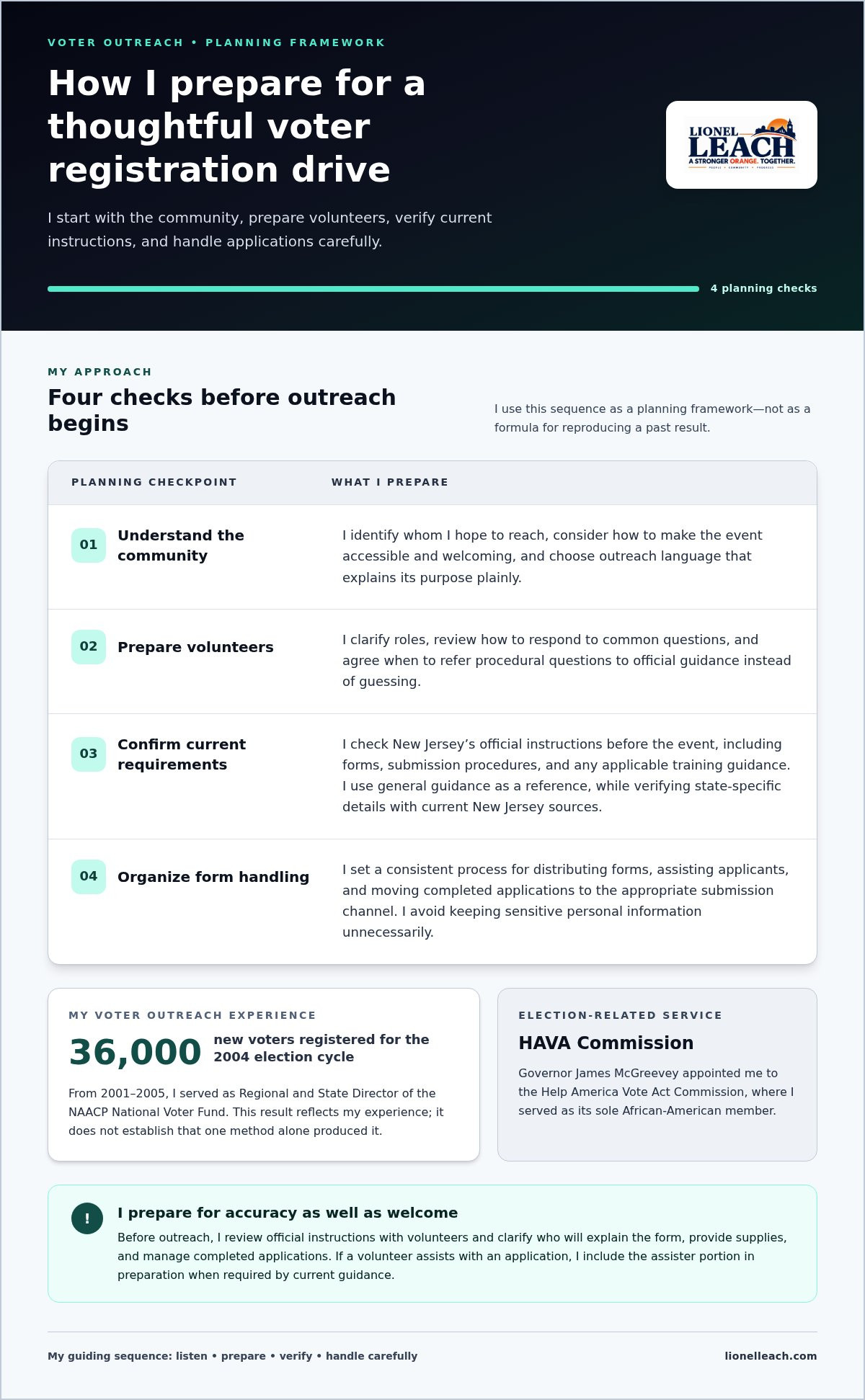
I recommend a simple sequence: understand the community, prepare volunteers, confirm current requirements, and decide how completed applications will be handled. These voter registration drive best practices are a planning framework, not a claim about the tactics behind my past results. Clear explanations and respectful conversations help people make informed choices without pressure.
Define the community. Identify whom you hope to reach and consider how to make the event accessible and welcoming. Choose outreach language that explains the purpose plainly.
Prepare volunteers. Assign clear roles, review how to answer common questions, and agree on when to refer procedural questions to official guidance instead of guessing.
Confirm current requirements. Check New Jersey’s official instructions before the event, including forms, submission procedures, and any applicable training guidance. USAGov’s voter registration guidance is a useful general reference, but state-specific details should be verified with current New Jersey sources.
Organize form handling. Set a consistent process for distributing forms, assisting applicants, and moving completed applications to the appropriate submission channel. Avoid keeping sensitive personal information unnecessarily.
Prepare volunteers and applications before outreach begins
Before the event, I’d review the official instructions with volunteers and clarify who will explain the form, who will provide supplies, and who will manage completed applications. New Jersey guidance should be checked for current form and handling details. If a volunteer helps someone complete an application, the assister portion may need to be completed as well, so include that step in preparation.
Accurate form handling is part of responsible voter outreach. A welcoming event matters, and so does treating each application carefully from start to finish. For a community-centered approach rooted in local needs, I connect voter outreach with community development strategy.
Applying voter registration drive best practices in Orange, New Jersey
In Orange, I would begin voter outreach by listening. Community organizations and residents can help identify what information people need, where outreach may be most useful, and how to make conversations welcoming. That first step keeps planning grounded in local priorities instead of assuming one approach fits every neighborhood.
Turn voter outreach experience into a community-centered starting point
I’d bring local partners together for a focused planning conversation: What are the outreach goals? Which volunteers will help, and what preparation do they need? How will organizers share clear information and handle applications responsibly? New Jersey procedures should be checked against current official guidance before a drive begins. These questions turn voter registration drive best practices into a practical starting point, while leaving room to adapt the plan based on what Orange residents and organizations share.
My community development strategy and voter outreach programs connect these pieces: listen first, communicate clearly, and prepare carefully. A drive should give people useful information without pressure, and organizers should be ready to direct procedural questions to current official guidance. This is a recommendation for applying my experience in Orange, not a claim that a local drive has already taken place or produced a particular result.
I also explore related lessons in my writing about overcoming voter apathy and my NAACP Voter Fund case study. Together, those perspectives can help community organizations consider how trust and preparation shape outreach. I invite you to explore my community development and voter outreach work as a starting point for thinking about what thoughtful, locally grounded engagement could look like in Orange.
Build a thoughtful starting point for Orange
Strong voter outreach begins before anyone sets out forms. It starts with listening to residents, learning from local organizations, and making a plan that respects people’s time and questions. For Orange, that kind of preparation can help community groups shape outreach around local priorities rather than assumptions.
My work in voter outreach and community development informs how I approach that effort: with clear communication, careful preparation, and an understanding that trust is earned through consistent engagement. The voter registration drive best practices I’ve shared are a place to begin, not a fixed formula. A thoughtful plan can grow through conversation and collaboration.
If you’re considering how community-centered outreach could serve Orange, explore my community development and voter outreach work. Every meaningful effort starts with a willingness to listen and take the next step together.
Frequently Asked Questions
Can I organize a voter registration drive in New Jersey?
I recommend that organizers planning a New Jersey voter registration drive consult current official state guidance before choosing a date or preparing materials. Because procedures can change, I’d verify the instructions for the relevant jurisdiction and election. I also distinguish planning outreach from confirming whether an individual is registered. For that, I direct people to official status-check instructions.
How can I tell whether a voter registration application was processed?
I tell applicants not to treat handing in a form as proof that their registration is complete. I’d direct anyone who submitted an application, including at a community event in Orange, to the relevant official election authority’s current instructions for checking status. I wouldn’t promise a particular confirmation method or timeframe; that authority’s guidance is the right source for those details.
Does a voter registration drive have to be nonpartisan?
I don’t assume one rule applies to every organization or activity. Before outreach, I recommend that organizers understand the requirements relevant to their organization and planned work by reviewing current official guidance. I also encourage clear, consistent explanations of the drive’s purpose, so people know what to expect. I would avoid presenting assumptions about nonpartisanship as universal requirements.
When should a community organization start planning a voter registration drive?
I recommend starting early enough to clarify the purpose, prepare volunteers and materials, and review current guidance for the relevant election and jurisdiction. For an organization in Orange, I’d also build in time to coordinate with local partners and consider community needs. I wouldn’t rely on a general timeline; I’d use current official information to guide the schedule.


Comments