Navigating Federal Government Structures: A Strategic Framework for Leaders

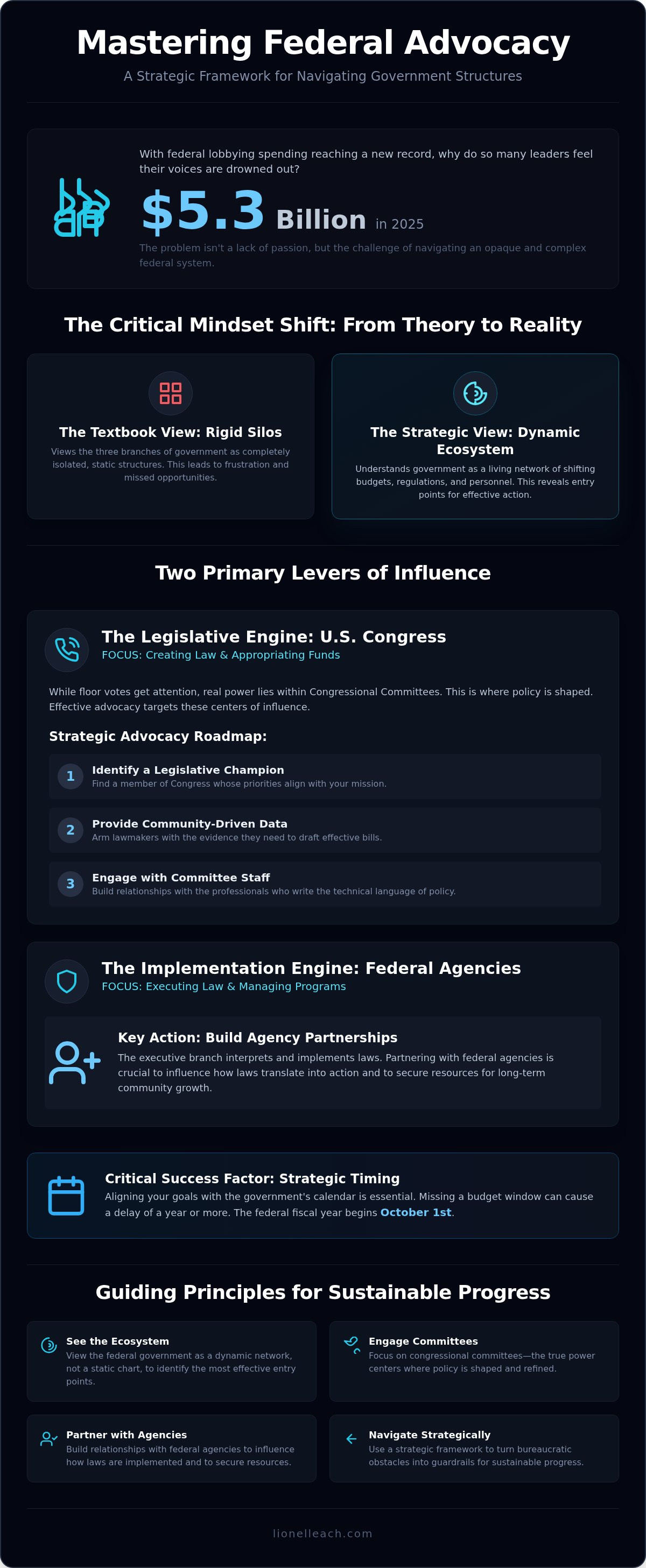
With federal lobbying spending reaching a record $5.3 billion in 2025, why do so many seasoned leaders still feel like their voices are drowned out? It isn't for a lack of passion, but rather the immense challenge of navigating federal government structures that often seem designed to stay opaque. You likely recognize that your mission deserves a seat at the table, yet finding the correct entry point can feel like solving a complex puzzle with missing pieces. It's frustrating to have a proven solution for your community but no clear path to the decision-makers who have the power to help you implement it.
The good news is that mastering the federal system is a strategic skill that can be learned and refined. When you understand the specific levers of the legislative and executive branches, you can move past the bureaucratic noise and position your organization as a vital partner in progress. This article provides a strategic framework to help you master these complexities. We'll map out clear entry points for advocacy, explore how to influence the legislative process effectively, and identify agency-level partnership opportunities that drive long-term community impact. You'll gain the clarity needed to lead with conviction and achieve sustainable results for the people you serve.
Table of Contents
Beyond the Textbook: The Federal Ecosystem as a Strategic Map
Most traditional education portrays the Federal government of the United States as a collection of rigid silos. We're often taught that the three branches operate in total isolation, yet experienced leaders understand that the reality is far more fluid. The federal structure functions as a dynamic ecosystem. It is a living network that breathes through shifting budgets, evolving regulations, and the movement of dedicated personnel. Successfully navigating federal government structures transforms a frustrating search for answers into a deliberate, mission-driven pursuit of progress.
The Constitution serves as the essential framework for this ecosystem, setting the boundaries for what federal action can and cannot achieve. Within these guardrails, success depends on strategic navigation. This involves identifying the right lever to pull at the exact moment it becomes most effective. Whether you are seeking a policy change or a new partnership, you must view the government as a map of opportunities rather than a wall of obstacles. By aligning your goals with the existing machinery of state, you ensure your advocacy is both principled and persuasive.
The Interconnectedness of Modern Governance
Modern governance is rarely a linear process. While the legislative branch drafts the laws, the executive branch interprets and implements them through a vast array of agencies. You will often find that a single policy goal requires simultaneous engagement across multiple levels. For instance, a community project might need a legislative champion to secure funding and an executive agency partner to oversee the distribution of those funds. This overlap is why professional strategic advocacy is so different from basic civics. It requires a deep understanding of how committee priorities in Congress eventually dictate the operational focus of department heads.
Identifying Your Strategic Entry Point
Determining your entry point begins with a fundamental question: is your issue a matter of law or a matter of implementation? Legislation focuses on the creation of authority and the appropriation of funds. Implementation focuses on the regulations and programs that turn those funds into action. Timing also plays a pivotal role in your success. The federal fiscal year starts on October 1, and the legislative calendar moves in a specific rhythm often influenced by election cycles. Missing a critical budget window can stall a project for a full year or more. Federal navigation is the art of aligning organizational goals with government processes to ensure your mission receives the attention it deserves.
The Legislative Engine: Strategic Advocacy in Congress
While standard civics lessons focus on the public vote, seasoned leaders know that the legislative process is actually a strategic exercise in timing and relationship building. The Branches of the U.S. government are designed to move slowly, yet the national agenda is often set by a small group of legislative leaders who decide which issues receive attention. In 2025, federal lobbying spending reached a record $5.3 billion, illustrating the high stakes involved in capturing this attention. For those navigating federal government structures, success depends on moving beyond simple requests and providing the community-driven data that lawmakers need to draft effective bills.
Navigating the Committee System
The real power centers of the federal government aren't found on the House or Senate floor, but within the committee rooms. Committees serve as the primary filters for legislation; they're where bills are marked up, debated, and often decided. To achieve your community development goals, you must identify the specific committee with jurisdiction over your issue. Perhaps more importantly, you must build relationships with committee staff. These professionals act as gatekeepers of information and often hold the pen when it comes to the technical language of a bill. Engaging them with clear, evidence-based solutions is the most direct path to influencing policy development.
From Idea to Law: The Advocacy Roadmap
Transforming a community need into a federal law requires a methodical approach that prioritizes collaboration over conflict. The journey generally follows a three-step strategic roadmap:
Identifying a Legislative Champion: Find a member of Congress whose personal or district priorities align with your mission. They will serve as the essential sponsor who carries your initiative through the process.
Building a Coalition: Strength lies in numbers. You should gather a diverse group of stakeholders, including non-profits, business leaders, and local officials, to demonstrate broad support for your proposal.
Refining Your Message: Government language is specific and technical. Partnering with a mentor for legislative advocacy can help you translate your community's raw data into a persuasive policy narrative that fits the current political environment.
By following this roadmap, you ensure that your voice is not just heard, but integrated into the very fabric of federal law. This strategic precision is what separates successful advocates from those who are simply making noise in a crowded system.
The Executive Branch: Engaging Agencies and Implementation
While the President often captures the headlines, the real work of governance happens within the Cabinet departments and independent agencies. These entities are the engines of implementation. They take the broad mandates passed by Congress and translate them into the specific rules and programs that govern daily life. Understanding the Branches of Government is only the first step for a leader. The true challenge lies in navigating federal government structures at the departmental level, where roughly 2.68 million civilian employees manage the programs your community relies on. It's here that policy becomes practice.
The Power of the Administrative State
Agencies like the Department of Housing and Urban Development (HUD), the Department of Transportation (DOT), or the Department of Energy (DOE) have a massive impact on local development. These agencies don't just follow orders; they engage in a rigorous rulemaking process that defines how laws are applied. This is why the Federal Register is such a vital resource. It's the official daily journal for federal agency rules, proposed regulations, and public notices. Monitoring this journal allows you to identify opportunities to comment on proposed rules before they're finalized. As of 2026, agencies are tending to create larger and more economically significant rules, making your participation in the administrative process more critical than ever.
Building Sustainable Partnerships with Federal Agencies
Successful engagement requires a shift in mindset from procurement to partnership. Procurement is often a transactional process of the government buying a service. In contrast, a partnership is a collaborative effort to achieve a shared goal. Finding the right program officer within a massive agency bureaucracy can be a daunting task for even the most seasoned executive. This is where Government Partnership Advisory becomes an essential tool for organizational growth. It helps bridge the gap between your specific community needs and the agency's broader mandates.
When you align your goals with the strategic priorities of a federal agency, you move beyond being a petitioner and become a collaborator. This alignment is particularly important when applying for federal grants or participating in pilot programs. By speaking the language of the agency and demonstrating how your mission supports their federal objectives, you build a foundation for long-term impact. This approach ensures that your organization isn't just reacting to federal changes but is actively helping to shape the implementation of national policy.
Overcoming Barriers: Checks, Balances, and Bureaucracy
Many leaders view the federal system as a labyrinth designed to impede progress. While "checks and balances" are often celebrated in theory, they can feel like significant hurdles when you're trying to drive community impact. However, these mechanisms are better understood as strategic guardrails. They ensure that power remains distributed, but they also require a high level of professional patience. Navigating federal government structures effectively means accepting that the system prioritizes deliberation over speed. It's a structure built for stability, not for rapid shifts.
The Judicial branch plays a critical role in this process. Courts can interpret or even halt federal policies long after they've passed through Congress or been implemented by an agency. For example, the Department of Labor plans to issue a final rule on worker classification in October 2026, but judicial review could still delay its enforcement. Understanding these potential legal shifts is essential for any long-term strategic plan. It's not enough to win the legislative battle; you must also be prepared for the regulatory and judicial scrutiny that follows.
The Slow Pace of Progress: Managing Expectations
Federal change is inherently incremental. Major policy shifts often require multi-year strategies that span different administrations. You must plan for continuity even as political control of the House or Senate shifts. Maintaining momentum during these transitions requires building relationships that transcend partisan lines. By focusing on the human-centric needs of your community, you can ensure your project remains a priority regardless of who holds the gavel. Success in this environment is measured by persistence and the ability to adapt to a shifting political landscape without losing sight of your core mission.
Navigating the "Red Tape" of Federal Compliance
Compliance isn't merely an administrative hurdle; it's a prerequisite for any meaningful partnership. One of the most common pitfalls in federal engagement is ignoring procedural requirements or submitting imprecise communications. The federal government operates on a foundation of strict documentation. A single error in a grant application or a missed deadline in a rulemaking comment period can derail months of work. Precision is your greatest asset when dealing with federal agencies. If you're ready to move past the frustration of bureaucracy, consider professional Government Partnership Advisory to refine your approach and mitigate the risk of procedural errors. An expert advisor helps you anticipate these requirements, ensuring your organizational voice is heard with the necessary authority and integrity.
The Strategic Path Forward: Why Expert Guidance Matters
The federal landscape is vast and constantly shifting. While the previous sections have outlined the mechanics of the legislative and executive branches, the daily reality of managing these relationships is often overwhelming for busy executive leaders. Attempting to manage everything internally can lead to missed deadlines, misinterpreted regulations, or lost opportunities. Successfully navigating federal government structures requires more than just a map. It requires a seasoned guide who understands the rhythm of the system and the nuances of negotiation. An expert advisor acts as a vital translator, bridging the gap between your community's urgent needs and the highly specific, technical language required by federal agencies and congressional offices.
With over 35 years of experience in government affairs, a mentor brings a perspective that textbooks cannot provide. This depth of experience allows for the identification of unseen opportunities, such as an under-the-radar sub-committee focus or a niche grant program that perfectly aligns with your organizational goals. This isn't about aggressive tactics or fleeting trends. It's about a human-centric approach to advocacy that prioritizes long-term impact and ethical responsibility. By seeking professional guidance, you ensure that your mission is represented with the gravitas and precision it deserves.
The Role of a Strategic Advisory Partner
A true partnership goes beyond simple lobbying. It involves a comprehensive approach to Government Partnership Advisory. This means integrating your federal goals into your overall Community Development Strategy. A principled advisor ensures that your advocacy remains rooted in integrity and mission-driven leadership. By aligning your organizational growth with national policy trends, you create a sustainable model for influence that survives shifts in administration or congressional control. This strategic alignment turns federal engagement from an occasional chore into a core pillar of your success.
Next Steps: Building Your Advocacy Framework
Building a successful framework starts with a clear-eyed internal audit. You must determine where your current policy goals align with federal priorities and identify which agency mandates match your mission. From there, you can develop a tiered engagement plan. This plan should balance short-term wins, like securing a meeting with key committee staff, with long-term policy shifts that require sustained effort over several years. This methodical approach ensures that your resources are used efficiently and your impact is maximized. If you are ready to elevate your organizational voice, you can connect with Lionel Leach for strategic guidance on navigating federal structures. Taking this first step moves your organization from being an observer of federal policy to becoming an active participant in its creation.
Empower Your Mission Through Strategic Advocacy
Mastering the federal ecosystem is about more than understanding procedures; it's about building the relationships that drive community progress. You've seen how identifying the right legislative champions and agency partners can turn an ambitious idea into a national reality. Successfully navigating federal government structures requires you to look beyond static organizational charts and see the dynamic network of people and priorities that shape our country's future. It's a journey that rewards those who approach it with a clear map and a principled heart.
When the stakes for your organization are high, you need a partner who understands the real-world nuances of negotiation. With over 35 years of strategic government affairs experience and a proven track record of drafting and passing impactful legislation, Lionel Leach provides the national reach and community development expertise you need to thrive. Don't let bureaucratic complexity stall your progress. Consult with Lionel Leach for Professional Legislative Advocacy to build a strategy that delivers sustainable results for the people you serve. Your vision for community growth is attainable when you have the right mentor by your side.
Frequently Asked Questions
What is the most effective way to start navigating federal government structures?
The most effective starting point is conducting an internal audit to align your organizational goals with current federal priorities. You must determine if your issue requires a change in law or a shift in how an existing program is implemented. Once you've identified the specific branch and agency involved, you can begin building relationships with key staff. This foundational step ensures your advocacy is targeted and your resources are used efficiently from the beginning.
How does the federal budget process impact community development initiatives?
The federal budget process determines the availability and timing of funding for every community initiative. For fiscal year 2026, the projected federal budget deficit is $1.9 trillion, which often leads to tighter competition for discretionary funds. Understanding the appropriations cycle is essential because missing a specific budget window can delay a project for a full year. Strategic planning allows you to position your development goals within these financial cycles to secure necessary resources.
What is the difference between legislative advocacy and lobbying?
Legislative advocacy is a broad strategic approach that focuses on education, relationship building, and long-term policy development. It involves translating community needs into persuasive narratives for lawmakers to drive sustainable impact. While lobbying is a specific, regulated activity aimed at influencing legislation, advocacy centers on the human element of organizational growth. It's important to remember that Lionel Leach provides strategic advocacy and advisory services rather than legal representation or lobbying registration.
How can small organizations influence federal policy without a massive budget?
Small organizations can exert significant influence by leveraging community-driven data and building diverse coalitions. Lawmakers value authentic stories from the field that demonstrate the real-world impact of policy. By partnering with other stakeholders, you can amplify your voice and share the costs of professional advisory services. Success doesn't always require the $5.3 billion spent on federal lobbying in 2025; it often comes down to timing, precision, and the integrity of your message.
What role do federal agencies play in local community growth?
Federal agencies like HUD or the Department of Transportation act as the primary engines for local implementation. They manage the grants and programs that fund infrastructure, housing, and economic development. These agencies also engage in rulemaking, which defines how broad federal laws are applied in your community. Building a sustainable partnership with agency program officers ensures that your local projects align with national mandates, making your initiatives more competitive for federal support and long-term growth.
How do I identify which federal branch is responsible for my specific issue?
Identification depends on whether your issue concerns the creation of a law or its daily application. If you need new funding or a change in authority, your primary focus is the legislative branch and its committee system. If your concern involves the interpretation of existing regulations or the management of a grant, the executive branch and its agencies are responsible. Correctly identifying this entry point is a critical part of navigating federal government structures successfully.
Why is a strategic advisory partner necessary for federal engagement?
A strategic advisory partner acts as a mentor who translates complex bureaucratic processes into actionable steps. With the federal workforce decreasing by 12% between 2024 and 2026, navigating federal government structures has become more difficult for those without deep experience. An experienced advisor helps you avoid common pitfalls like procedural errors or missed deadlines. This guidance ensures your organization maintains a professional gravitas in the boardroom while remaining grounded in the needs of the community.
How often do federal regulations and structures change?
Federal regulations and structures undergo constant adjustment, particularly during administration shifts or new fiscal years. In the first half of 2026 alone, the administration identified over 700 rules for potential elimination as part of a broader deregulatory agenda. While the underlying constitutional framework remains stable, the operational "rules of the road" are dynamic. Staying informed through resources like the Federal Register is essential for maintaining compliance and identifying new partnership opportunities as they emerge.



Comments