Overcoming Voter Apathy: How Community Trust Can Renew Civic Participation

Overcoming voter apathy in Orange starts with more than asking residents to care. I believe it means making civic participation relevant, accessible, and worthy of trust.
Public decisions can feel distant from everyday concerns. Distrust, access barriers, or discouraging experiences can also make participation seem difficult. I don’t assume disengagement means indifference. I see it as a reason to listen more closely, understand what is getting in the way, and earn trust over time.
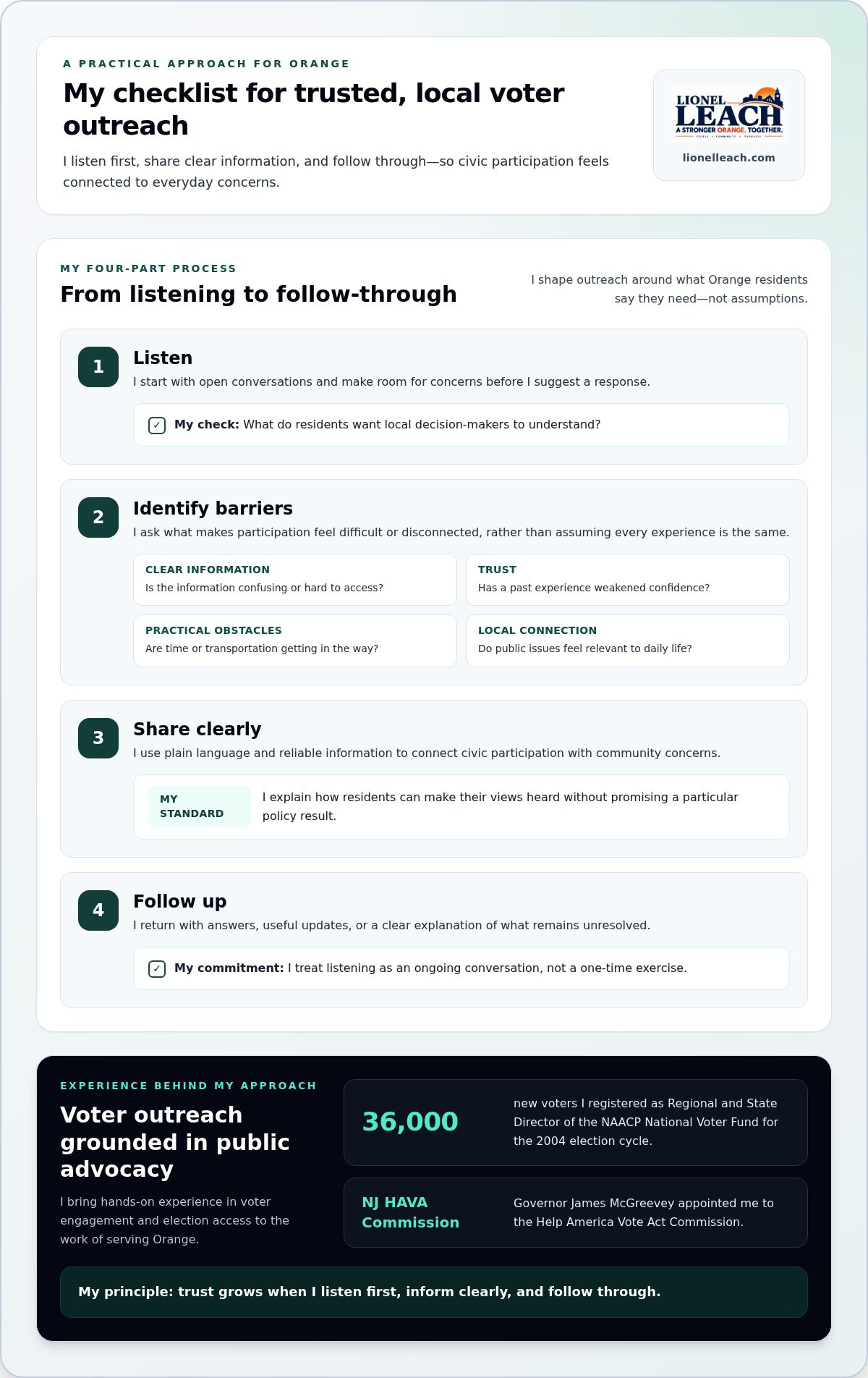
My perspective comes from years of public advocacy. As Regional and State Director of the NAACP National Voter Fund, I registered 36,000 new voters for the 2004 election cycle. Governor James McGreevey appointed me to the NJ Help America Vote Act Commission. That work taught me that effective outreach involves more than sharing a message: it means understanding residents’ concerns and following through. I would bring that approach to serving Orange.
Table of Contents
Overcoming Voter Apathy Starts with Understanding Why People Disengage
Voter apathy is a reduced interest in, or sense of connection to, voting and public affairs. It can show up as not following local issues, feeling that voting won’t make a difference, or choosing not to participate. The Voter Apathy Explained overview discusses how personal, political, and social factors can shape participation. In Orange, I believe the first step is hearing how residents connect public decisions to their daily lives.
People may disengage when they doubt elected leaders will listen, distrust institutions, or carry discouraging past experiences into the next election. Practical obstacles can matter, too. Confusing information, limited time, transportation challenges, or uncertainty about how to take part may make participation harder. These experiences are different, so a useful response begins with curiosity rather than assumptions about why a neighbor doesn’t vote.
How disengagement differs from voter suppression
Personal disengagement describes a person’s distance from voting or civic life. Voter suppression refers to efforts or conditions that prevent or discourage eligible people from participating. The League of Women Voters’ access-focused framing draws attention to barriers that can restrict voting. It doesn’t mean every instance of nonparticipation has the same cause.
That distinction matters when I plan outreach. I would ask residents what makes participation feel difficult or irrelevant, then listen before suggesting a response. Is the information unclear? Has a past experience weakened trust? Is a practical obstacle getting in the way? The answers help me distinguish an access problem from a lack of connection and shape voter outreach that respects residents rather than blaming them. That is a more grounded starting point for overcoming voter apathy in Orange.
How to Overcome Voter Apathy Through Trusted, Local Outreach
Overcoming voter apathy takes more than reminders. In Orange, outreach should help residents connect participation with issues they care about, while recognizing that each person’s experience is different. My work in public advocacy has taught me that trust grows when people are heard, given clear information, and treated as partners in civic life.
Make voter outreach relevant to Orange residents
I would start with listening sessions and conversations through trusted community relationships, before choosing messages or outreach channels. Residents should help identify the questions that matter and the information they need. Then I’d use a practical sequence:
Listen: Ask open questions about what residents want local decision-makers to understand. Make space for concerns without rushing to respond.
Identify barriers: Find out whether people need clearer information, a way around a practical obstacle, or a stronger connection to local issues. Shape outreach around what residents say would help.
Share clearly: Explain how civic participation connects to community concerns, using plain language and reliable information. Don’t promise a particular policy result. Clarify how residents can make their views heard.
Follow up: Return with answers, useful updates, or a clear explanation of what remains unresolved. Consistent follow-through shows that listening wasn’t a one-time exercise.
Trust grows when outreach listens first, informs clearly, and follows through. That approach can make voter outreach programs more responsive to Orange residents than a message chosen without their input. For me, overcoming voter apathy means building civic connection beyond a single election moment and treating community development as an ongoing conversation.
Sustaining Civic Engagement in Orange, NJ Through Trust and Follow-Through
My public-service experience has taught me that civic participation connects to more than elections. I’ve organized taxi drivers, worked with USA Track & Field, and served as a public advocate for the NAACP National Voter Fund. I also took on the Catholic Archdiocese of Newark over its effort to monopolize New Jersey’s headstone industry and helped stop the takeover. These experiences reinforced the importance of listening to people whose interests may otherwise be overlooked.
What my voter outreach experience taught me about public trust
I learned about government and policy directly through my work with Mayor Sharpe James, Congressman Donald Payne, Assemblyman Tucker, Newark Councilman Branch, and Mayor Robert Bowser. Senator Ronald Rice was also central to my public-service journey. I worked with him beginning in 1992 and spent 14 years as his Legislative Director. Lt. Governor Sheila Oliver was a close mentor, and I carry lessons from that relationship into how I think about serving communities.
I’ve also made difficult choices in public life. I helped get Congresswoman Bonnie Watson Coleman elected when my union supported someone else. Senator Rice sent me to help Derek Armstead become mayor against the Union County Democratic machine. More recently, I’ve worked in Irvington Code Enforcement, developing Section 5 of its multifamily housing receivership program, and in Irvington Economic Development.
Losing my mother, Ronald Rice, and Sheila Oliver within a four-month span changed my life. My mother and Sheila Oliver passed within 24 hours of each other. They were my backbone. Recovering from those losses deepened my understanding of resilience and the importance of showing up for people. I would bring that perspective, along with my public-service experience, to the future of political representation in Orange.
Help Build Orange’s Next Chapter of Civic Participation
Overcoming voter apathy isn’t a task we complete once. It calls for a lasting commitment to making public life feel connected to the people it serves. In Orange, I believe that starts with treating residents’ concerns as part of community development and creating space for their voices to shape ongoing conversations.
I bring a public-service perspective grounded in voter outreach and government experience. My focus is helping civic participation feel meaningful between elections as well as at the ballot box. That work depends on listening, accountability, and relationships built with care.
Explore my community development and voter outreach work to learn how I approach this work and what I hope to contribute in Orange. Together, we can strengthen a civic life where every resident feels their voice belongs.
Frequently Asked Questions
Can voter apathy be overcome without changing election laws?
Yes. Community outreach can help make civic participation feel relevant and improve how information is shared, but it can’t replace election protections or policy changes. Overcoming voter apathy may call for one response, while barriers to access may require another. In Orange, I’d first ask residents what discourages them, then consider whether outreach, better access, or broader changes are needed.
What can community organizations do to encourage voting between elections?
Community organizations can keep civic connection alive through regular, useful contact, not just election-season messages. I’d encourage groups in Orange to invite residents to share priorities, provide clear information about local public issues, and check back when questions arise. The right activities depend on what residents say they need. No single meeting, message, or reminder can guarantee that more people will vote.
How should I talk with someone who says their vote does not matter?
Start by asking what led them to feel that way, then listen without turning the conversation into a debate. Acknowledge their experience instead of promising that one vote will produce a specific result. If they’re open to it, share accurate information relevant to their concern and mention other ways to stay involved in community life. Leave the choice to participate with them.
Does voter registration alone solve voter apathy?
No. Registration makes it possible for an eligible person to take part, but completing that step may not ease distrust, doubts about whether public input matters, or practical obstacles. I’d treat registration as an opening for further conversation: ask what questions remain, clarify relevant information, and make space for continued involvement in Orange. Civic participation can take more than one form.



Comments