Voter Engagement Strategy: A Comprehensive Template for Newark and Urban Centers

What if the persistent challenge of low voter turnout in our urban centers isn't a sign of community apathy, but rather a symptom of a broken engagement model? For too long, civic outreach has been treated as a seasonal task that starts sixty days before an election and vanishes the morning after. This transactional approach often leaves residents feeling used rather than empowered. If you've struggled to build lasting trust in disillusioned districts, you understand that a professional voter engagement strategy Newark advocates can sustain must be rooted in something deeper than a get-out-the-vote flyer.
You deserve a framework that turns fleeting interactions into long-term civic power. This guide provides a comprehensive template designed for modern civic leadership, moving away from reactive tactics toward a structured, professional methodology. We'll explore how to master the frameworks of professional community mobilization and voter outreach through a strategic template built for impact. By the end of this article, you'll have a repeatable system for mobilization, clear metrics for success, and a strategy that aligns community development with active voter participation. It's time to build a permanent infrastructure for change.
Table of Contents
Understanding the Core Pillars of a Voter Engagement Strategy
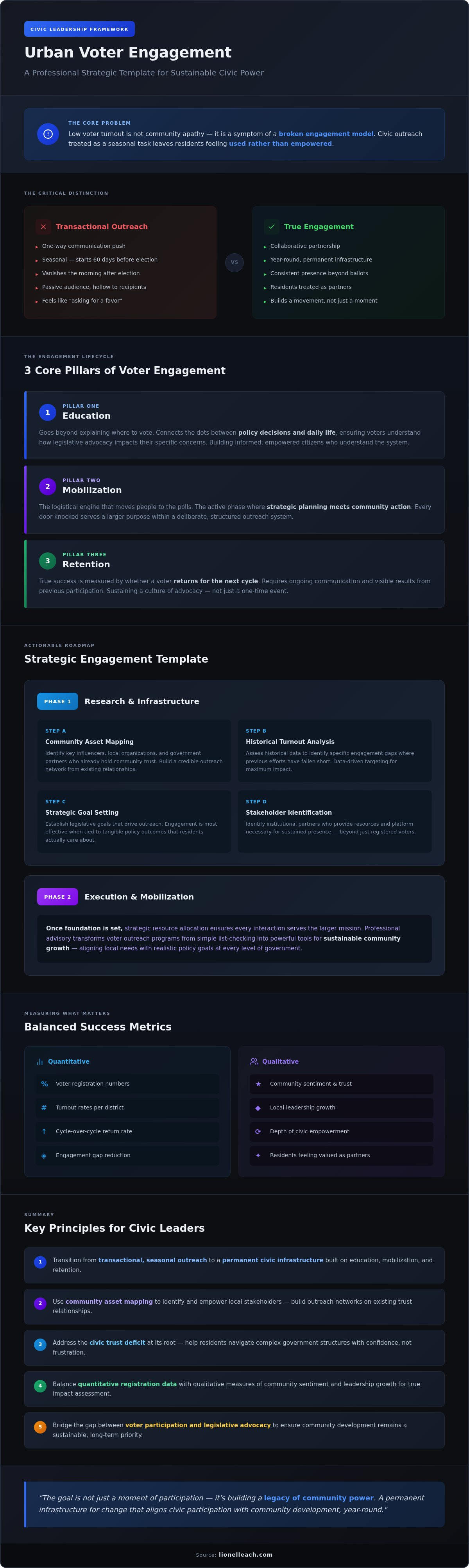
Effective civic participation requires more than a last-minute push. A robust voter engagement strategy Newark organizations can rely on must be built upon a foundation of trust and long-term planning. We view this not as a single event, but as a continuous lifecycle consisting of three core pillars: education, mobilization, and retention.
Education: This phase goes beyond explaining where to vote. It involves connecting the dots between policy decisions and daily life, ensuring voters understand how legislative advocacy impacts their specific concerns.
Mobilization: This is the logistical engine that moves people to the polls. It's the active phase where strategic planning meets community action.
Retention: True success is measured by whether a voter returns for the next cycle. This requires ongoing communication and visible results from previous participation.
When these pillars are aligned, the focus shifts from simple tactical outreach to strategic civic participation. This transition is vital for urban centers where residents may feel disconnected from the legislative process. By positioning voter engagement as a primary pillar of community development strategy, leaders can create a sustainable culture of advocacy that thrives year-round.
The Difference Between Outreach and Engagement
Many organizations confuse outreach with engagement. Outreach is often a one-way communication channel where information is pushed out to a passive audience. It's transactional and often feels hollow to the recipient. In contrast, engagement is a collaborative partnership. It's about building a consistent presence that doesn't disappear once the ballots are counted. Transactional efforts often fail because they don't value the person behind the vote. Engagement succeeds because it treats residents as partners in a shared mission. It's the difference between asking for a favor and building a movement.
The Role of Professional Advisory in Civic Strategy
Navigating the complexities of federal, state, and local government structures requires a principled approach and deep experience. Professional advisory helps civic leaders move beyond reactive tactics. It's about strategic resource allocation and ensuring that every door knocked serves a larger purpose. When developing a comprehensive voter engagement strategy Newark districts can trust, it's essential to align community needs with realistic policy goals. This level of planning transforms voter outreach programs from simple list-checking into powerful tools for sustainable growth. It's about building a legacy of community power, rather than just a moment of participation.
A Strategic Template for Urban Voter Engagement
Transitioning from broad principles to actionable results requires a disciplined roadmap. A professional voter engagement strategy Newark organizations utilize must provide a clear sequence of steps to ensure no segment of the community is overlooked. This template serves as a structural guide for leaders who are committed to building long-term civic power through deliberate planning and ethical execution.
Phase 1: Research and Infrastructure
Before the first door is knocked, the infrastructure for success must be established. This begins with community asset mapping, which is the process of identifying key influencers, local organizations, and government partners who already hold the community's trust. By understanding who residents turn to for advice, you can build a more credible outreach network. Assessing historical turnout data is equally vital; it allows us to identify specific engagement gaps where previous efforts may have fallen short.
Strategic Goal Setting: We establish the legislative goals that drive the outreach. Engagement is most effective when it's tied to tangible policy outcomes that residents care about.
Stakeholder Identification: Beyond just voters, we identify the institutional partners who can provide the resources and platform necessary for a sustained presence.
Professional government partnership advisory ensures that these local goals are aligned with broader policy structures. This alignment makes your efforts more effective at every level of government and ensures that your resources are focused on high-impact initiatives.
Phase 2: Execution and Mobilization
Once the foundation is set, the focus shifts to designing culturally relevant educational frameworks. Information must be presented in a way that resonates with the lived experiences of urban residents. This involves translating complex policy jargon into the language of community impact. It's about ensuring every resident understands exactly how their participation influences the decisions made in council chambers and state houses.
Effective mobilization requires a multi-channel approach. We combine traditional grassroots methods, such as face-to-face conversations, with modern digital touchpoints to ensure consistent messaging across all platforms. This professional strategic oversight prevents resources from being wasted on low-impact activities. Finally, establishing feedback loops is critical. By listening to community responses during the mobilization phase, you can adjust your tactics in real-time. This ensures that your voter outreach programs remain responsive and respectful to the people they serve. Integrating these efforts into a broader community development strategy ensures that civic momentum continues long after the current cycle ends.
Navigating Barriers to Civic Participation in Urban Environments
Urban centers often face deep-seated hurdles that go beyond simple registration deadlines or polling location changes. A successful voter engagement strategy Newark leaders implement must address the "civic trust deficit" that exists when residents feel their participation yields no tangible results. This deficit isn't a lack of interest; it's a rational response to years of feeling unheard. When government structures seem overly complex or inaccessible, motivation naturally wanes. Residents shouldn't need a degree in political science to understand how to impact their own neighborhoods or influence the decisions that affect their families.
Systemic hurdles require systemic solutions. Legislative advocacy serves as a powerful tool to dismantle these barriers by focusing on policy changes that make engagement feel meaningful and accessible. Instead of viewing the government as a distant or even adversarial entity, we position collaboration between community members and officials as the primary path forward. By creating a transparent, structured dialogue, we turn a sterile process into a principled partnership for growth. A refined voter engagement strategy Newark organizations utilize focuses on removing these friction points to clear the path for active participation.
Overcoming Apathy Through Policy Impact
Apathy is often just unaddressed frustration. To move beyond it, we must connect local policy wins directly to the act of voting. When residents see a specific bill drafted to improve infrastructure, housing, or public safety, the power of the ballot becomes visible. Successful legislative strategy demonstrates that community growth isn't accidental; it's the direct result of organized civic pressure. We don't just ask for participation; we show the receipts of what participation has already achieved. This approach transforms voting from a chore into a strategic investment in the collective future. It's about making the intangible tangible through steady, principled leadership.
Building Trust Through Government Partnerships
Trust is built through consistency and transparency over time. Professional government partnership advisory plays a critical role here by bridging the communication gaps that often lead to disillusionment. It isn't enough for officials to make decisions; they must engage in a two-way dialogue with the people they represent. Sustainable growth happens when we facilitate these connections, ensuring that community voices are integrated into the decision-making process from the beginning. Collaborative civic leadership moves us away from top-down mandates and toward a model of shared responsibility. This principled foundation ensures that mobilization efforts aren't just effective during an election, but remain a permanent part of the community's development strategy. When people feel like partners in the process, they don't just show up to vote; they stay engaged to lead.
Measuring Impact: Metrics for Voter Outreach Success
Success in civic mobilization is rarely accidental. It's the result of rigorous measurement and a commitment to data-driven deliberation. When implementing a voter engagement strategy Newark leaders can rely on, we must distinguish between simple activity and actual impact. Measuring progress allows us to move from hope to certainty, ensuring that every hour of outreach contributes to a larger, sustainable vision of community empowerment. This analytical approach transforms voter outreach programs from well-intentioned efforts into high-impact initiatives.
Quantitative Metrics: We track registration rates, turnout percentages, and, most importantly, voter retention. Retention is the gold standard of engagement; it proves that we've successfully moved an individual from a one-time participant to a lifelong stakeholder in the democratic process.
Qualitative Metrics: Numbers only tell half the story. We also measure community sentiment, trust levels, and the growth of local leadership capacity. Success is found when residents feel more confident in their ability to influence government structures.
Evaluating the ROI of different community development strategies requires a broad perspective. We don't just look at the cost per vote; we look at the long-term value of a more engaged, informed, and active constituency. This principled focus on impact ensures that resources are always allocated to the strategies that yield the most significant community growth.
Short-Term vs. Long-Term KPIs
Immediate turnout is a necessary milestone, but it isn't the ultimate goal. We look for permanent increases in civic participation that persist across multiple election cycles. This involves tracking the growth of local community leadership capacity. Are the people we engaged today becoming the advocates of tomorrow? Evaluating the effectiveness of government relations strategies also requires looking at how community input has shifted legislative priorities over time. True success is measured by the durability of the civic infrastructure we build together.
Data-Driven Strategy Refinement
Engagement data serves as a compass for optimizing outreach methods. If a particular channel isn't resonating with the community, the data provides the signal to pivot. Professional advisory plays a vital role in interpreting these complex community data sets, moving beyond raw numbers to find the human stories underneath. We maintain a principled approach to data management, prioritizing integrity and ethical responsibility at every step. This ensures that the information we collect is used solely to empower the collective. If you're ready to build a measurable framework for your organization, consider a professional community development strategy to guide your efforts.
The Path Forward: Integrating Advocacy into Community Growth
Real progress in urban development isn't accidental. It's the result of a deliberate fusion between active community participation and sophisticated policy work. When a voter engagement strategy Newark leaders implement is successful, it does more than increase turnout; it creates the political capital necessary for effective legislative advocacy. This capital is what allows community needs to be translated into binding laws and budget priorities. Without the engine of an engaged electorate, even the most well-crafted policy proposals often stall in the face of competing interests.
Sustaining this momentum requires a comprehensive community development strategy that looks beyond the next election. We don't view engagement as a series of isolated events, but as a continuous cycle of growth and empowerment. Principled leadership serves as the foundation for this work. It's the steady hand that ensures government partnerships remain focused on the collective good rather than short-term gains. By building these bridges with integrity, we create a resilient infrastructure that can navigate the shifting tides of political cycles.
Designing a Roadmap for Sustainable Success
Building a legacy of civic empowerment starts with aligning organizational goals with the everyday realities of the community. This alignment ensures that every initiative feels relevant and worth the investment of time and energy. Professional guidance is essential here, especially when navigating the intricate layers of federal, state, and local government structures. A structured roadmap helps leaders avoid common pitfalls and ensures that resources are always directed toward high-impact advocacy. It's about moving from reactive problem-solving to proactive, strategic leadership that anticipates challenges before they arise.
Partnering for Strategic Impact
The complexities of modern community dynamics require more than just enthusiasm; they require seasoned experience. Professional advisory services facilitate effective policy development by providing the strategic oversight needed to turn community voices into legislative action. A mentor who has spent decades navigating these systems offers a unique perspective that can't be replicated. This level of expertise ensures that your voter outreach programs are built to national standards, focusing on long-term sustainability rather than fleeting trends.
The next steps for your organization involve moving away from informal outreach and toward a professional, strategic framework. This transition is how we build lasting power and ensure that community development remains a priority for years to come. If you're ready to master the frameworks of professional community mobilization, it's time to invest in a legislative advocacy strategy that reflects the strength and potential of the people you serve. Let's build a future where every voice isn't just heard, but becomes a permanent part of the policy landscape.
Building a Legacy of Civic Power
Transforming urban districts requires a shift from seasonal outreach to a permanent infrastructure of civic trust. We've explored how a professional voter engagement strategy Newark leaders implement must move beyond transactional voting to embrace a multi-stage process of education and retention. By addressing the civic trust deficit and utilizing clear metrics, you can ensure that your efforts lead to measurable growth and sustainable power. True progress happens when we bridge the gap between community needs and legislative action through disciplined planning and steady leadership.
Navigating these complex government structures doesn't have to be a solitary journey. You can leverage over 35 years of government affairs experience and access a track record of successful legislative strategy by partnering with a principled leader dedicated to community growth. It's time to move your mission forward with confidence and clarity. Consult with Lionel Leach on your Strategic Community Development and Voter Outreach Programs to begin designing a roadmap for long-term success. Together, we can build a future where every community member is an active partner in progress.
Frequently Asked Questions
What are the essential components of a voter engagement strategy?
Education, mobilization, and retention are the three core pillars of a successful program. A robust voter engagement strategy Newark organizations implement focuses on building a continuous lifecycle rather than a seasonal campaign. This involves identifying community assets, creating culturally relevant educational materials, and establishing multi-channel mobilization tactics. By prioritizing long-term participation over one-time turnout, leaders can build a permanent infrastructure of civic power that remains active across every election cycle.
How does community development impact voter turnout in urban centers?
Community development provides the tangible results that make voting feel meaningful to residents. When people see improvements in infrastructure, housing, and public safety, they're more likely to believe their participation influences outcomes. Integrating voter outreach into broader development plans transforms the act of voting from a chore into a strategic investment. This alignment ensures that civic momentum is sustained by visible progress, directly addressing the disillusionment often found in underserved districts.
Why is professional legislative advocacy important for civic engagement?
Legislative advocacy bridges the gap between community voices and binding policy. While engagement gets people to the polls, advocacy ensures their concerns are translated into successful legislation. Professional guidance helps organizations navigate complex government structures to achieve specific objectives. It turns raw civic energy into a structured force that can influence budget priorities and legal frameworks. Without this strategic layer, community participation often lacks the leverage needed to drive systemic change.
Can a voter outreach program be successful without government partnerships?
While grassroots efforts are vital, long-term success usually requires collaboration with government entities. Government partnership advisory helps facilitate transparent dialogue between officials and residents. These partnerships provide access to resources and ensure that community input is integrated into the decision-making process from the start. Collaborative civic leadership moves away from top-down mandates toward a model of shared responsibility. This cooperation builds the institutional trust necessary for sustainable, multi-cycle voter participation.
How do you measure the success of a civic participation program?
Success is measured through a balance of quantitative and qualitative data. Quantitative metrics include registration rates, turnout percentages, and voter retention across cycles. Qualitative metrics focus on community sentiment, trust levels, and the growth of local leadership capacity. Data-driven deliberation allows leaders to pivot their outreach methods based on real-world results. A refined voter engagement strategy Newark districts utilize prioritizes these metrics to ensure that every resource is allocated toward high-impact initiatives.
What is the difference between grassroots mobilization and professional strategic advisory?
Grassroots mobilization is the engine of community action, while professional strategic advisory is the navigation system. Mobilization involves the direct work of knocking on doors and organizing rallies. Strategic advisory provides the high-level oversight needed to ensure those efforts align with legislative goals and government structures. It uses over 35 years of experience to allocate resources efficiently and navigate complex negotiations. Both are necessary to turn community enthusiasm into a sustainable political force.
How can community leaders build trust in government systems?
Trust is built through consistent, transparent engagement and visible results. Leaders must move beyond transactional outreach and establish a permanent presence in the community. Facilitating two-way dialogues between residents and officials helps demystify complex government processes. When people see that their input leads to successful policy changes, the civic trust deficit begins to shrink. This principled approach treats residents as partners in a shared mission rather than just statistics in a database.
What role does strategic planning play in civic leadership development?
Strategic planning provides the roadmap for moving from reactive problem-solving to proactive leadership. It helps emerging leaders understand how to align organizational goals with community needs. By mastering professional frameworks for mobilization, leaders can build a legacy of civic empowerment that outlasts any single campaign. This deliberation ensures that leadership development is rooted in integrity and ethical responsibility. It prepares individuals to navigate the nuances of negotiation at local, state, and federal levels effectively.



Comments