Taxi Driver Representation: Building a Stronger Voice in New Jersey

What changes when taxi drivers’ concerns are brought forward together, in a clear and constructive conversation with decision-makers? I know that individual concerns can be difficult to raise collectively, especially when drivers aren’t sure how to make their voices heard. Effective taxi driver representation helps turn shared concerns into organized advocacy and sustained dialogue.
In this article, I explain what that representation can involve and how drivers can approach decision-makers with a shared, practical message. I bring experience in taxi organizing, labor advocacy, and public service, including 14 years as Legislative Director to Senator Ronald L. Rice and work as a public advocate for the NAACP National Voter Fund. I’ll also clarify the distinction between advocacy and legal representation, and connect this experience to the kind of community-focused work I believe can serve Orange, New Jersey.
Table of Contents
What Taxi Driver Representation Means for Drivers in Northern New Jersey
I recognize that drivers need a clear, constructive way to raise concerns they may find difficult to bring forward alone. In Northern New Jersey, taxi driver representation can provide a process for identifying common issues, deciding which deserve attention first, and presenting them for dialogue. That process can make concerns easier to understand, but it can’t guarantee that an institution will change a policy or reach a particular outcome.
How individual concerns become a shared voice
I see representation as careful listening before speaking on behalf of a group. Drivers may raise similar concerns, while differing on what matters most or how to address it. Listening for recurring themes can help identify shared priorities without suggesting that every driver agrees. A useful starting point is to distinguish a widely shared concern from an individual experience, then describe each accurately.
Taxi driver representation is the organized expression of drivers’ shared concerns for constructive dialogue, while respecting differences among individual drivers. This is advocacy: helping shape concerns into a clear message and bringing that message into discussion. The Taxi Workers Alliance offers a historical example of organized advocacy for taxi drivers; its history can provide context for why workers may seek a collective voice.
I also want to be clear about the boundaries. Advocacy is not legal advice or representation in litigation, and it doesn’t promise a specific result. Lobbying registration is a separate matter, not what I mean by organizing drivers’ concerns for dialogue. Keeping these roles distinct helps drivers understand the purpose of representation and the kind of support being discussed. For me, the goal is to create a respectful, practical way to be heard, not to speak over drivers or claim that one message reflects every person’s experience.
A Practical Framework for Organizing Taxi Drivers’ Concerns
I would begin with a simple principle: organize what drivers actually raise, not what I assume they need. A useful framework makes room for different experiences while helping a group identify concerns it wants to discuss together. That discipline can make an advocacy message clearer and more constructive.
Turning shared concerns into a focused advocacy agenda
Listen first. Invite drivers to describe concerns in their own words, and make space for differing views.
Document recurring themes. Record common issues separately from individual cases. This helps preserve personal concerns without presenting them as shared priorities.
Agree on priorities. Review the themes with participating drivers and identify which concerns they want to raise collectively. Agreement on priorities matters; it shouldn’t be assumed.
Prepare a focused message. State the concern, explain who is affected, and identify the discussion being requested. Keep the wording respectful, specific, and grounded in what drivers have shared.
Listen to drivers, document recurring concerns, agree on priorities, and prepare a clear message for discussion. That sequence gives taxi driver representation a practical foundation without promising that a particular policy or decision will follow. For instance, a group can describe a recurring concern, clarify which drivers say it affects them, and request a conversation about it, without claiming to speak for every driver.
Constructive dialogue also depends on preparation and relationships. My approach to negotiation skills for advocates emphasizes clear communication, while building a coalition can help bring people together around carefully defined priorities. I apply those ideas by keeping the message focused and leaving room for discussion with relevant institutions.
This same community-centered thinking informs my community development strategy for Orange, New Jersey: listen carefully, organize shared priorities, and bring forward a clear, respectful message.
What My Labor and Public Advocacy Experience Brings to Taxi Driver Representation
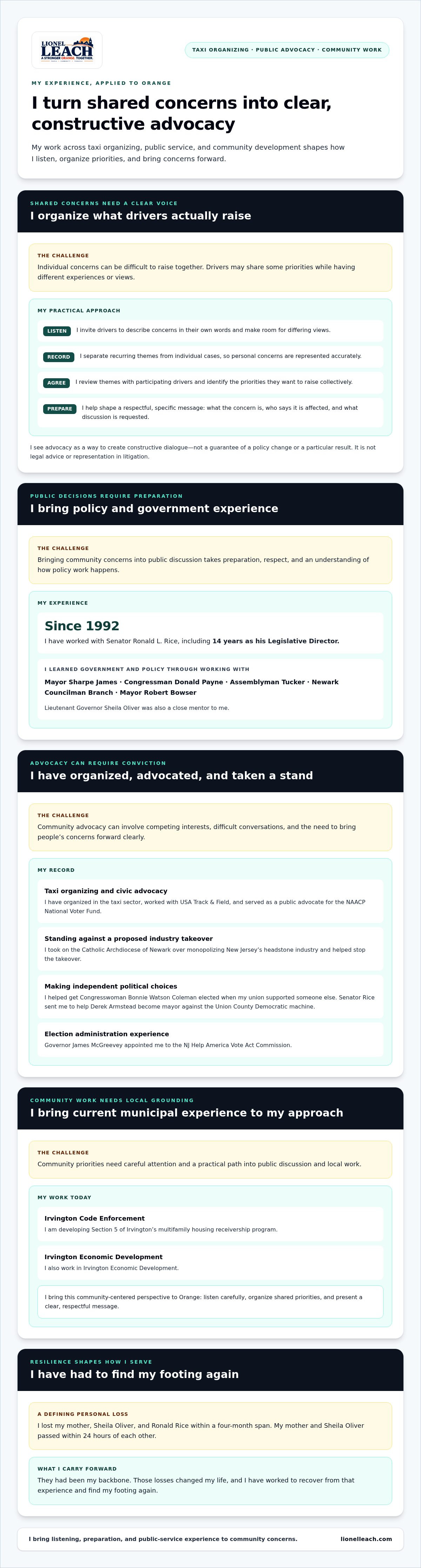
I bring an organizer’s perspective to taxi driver representation, shaped by work across government, unions, and community advocacy. My taxi experience is in organizing, and I don’t claim a specific driver campaign or outcome. I also worked with USA Track & Field and served as a public advocate for the NAACP National Voter Fund, experiences that strengthened my commitment to listening and civic engagement.
Applying an organizer’s perspective to representation in Orange
I have worked with Senator Ronald L. Rice since 1992, including 14 years as his Legislative Director. I learned about government and policy through working with Mayor Sharpe James, Congressman Donald Payne, Assemblyman Tucker, Newark Councilman Branch, and Mayor Robert Bowser. Lieutenant Governor Sheila Oliver was also a close mentor. That experience informs how I approach public concerns: with preparation, respect, and attention to the people affected.
I’ve also stood against the Catholic Archdiocese of Newark over its effort to monopolize New Jersey’s headstone industry, helping stop that takeover. I supported Congresswoman Bonnie Watson Coleman’s election when my union backed someone else, and Senator Rice sent me to help Derek Armstead become mayor in a challenge to the Union County Democratic machine. Governor James McGreevey appointed me to the NJ Help America Vote Act Commission.
After losing my mother, Sheila Oliver, and Ronald Rice within four months, with my mother and Sheila Oliver passing within 24 hours of each other, I had to find my footing again. They had been my backbone, and those losses changed my life. Today, I work in Irvington Code Enforcement, developing Section 5 of its multifamily housing receivership program, and in Irvington Economic Development. I bring this perspective to community development and advocacy in Orange, New Jersey.
I invite you to explore my labor advocacy work and public service with Senator Ronald L. Rice, and consider how that experience can inform constructive community engagement in Orange.
Carry a Stronger Voice Forward
A stronger voice grows through continued participation. I believe drivers should remain involved as shared concerns develop, helping keep the conversation connected to their lived experience and changing priorities. That makes advocacy an ongoing practice of listening and engagement, rather than a message delivered once and left behind.
In Orange, I want to bring that same commitment to public life by making room for residents to shape the issues that affect their community. Taxi driver representation offers one example of how organized voices can contribute to constructive dialogue, while keeping expectations grounded and outcomes open.
If you’re considering how community concerns can be heard and addressed, explore my community development and advocacy work. Together, we can keep building thoughtful ways for people to take part and move forward with purpose.
Frequently Asked Questions
What does taxi driver representation involve?
Taxi driver representation involves helping drivers decide what they want raised collectively and communicating that concern in an organized way. In my approach, it can also mean keeping participants informed about what was shared and inviting them to refine the message as circumstances change. For drivers connected to Orange, that feedback loop helps maintain trust and avoids treating one person’s experience as everyone’s position.
Can taxi drivers organize around shared workplace concerns?
Yes. Drivers can meet, compare experiences, and coordinate how they want to express workplace concerns. Organizing might begin with a discussion of whether an issue affecting some drivers deserves collective attention, while recognizing that others may see it differently. I recommend making room for those differences so participation doesn’t depend on everyone agreeing about every detail.
Is taxi driver representation the same as legal representation?
No. Taxi driver representation, as I describe it, is advocacy and organized communication, not legal representation. I can help clarify a group concern and prepare it for constructive discussion, but I don’t provide legal advice, represent drivers in court, or handle litigation. Questions requiring legal interpretation or a legal case are separate from the advocacy role described here.
How can drivers make their concerns easier for decision-makers to understand?
Use plain language, distinguish firsthand observations from conclusions, and be clear about where drivers’ views differ. A concise account of a recurring issue can help others understand its context without overstating how widely it is shared. In Orange, a focused message can make a community concern easier to discuss while leaving room for questions and further input.



Comments