Sustainable Community Development Guide for Orange, NJ

Which sustainable community development models can turn Orange residents’ priorities into lasting, accountable progress? A framework on paper is only a starting point. Residents need a meaningful voice, public resources must connect to their priorities, and commitments need clear owners and follow-through.
That is the standard I bring to this work. Orange’s Community Energy Plan for 2024-2028 and five-year Urban Enterprise Zone Development Plan offer local foundations for energy efficiency and economic development. The task is to build on those priorities, not import a generic template.
In this guide, I compare established models, explain when each can help, and share practical criteria for choosing an approach grounded in Orange. I draw on my work with Senator Ronald L. Rice since 1992, including 14 of those years as his Legislative Director, and on my experience connecting community advocacy with government and policy. The goal is to bring resident priorities, public systems, and accountable action together.
Table of Contents
What Sustainable Community Development Models Mean for Orange, NJ
I see sustainable community development as long-term work connecting residents’ priorities with social well-being, economic opportunity, and environmental health. A model can organize that work, but its label alone won’t tell you whether it serves a community. What matters is how an approach uses local assets, includes residents, works with public systems, and holds partners accountable.
For Orange, the useful question is not which model sounds best in theory. It is whether the approach reflects residents’ perspectives and can be coordinated with public planning and resources, without assuming every neighborhood has the same needs. My experience in government, advocacy, and organizing has taught me that collaboration and follow-through are essential to community development.
To explore an asset-focused perspective, watch this TEDx talk:
How asset-based, community-led, and circular approaches differ
Asset-Based Community Development starts with strengths already present, such as residents’ skills, relationships, and local organizations. This differs from expert-led social planning, where specialists typically define problems and shape proposed responses. Planning expertise can be valuable, but it should inform community goals, not replace them.
Community-led development gives residents a role in naming priorities and shaping action. Participation is meaningful when people can influence decisions, not simply attend a meeting. Circular-sustainable approaches add an environmental lens, emphasizing resource reuse and waste reduction. That lens can complement resident-led or expert-supported planning, but it is not a universal substitute for addressing social and economic goals. I compare sustainable community development models by how well they connect local strengths, public coordination, and accountable action.
How to Compare Sustainable Community Development Models
Compare approaches by asking who sets priorities, which strengths they build on, how public partners are involved, whose needs are considered, and who tracks follow-through. These questions keep the choice grounded in local priorities and capacity rather than a model’s label.
A practical decision framework for local leaders
Start with priorities residents have stated and assets already present. Then compare each model’s decision-making process, public coordination needs, equity considerations, and long-term responsibilities. Participation matters, but it doesn’t guarantee progress. Plans also need capable partners, clear ownership, and regular review. For wider context, the Smithsonian’s Sustainable Communities research guide connects community action with topics such as planning, housing, and resource use.
I bring experience translating community priorities into public processes. I have worked with Senator Ronald L. Rice since 1992, including 14 years as his Legislative Director. For practical help connecting resident input with government coordination, explore my community development strategy.
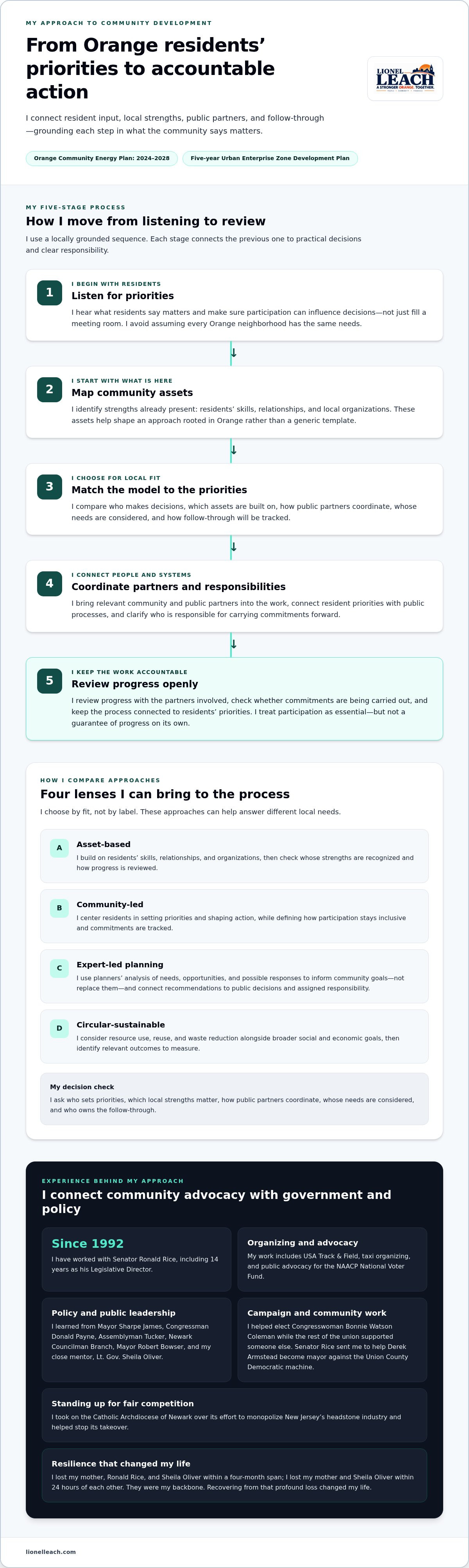
Applying a Sustainable Community Development Model in Orange, NJ
A locally grounded process can move from listening to accountable action without assuming every neighborhood has the same priorities. I would take five steps: listen to residents, map community assets, choose a model that fits the identified priorities and capacity, coordinate relevant public and community partners, and review progress openly. The aim is a clear path from resident input to decisions and follow-through, not a promise of a particular outcome.
This process should consider social, economic, and environmental concerns together. The archived framework for sustainable development offers a useful reference for balancing those dimensions. In Orange, local leaders can apply that broad lens while grounding choices in what residents say matters and what partners can realistically carry forward.
What my experience brings to community-first strategy
I have worked with Senator Ronald L. Rice since 1992, including 14 years as his Legislative Director, gaining direct experience with policy and government processes. My work also spans USA Track & Field, taxi organizing, and public advocacy for the NAACP National Voter Fund. I took on the Catholic Archdiocese of Newark over its effort to monopolize New Jersey’s headstone industry and helped stop its takeover. I helped get Congresswoman Bonnie Watson Coleman elected while the rest of the union supported someone else. Senator Rice also sent me to help Derek Armstead become mayor against the Union County Democratic machine.
I learned about government and policy from Mayor Sharpe James, Congressman Donald Payne, Assemblyman Tucker, Newark Councilman Branch, Mayor Robert Bowser, and my close mentor, Lt. Gov. Sheila Oliver. I lost my mother, Ronald Rice, and Sheila Oliver within a four-month span. My mother and Sheila Oliver died within 24 hours of each other. They were my backbone, and recovering from that profound loss changed my life. Their influence deepened my commitment to listen, stand firm, and connect community priorities with public action.
For Orange leaders, a practical next step is to bring residents and public partners together to identify priorities, assets, responsibilities, and a way to review progress. That groundwork can show which sustainable community development models best fit the work ahead.
Build Orange’s Next Chapter Through Accountable Action
The right sustainable community development models connect resident priorities with local strengths, public partners, and clear responsibility for progress. Choosing an approach is only the beginning. Listening, coordination, and regular review help keep the work grounded in community priorities.
I bring practical experience in policy and public service to this work. I drafted 178 pieces of legislation signed into law by the Governor of New Jersey and secured $1 billion for recreational and infrastructure facilities in urban areas. Those experiences reinforce my belief that community priorities need a path into public decisions and sustained action.
Orange’s next steps should begin with residents and build from what they identify as important. Explore my community development strategy and public-service experience to learn how I approach that work. I am committed to bringing thoughtful leadership and accountability to Orange’s future.
Frequently Asked Questions
What is a sustainable community development model?
A sustainable community development model is a framework for guiding lasting local progress by connecting resident priorities and community assets with public coordination and social, economic, and environmental considerations. It is broader than a single project: a project is one action, while the model helps set priorities, coordinate related efforts, and guide decisions over time. No single model fits every place, including Orange; fit depends on local context.
Which community development model is best for a local community?
No single model is best for every community. Choose sustainable community development models according to local priorities, assets, resident decision-making, public capacity, and accountability. Asset-based approaches build on existing strengths; community-led approaches center resident direction; planning-led approaches rely more on expert analysis; circular approaches emphasize resource use and reuse. In Orange, the right fit should follow locally identified priorities, not assumptions.
How can residents participate in sustainable community development?
Residents can help identify priorities, shape decisions, and review progress as work moves forward. I consider participation meaningful when community input has a clear path into partner coordination and public action, rather than ending after a meeting. Residents can clarify which goals matter, identify relevant local strengths, and assess whether agreed actions are advancing.
How do you measure whether a community development model is working?
Set locally agreed goals, then review progress over time. I recommend tracking whether residents have a role in decisions, whether agreed actions are completed, and whether public and community partners coordinate effectively. Depending on the goals, teams can also review relevant social, economic, or environmental indicators. Establish measures with residents; don’t assume baselines, targets, or results for Orange.



Comments