Strategic Community Development Planning: A Guide to Sustainable Growth

Why do so many meticulously crafted community visions end up as nothing more than expensive paperweights gathering dust on a library shelf? It's a common frustration for dedicated leaders who see their hard work stall because it lacks a clear path through complex government structures. You've likely felt the discouragement of a plan that resonates with your neighbors but fails to gain traction with legislators. Successful strategic community development planning isn't just about dreaming of a better future. It's about building a practical bridge between those local aspirations and the legislative priorities that make them possible.
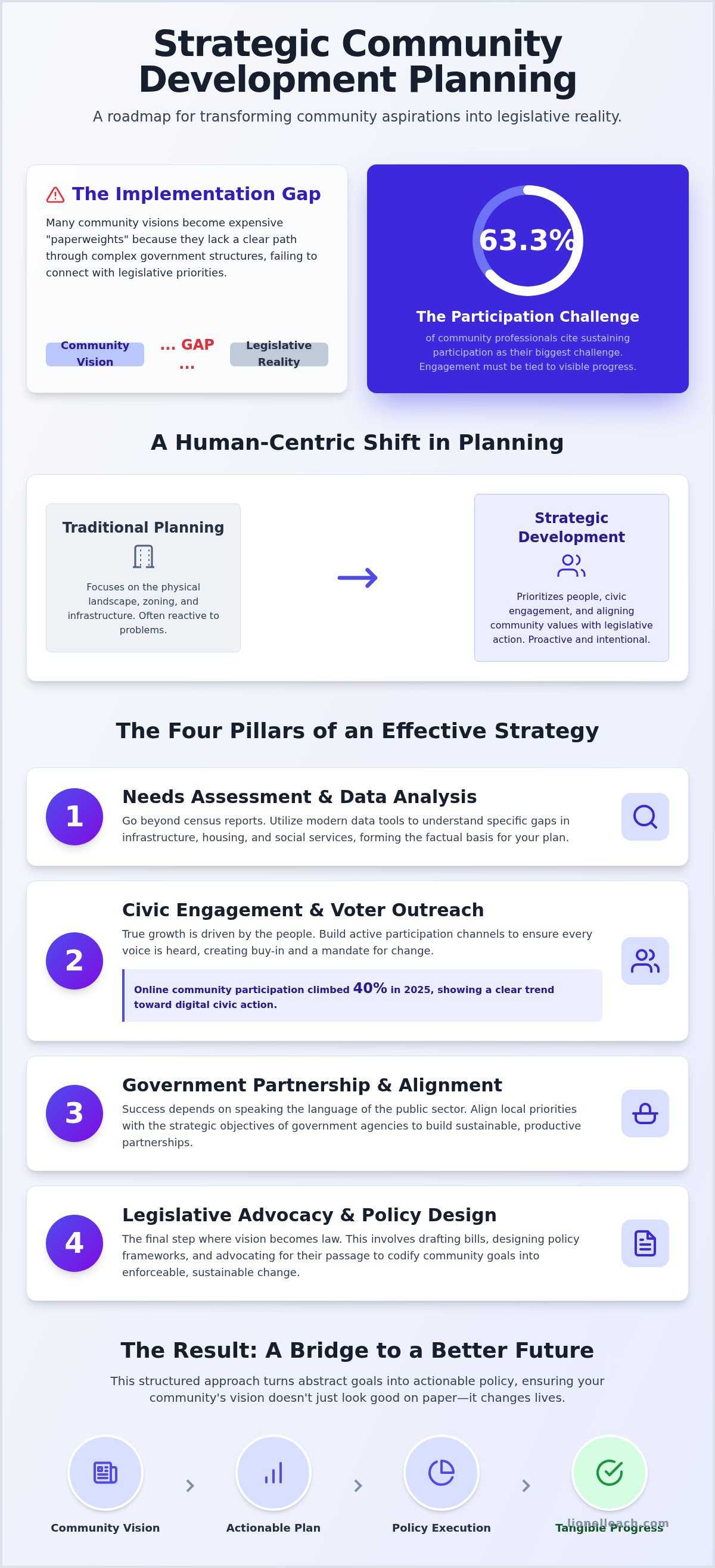
You deserve a roadmap that doesn't just sit in a drawer. Since 63.3% of community professionals cite sustaining participation as their biggest challenge, it's clear that engagement must be tied to visible progress. We believe that sustainable growth happens when civic engagement meets seasoned advocacy. In this guide, you'll discover how to navigate the nuances of government partnership advisory using a structured, 35-year proven approach to development. We'll examine how to align community needs with policy execution, foster effective partnerships with government entities, and increase voter engagement to ensure your vision becomes a reality. It's time to move beyond the planning phase and start seeing the results your community deserves.
Table of Contents
What is Strategic Community Development Planning?
Traditional urban planning often focuses on the physical landscape; it looks at zoning, infrastructure, and land use. While these elements are vital, Community development takes a broader, more holistic view. It's a proactive framework for growth that prioritizes the people living within those spaces. Strategic community development planning is the process of aligning a community's core values with the legislative and economic resources required to sustain them. It moves beyond simple reactive measures and establishes a clear, intentional path for the future.
Too often, development strategies are reduced to balance sheets and tax revenue projections. While fiscal health is a necessary outcome, it shouldn't be the starting point. A truly effective plan is human-centric. It asks what the residents need to thrive, how they want to engage with their local government, and what kind of legacy they wish to leave behind. This approach ensures that growth doesn't happen to a community, but rather with it. It builds trust and ensures that the benefits of development are felt by everyone, not just a select few.
Even the most inspired vision will fail without a path to implementation. This is where legislative advocacy becomes indispensable. It acts as the engine that drives a plan from a theoretical document to a legislative reality. By utilizing government partnership advisory, leaders can secure the funding and policy support needed to turn community goals into tangible progress. We don't just want a plan that looks good on paper; we want a plan that changes lives through effective policy execution.
The Evolution of Community Planning in 2026
As we move through 2026, the landscape of planning is shifting. Modern technology and advanced data analytics now allow for more precise community needs assessments. We're seeing a significant move toward inclusive, community-driven policy strategies where residents have a direct hand in shaping their future. Member participation in online communities climbed 40% in 2025, and this momentum is carrying into how we draft local legislation today. Community development is the intersection of civic will and legislative action.
Core Objectives of a Strategic Framework
A robust strategic framework provides more than just a list of projects. It establishes clear, measurable goals for sustainable growth that can be tracked over time. It also focuses on building the capacity of local organizations, ensuring they have the strength to maintain long-term partnerships with government entities. Finally, it demands a commitment to ethical responsibility and stewardship. We aren't just planning for next year; we're stewarding the resources and trust of the collective for the next generation. This ensures that every step taken is principled, deliberate, and focused on the common good.
The Four Pillars of an Effective Development Strategy
A vision without a structure is merely a wish. To move from a conceptual dream to a living reality, your approach must be built on a foundation that can withstand the pressures of shifting political climates and economic fluctuations. Effective strategic community development planning relies on a balance of data and human connection. It requires a disciplined focus on four essential pillars that transform abstract goals into measurable progress.
Pillar 1: Comprehensive Needs Assessment and Data Analysis. This involves more than just reading census reports. It's about utilizing 2026 data tools to understand the specific gaps in infrastructure, housing, and social services.
Pillar 2: Civic Engagement and Voter Outreach Programs. True growth is driven by the people. We focus on building active participation channels that ensure every voice is heard and every vote is counted.
Pillar 3: Government Partnership Advisory and Alignment. Success depends on your ability to speak the language of the public sector. We align your local priorities with the strategic objectives of government agencies.
Pillar 4: Legislative Advocacy and Policy Framework Design. This is the final step where we draft the bills and design the frameworks that codify your vision into law.
Civic Participation as a Growth Engine
Voter outreach is often the missing link in development strategies. While 85% of brands are projected to use community marketing in 2026, civic leaders must go further by fostering deep connection. With 63.3% of community professionals reporting that sustaining participation is their greatest hurdle, we must treat engagement as a continuous process rather than a one-time event. We build trust by creating transparent mobilization methods. When residents see their input directly influencing policy, their commitment to the community deepens. A seasoned advisor can help you refine these pillars through professional government partnership advisory.
Aligning Local Needs with Legislative Realities
Your plan must exist within the world of existing laws and upcoming deadlines. For example, the Federal CDBG formula grant deadline for the 2026 fiscal year is August 16, 2026. If your planning doesn't account for these specific windows, you risk losing vital funding. We conduct a thorough legislative scan to identify every available resource, from grant structures to policy incentives. This requires principled leadership and a steady hand during negotiations. By designing frameworks that resonate with public sector stakeholders, we ensure your community isn't just asking for help, but is offering a viable, well-researched solution that legislators are eager to support.
Bridging the Gap: Why Traditional Planning Often Fails
The most common tragedy in civic life is the beautifully designed plan that never leaves the shelf. Many organizations dedicate months to visioning and community workshops only to find their progress stalled by legislative indifference or bureaucratic red tape. While some consultants suggest these failures stem from poor financial management, the truth is often more complex. Strategic community development planning fails when it exists in a vacuum; it must be connected to the legislative machinery that provides funding and legal authority.
Implementation gaps occur when the desires of a community aren't translated into the language of policy. You might have a vision for affordable housing or infrastructure, but without a strategy to navigate specific regulatory shifts, the project remains a concept. For example, as of March 16, 2026, HUD increased the project threshold for Section 3 applicability to $300,000. If your development strategy isn't anchored in these real-world updates, you're building on a foundation of outdated assumptions. Seasoned advocacy ensures your project moves forward by anticipating these hurdles before they become roadblocks.
Navigating Complex Government Structures
Understanding the hierarchy of federal, state, and local government is essential for any leader. Success requires more than just knowing who holds office; it requires an understanding of how these different levels interact and where their priorities overlap. We've seen projects fail because they focused solely on local approval while ignoring state-level funding requirements or federal grant deadlines. Identifying key decision-makers early in the process allows you to build relationships before you need to ask for support.
Breaking down silos is another critical step. Community development often involves multiple departments, from transportation to public health. When these entities don't communicate, the result is a fragmented strategy that confuses the public and frustrates legislators. We work to align these disparate interests into a single, cohesive narrative that demonstrates broad support and clear benefit to the collective.
Turning Vision into Policy
Drafting successful bills and policy recommendations is a specialized skill that requires both technical knowledge and a deep understanding of negotiation. It isn't enough to present a problem; you must provide a viable, legally sound solution that a legislator can champion. We help you build a compelling case by combining community data with a clear legislative framework. This approach transforms your goals from abstract ideas into actionable items on a legislative agenda. A plan without a legislative strategy is merely a wish list. We ensure your vision has the advocacy it needs to become the law of the land.
Building Your Community Development Roadmap
A successful roadmap is a living document that guides a community from its current state to its desired future. It requires a methodical approach that balances long-term vision with the immediate realities of the legislative calendar. When we engage in strategic community development planning, we aren't just creating a list of projects; we're designing a sequence of actions that build momentum and trust. This process ensures that every stakeholder understands their role in the collective success of the initiative.
Step 1: Visioning and Stakeholder Identification. We begin by identifying the diverse voices that must be heard. This isn't just about leadership; it's about the residents who live the vision every day.
Step 2: Resource Mapping and Legislative Scanning. This involves identifying funding streams and regulatory windows. For instance, we track critical federal dates, such as the October 13, 2026, deadline for comments on the proposed Community Reinvestment Act rule amendments.
Step 3: Mobilization and Civic Engagement Execution. We move from discussion to action by organizing outreach programs that turn passive support into active civic participation.
Step 4: Government Partnership Facilitation and Advocacy. The final step is presenting a unified front to decision-makers, backed by a principled policy framework.
Visioning for Collective Impact
True visioning goes beyond a simple brainstorming session. It's a structured facilitation designed to identify common goals that resonate across different demographics. We focus on an asset-based approach, determining the positive qualities and resources that already exist within the community. By encouraging diverse participation, we ensure equity is baked into the plan from the start. This prevents the "silo" effect and ensures the roadmap reflects the genuine needs of the collective rather than the interests of a few.
Facilitating Sustainable Partnerships
Building collaborative government partnerships is a marathon, not a sprint. It requires maintaining long-term momentum through regular policy updates and consistent communication with public sector stakeholders. We measure success beyond the initial implementation phase by tracking how these partnerships evolve and how they adapt to new challenges. Whether you're navigating federal grant structures or building local coalitions, having a seasoned mentor is vital. You can begin this journey by engaging with a professional community development strategy consultant to ensure your roadmap is built for longevity.
Leveraging Expert Advisory for Community Success
Navigating the intricacies of public policy requires more than just a theoretical understanding of the law. It demands a level of intuition and experience that only comes from decades of direct engagement in government affairs. This is where the role of a community development strategy consultant becomes vital. Effective strategic community development planning is a deeply human endeavor. It isn't just about checking boxes or meeting grant deadlines; it's about facilitating the human element of professional services to ensure that every voice in the room is valued and heard.
With over 35 years of experience in legislative advocacy, Lionel Leach provides a real-world advantage that traditional consulting firms often lack. This tenure isn't just a number. It represents a track record of drafting successful bills and navigating the nuances of negotiation at every level of government. By closing the loop between community desire and public policy, an expert advisor ensures that your vision doesn't just remain an aspiration but becomes a codified reality. We focus on bridging the gap between local needs and the legislative priorities that drive funding and support.
Strategic Advocacy and Mentorship
Organizations often face complex negotiations where the stakes are high and the path forward is unclear. In these moments, you need a trusted advisor who approaches the work with a principled, mission-driven mindset. A seasoned mentor doesn't just provide answers. They offer a strategic perspective that helps you anticipate challenges and build consensus among diverse stakeholders. This level of advocacy is essential for sustainable growth, as it prioritizes long-term impact over fleeting trends. We position ourselves as your logical partner, dedicated to the success of the collective through steady leadership and ethical responsibility.
Taking the Next Step in Your Development Journey
Knowing when your community is ready for a strategic overhaul is the first step toward meaningful change. If your current plans are failing to gain traction or if you struggle to align local needs with legislative priorities, it's likely time for a fresh approach. Integrating voter outreach programs into your existing framework can revitalize civic engagement and build the public support necessary for project success. You don't have to navigate these complexities alone. To begin building a roadmap that leads to tangible results, consult with Lionel Leach on your development strategy. Together, we can ensure your community's vision has the strategic backing it needs to thrive.
Empowering Your Community Toward a Sustainable Future
Success in strategic community development planning requires more than just a well-documented vision. It demands a deliberate bridge between civic aspirations and legislative execution. By focusing on the four pillars of development and utilizing a structured roadmap, you can ensure your projects move beyond the planning phase and into policy reality. Effective voter outreach and government partnership advisory are essential tools for turning local needs into tangible growth.
Managing the complexities of government structures and funding windows is a significant challenge for any leader. With over 35 years of legislative leadership and a proven track record in community mobilization, Lionel Leach offers the seasoned mentorship needed to drive your initiatives forward. Don't let your community's goals stall due to bureaucratic hurdles or project stagnation. Partner with Lionel Leach for Strategic Community Development Planning to secure the expertise in navigating complex government structures your project deserves. Your community has the potential for lasting transformation; we're here to help you build the path to achieve it.
Frequently Asked Questions
What is the difference between urban planning and community development planning?
Urban planning primarily addresses the physical environment, such as land use, zoning laws, and infrastructure design. In contrast, strategic community development planning focuses on the human element, addressing social, economic, and political health. While an urban planner might design a park, a community development strategist ensures that residents have the civic engagement and legislative support to sustain it. This approach prioritizes long-term community empowerment over mere physical layout.
How long does a typical strategic community development process take?
The timeline for creating a comprehensive roadmap typically ranges from six to twelve months, depending on the community's complexity. This initial phase involves stakeholder visioning, data analysis, and legislative scanning. However, true development is an ongoing commitment to sustainable growth. Implementation often spans several years as the community navigates specific grant cycles and legislative windows. Success requires a steady, methodical pace rather than a rushed attempt to achieve immediate results without a solid foundation.
Why is voter outreach included in community development strategy?
Voter outreach is a critical growth engine because it bridges the gap between community desires and legislative action. When residents are mobilized and engaged, they provide the collective voice needed to influence decision-makers and secure policy changes. High levels of civic participation demonstrate to government entities that a development plan has broad public support. This engagement ensures that the community's vision is not just a suggestion but a clear mandate for sustainable progress.
How can a consultant help with government partnership advisory?
A consultant acts as a seasoned mentor who understands the nuances of negotiation across federal, state, and local government levels. Through government partnership advisory, they help organizations identify key decision-makers and align community goals with the strategic priorities of public sector stakeholders. This guidance is essential for navigating complex bureaucracies and securing the partnerships required for successful project implementation. Their experience allows them to anticipate regulatory hurdles and build principled, long-term collaborations.
What are the most common mistakes in community development planning?
The most frequent error is creating a plan that lacks a clear legislative strategy, often resulting in documents that sit on shelves without action. Another common mistake is focusing solely on financial projections while ignoring the human element and civic engagement. Organizations also struggle when they fail to account for specific government deadlines or regulatory shifts. Avoiding these pitfalls requires a proactive framework that connects community vision directly to the policy execution needed for real-world impact.
Can strategic planning help with securing federal or state funding?
Yes, strategic community development planning is essential for identifying and securing federal or state funding. A robust plan includes a legislative scan to map out available grant structures and ensures that projects meet specific eligibility criteria. For example, aligning a project with updated HUD Section 3 thresholds or meeting CDBG formula grant deadlines requires careful preparation. A well-structured roadmap demonstrates to funders that the community has a viable, data-driven strategy for success.
How do you measure the success of a community development roadmap?
Success is measured through both tangible outputs and long-term community impact. Key indicators include the amount of funding secured, the number of policy recommendations adopted into law, and the growth in voter participation rates. We also look at the strength of sustained partnerships with government entities and the successful completion of infrastructure or social projects. Ultimately, a roadmap is successful when it creates a self-sustaining cycle of civic engagement and principled, mission-driven growth for the collective.



Comments