Orange Property Taxes: Understand Your Bill and Evaluate Local Policy

What if the clearest way to judge Orange property-tax policy is to understand your bill before weighing a leader’s promises? When orange property taxes are a concern, start by identifying what your bill says, which public records can clarify it, and which local decisions residents are asking about.
This guide offers a practical way to review bill information, check relevant public records, and ask focused questions about budgets and tax decisions. It does not promise a tax reduction or substitute for guidance from the responsible government office. It also explains how residents can assess public leadership through experience, accountability, and attention to community priorities.
My perspective comes from more than 30 years of experience across government, unions, and nonprofit organizations. I have worked with Senator Ronald L. Rice since 1992 and spent 14 years as his Legislative Director. That experience informs how I approach listening, transparency, and community representation in Orange, but it does not make me a tax specialist.
Table of Contents
Orange Property Taxes: What to Check Before Drawing Conclusions
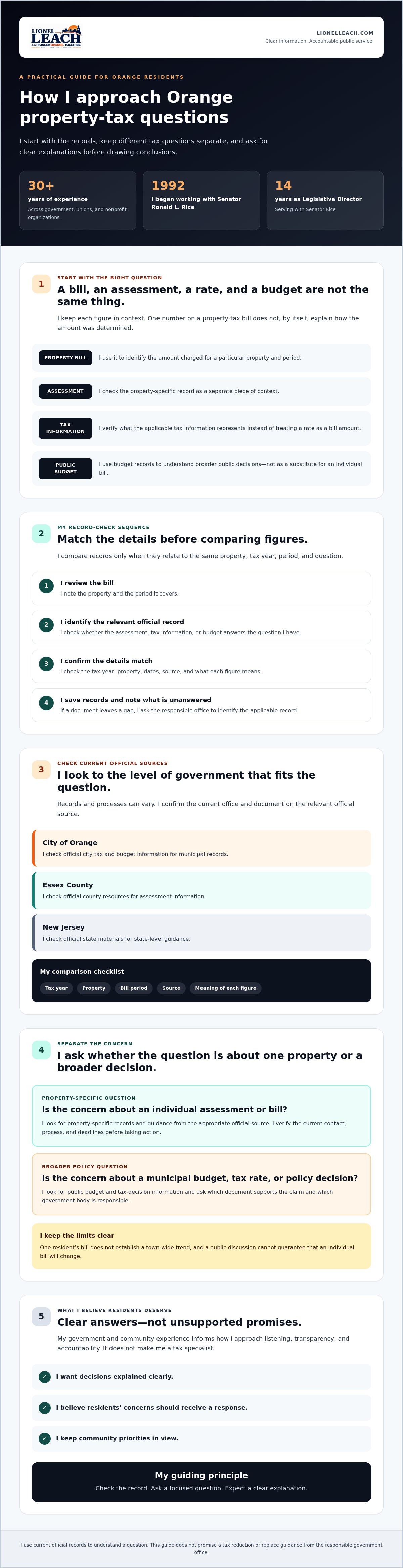
Orange residents can ask clearer questions about a tax bill by keeping several related details separate. The bill shows the amount charged for a particular property and period. The property assessment, applicable tax information, and public budgets provide related context, but each answers a different question. One figure on a bill does not, on its own, explain how the amount was determined.
Property-tax systems and records vary by location. The national overview of Property tax in the United States provides general background, but it cannot confirm Orange-specific details. For a local question, use current Orange, Essex County, and New Jersey government records and check that each document applies to the same property, tax year, and issue. My government experience informs my interest in clear public information, not specialized tax advice.
Where can Orange residents verify property-tax information?
Begin with the City of Orange’s official tax and budget information for municipal records. For county assessment information, check Essex County’s official resources. New Jersey’s official materials may provide state-level guidance. Confirm the current office name and identify the relevant document on each official website before relying on a figure, since offices and records may change.
Before comparing figures, check the tax year, property assessment, bill period, and source. Then note what each figure represents. A budget total is not the same as an individual bill, and a tax rate should not be treated as a bill amount. Avoid combining figures from different years or properties as if they described the same situation.
A simple record-keeping approach can make follow-up easier: save the bill and the official records you consulted, write down the questions those records leave unanswered, and note which government source may be able to clarify each one. These habits support the broader questions I raise in The Future of Political Representation in Orange, NJ: residents need accessible information and accountable public decision-making.
How to Assess Orange Property-Tax Concerns and Ask Better Questions
A focused question is more useful than a general claim that taxes are “too high” or a promise that they will go down. If you are concerned about orange property taxes, work through the issue in order: review the bill, identify what seems unclear, find the current official record that relates to it, and ask the relevant office or public body for an explanation.
Is the concern about a particular property’s assessment or bill?
Is it about a municipal budget, tax rate, or broader policy decision?
Which current official record supports the figure being discussed?
These questions point to different kinds of information. An individual billing or assessment concern requires property-specific records and guidance from the appropriate official source. A broader policy concern calls for public budget and tax-decision information. Keep the two issues distinct: one resident’s bill does not establish a town-wide trend, and a public discussion cannot guarantee an individual bill will change.
What should residents ask about local tax decisions?
Ask which document supports a public claim and which government body is responsible for the decision. When comparing records, check that they refer to the same tax year and that the terms, dates, and figures mean the same thing. If the question concerns an individual assessment or bill, verify the current contact, process, and deadlines through the responsible official source before taking action. Do not rely on an old form or an informal summary when current instructions are available.
Before drawing a conclusion, compare the property-tax bill, assessment record, current municipal budget, and tax-rate information with official Orange, Essex County, and New Jersey sources. Check that each record relates to the same period and question. If a document does not answer your question, ask the responsible office to identify the applicable record rather than filling in the gaps with an assumption.
My work across government and community organizations has taught me to value clear records and direct questions. It does not make me a tax specialist, but it informs how I would listen and encourage accountable public discussion in Orange. Residents can read more about my approach to public service.
How I Would Bring Property-Tax Accountability into Orange Public Service
Residents concerned about orange property taxes deserve to be heard and to receive clear explanations, not unsupported promises. I would bring a community-focused approach shaped by more than 30 years across state, county, and local government, unions, and nonprofit organizations: listen closely, ask practical questions, and support transparent public information. My experience is not tax expertise, and I cannot promise a particular outcome.
How does my government experience inform my approach?
I have worked with Senator Ronald L. Rice since 1992 and spent 14 years as his Legislative Director. My experience also includes work in government, organized labor, voter outreach, and youth sports. Across those settings, the work has involved engaging communities and navigating public institutions. Those experiences inform my approach to listening, organizing, and speaking up when community interests are at stake.
My professional background includes roles in state and local government, public-sector unions, and nonprofit organizations. I have worked on legislative processes, voter outreach, and community engagement. That background is relevant to public leadership because it provides experience with government structures and civic participation, but it should not be mistaken for tax-specific training or advice.
As I focus on public service in Orange, I believe residents should be able to raise concerns, understand which public body is responsible, and see the information behind decisions. Learn about my community-first vision for Orange.
Take the Next Step Toward Accountable Representation
Understanding orange property taxes starts with checking the right records, separating an individual bill question from a broader policy concern, and asking leaders to explain the decisions behind public claims. These steps can help Orange residents take part in a more informed conversation about local priorities.
My background includes more than 30 years of experience across state, county, and local government, unions, and nonprofit organizations. I have served as Project Manager for the Essex County Board of Commissioners since 2017. That work informs my commitment to listening and accountability, but it is not tax expertise or a promise of a particular result.
I invite Orange residents to consider whether my community-first approach reflects the leadership they want. Learn about my community-first vision for Orange.
Frequently Asked Questions
How are property taxes determined in Orange, New Jersey?
To understand orange property taxes, keep three kinds of information distinct: a property’s official assessment, applicable tax information, and public budgets. These records are related, but this article does not verify Orange’s current calculation method or the components of every bill. Check current Orange and New Jersey government materials for the relevant tax year before interpreting a bill or drawing a conclusion.
Why might an Orange property-tax bill change?
A change in the amount shown does not, by itself, establish why it changed. Compare the bill with the property’s assessment, applicable tax information, and relevant budget records, making sure the dates and periods match. These documents can help you identify what to ask, but an individual change must be checked against that property’s current records. Ask the appropriate official source for clarification rather than assuming a cause.
Can I appeal my property assessment in Orange, NJ?
You may be able to challenge an assessment, but I cannot confirm current eligibility, filing procedures, or deadlines here. Check the latest guidance from the appropriate Essex County and New Jersey government sources, and confirm which office handles the matter before taking action. This is general information, not legal advice. I do not provide legal representation; rely on official instructions for your individual assessment question.
Where can I find official Orange property-tax information?
Start with current government information from Orange, Essex County, and New Jersey. Use municipal materials for Orange-specific public tax and budget information, and consult county or state sources for information within their remit. Confirm current office names and records on official websites. General public documents may explain policy, but direct an individual bill or assessment question to the appropriate official source.
For help with community development strategy, voter outreach, or government partnership advisory in Orange, visit Lionel Leach’s website to learn more.



Comments