Newark Community Growth: Strategic Civic Impact & Advocacy Guide

What if the gap between a struggling neighborhood and a thriving urban center isn't a lack of passion, but a missing strategic roadmap? Many residents feel sidelined by complex government processes, and it's frustrating when low voter turnout stalls the progress your community deserves. Implementing effective community growth strategies Orange NJ residents can rely on requires more than just enthusiasm; it demands a disciplined approach to legislative advocacy. This guide shares the professional frameworks needed to bridge the divide between grassroots mobilization and sustainable urban growth. Using the same principles applied while serving Senator Rice and advocating for the residents of Orange, Lionel Leach outlines how to turn civic participation into tangible results. You'll gain a clear understanding of community development roadmaps and learn how to build high-impact partnerships with government entities to ensure your collective voice is finally heard.
Key Takeaways
Learn how to implement professional community growth strategies Newark leaders use to align local grassroots efforts with high-level legislative goals.
Discover how to set measurable development KPIs and leverage resource allocation frameworks that have successfully secured $1 billion for urban infrastructure.
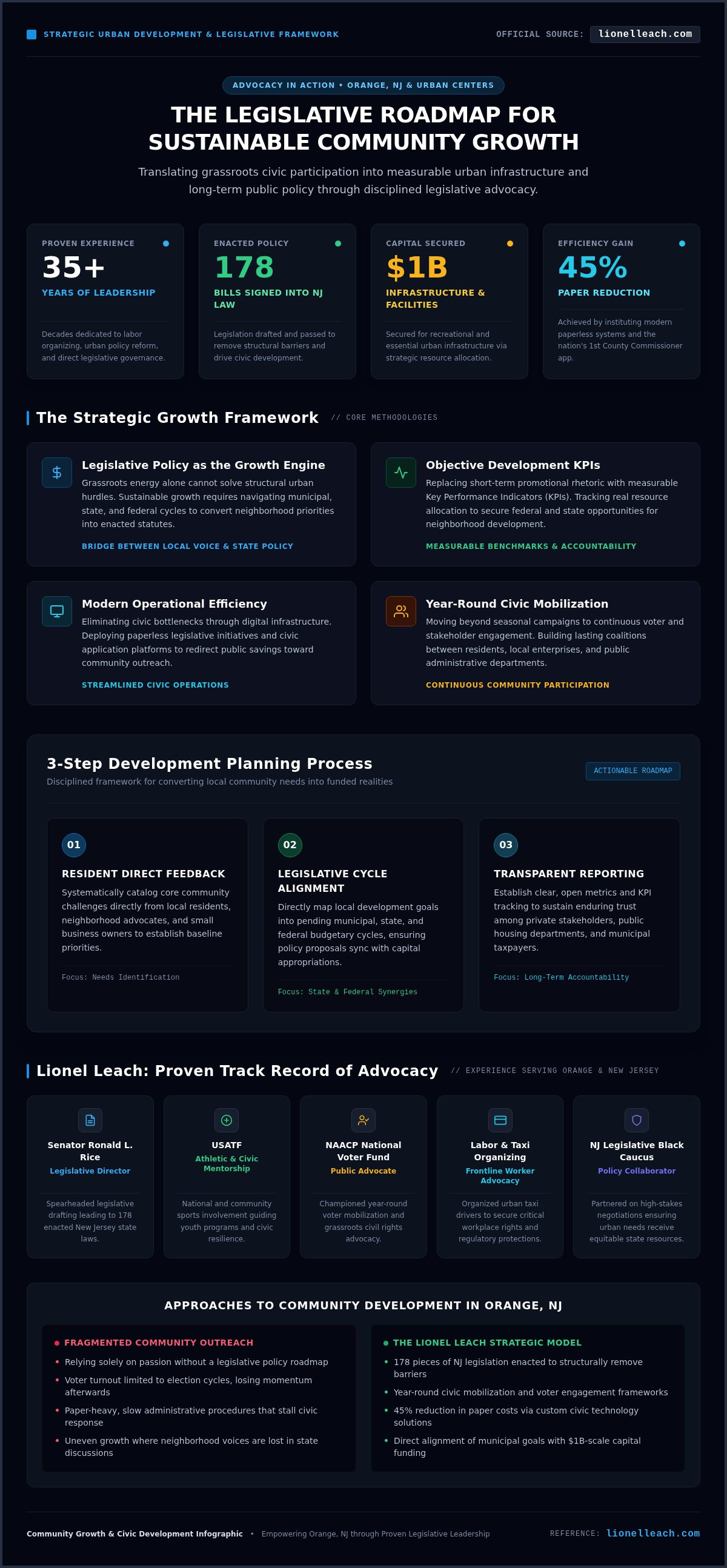
Understand the mechanics of legislative advocacy by studying the processes used to draft 178 pieces of legislation signed into New Jersey law.
Master year-round voter outreach programs that increase civic mobilization and ensure your community's voice remains a priority in government partnerships.
Table of Contents
The Foundation of Sustainable Community Growth Strategies
True community growth is a multi-dimensional process. It integrates economic opportunity, deep social ties, and the legislative policy required to sustain them. While organic growth occurs naturally, it's often uneven. Strategic development, however, relies on professional leadership to ensure progress is equitable. For residents in Orange, NJ, I apply over 35 years of experience to transform local vision into reality. By adopting proven sustainable community development practices, leaders can change a neighborhood's trajectory. Effective community growth strategies Newark and Orange leaders utilize must focus on removing the structural barriers that hinder expansion.
My history in government affairs, from organizing taxi drivers to serving as Legislative Director for Senator Ronald L. Rice, demonstrates that advocacy is the key to removing these barriers. I've helped draft 178 pieces of legislation signed into law, each one designed to clear the path for urban progress. This type of leadership moves beyond simple engagement; it builds a foundation where every resident has a stake in the city's future. By bringing this level of expertise to Orange, NJ, we can navigate the complexities of state government to deliver real results for our families.
To better understand this concept, watch this helpful video:
The Legislative Engine of Urban Change
Legislative strategy serves as the bridge between local neighborhood needs and state-level policy. It dictates a community's potential by ensuring local voices aren't lost in the halls of power. Navigating the complex layers of government requires a seasoned mentor who understands the nuances of negotiation across federal, state, and local levels. My work with USATF and the New Jersey Legislative Black Caucus has prepared me to advocate for the specific needs of Orange, NJ. By applying these community growth strategies Newark and Orange can build a more resilient future. Legislative advocacy is the proactive foundation of civic progress.
A Professional Roadmap for Community Development Planning
Success in urban expansion requires shifting from vague intentions to measurable results. Effective community growth strategies Newark leaders implement must prioritize Key Performance Indicators (KPIs) that track long-term health rather than temporary buzz. Securing $1 billion for recreational and infrastructure facilities serves as a professional benchmark for what's possible when vision meets strategic resource allocation. This level of funding doesn't happen by accident. It requires the deliberate alignment of municipal goals with federal and state opportunities, ensuring every dollar supports the collective good.
Building sustainable urban environments involves more than just public funding. It requires a synergy between government agencies and private sector stakeholders. By collaborating with the City of Newark Department of Economic and Housing Development, community leaders can ensure that neighborhood investments remain equitable and focused on local residents. These partnerships provide the necessary stability for long-term growth.
Securing Resources and Stakeholder Alignment
A successful roadmap maps the entire ecosystem of local businesses, residents, and government officials. In Orange, NJ, this collaboration is the engine of progress. In my experience developing the nation's first County Commissioner app, operational efficiency was paramount. Implementing a paperless legislation program led to a 45% decrease in paper purchases. This proves that modern tools can streamline civic operations and free up resources for more critical outreach. When navigating these complex structures, seeking a seasoned advisor for community development strategy ensures you don't waste time on ineffective outreach. Leaders should follow these steps:
Identify core community needs through direct resident feedback.
Align those needs with existing state and federal legislative cycles.
Establish transparent reporting to maintain trust with private and public partners.
By following this structured approach, leaders can move beyond simple advocacy and into the realm of sustainable, high-impact community development.
Increasing Civic Participation and Voter Engagement
Sustainable community growth strategies Newark and Orange residents can rely on require active participation from every neighborhood. I've seen firsthand how high-impact mobilization changes the political landscape. When I served as Regional and State Director for the NAACP National Voter Fund, we registered 36,000 new voters for the 2004 election cycle. This effort proved that when we organize, we shift the focus of leadership back to the people. Bringing this same energy to Orange, NJ, ensures that our local concerns are prioritized by state and federal partners.
Voter apathy often stems from a lack of transparency. People stop voting when they don't see the legislative impact of their participation. By highlighting how voter turnout directly correlates to secured funding, we can rebuild that trust. Residents can check their status through the New Jersey Division of Elections voter registration portal to stay prepared for every cycle. Year-round engagement is the only way to ensure our community stays empowered between elections.
Mobilization Strategies for Sustainable Success
Actionable participation starts with community leaders who act as local ambassadors. They turn awareness into a movement. My work developing the nation’s first County Commissioner app was designed to facilitate this exact type of modern outreach. It makes engagement immediate rather than an afterthought. In Orange, NJ, I use these tools to ensure residents are informed and active. Understanding committee structures is vital because these bodies decide the fate of local projects before they ever reach a full vote. By mastering these dynamics, we ensure the community's voice is present in every room where decisions are made.
Advancing Your Community's Legislative Future
Sustainable urban progress isn't a result of chance; it's the outcome of deliberate, professional strategy. We've explored how integrating legislative advocacy with robust voter outreach creates a foundation for lasting change. By establishing clear KPIs and securing multi-sector partnerships, you can transform local needs into statewide policy. My work has always been rooted in these principles, from drafting 178 pieces of legislation signed into law to securing $1 billion for recreational and infrastructure facilities. These results show that the right framework can overcome even the most complex structural barriers. Implementing effective community growth strategies Newark residents deserve requires a mentor who understands the nuances of government affairs. If you're ready to drive significant civic impact, it's time to take the next step. Partner with Lionel Leach for Strategic Community Advisory to build a stronger, more resilient collective future together.
Frequently Asked Questions
What are the most effective community growth strategies for urban areas like Newark?
The most effective community growth strategies Newark leaders implement involve the integration of grassroots mobilization with high-level legislative policy. This dual approach ensures that neighborhood needs are translated into laws that provide sustainable funding. For instance, securing $1 billion for urban recreational and infrastructure facilities demonstrates how strategic advocacy creates tangible physical improvements. Success depends on aligning local priorities with state-level resources to ensure growth remains equitable.
How does legislative advocacy influence local community development?
Legislative advocacy provides the legal and financial framework necessary for large-scale community improvements. By drafting policy, such as the 178 pieces of legislation signed into New Jersey law during my career, advocates can remove structural barriers to expansion. This process secures the funding and authority required for projects in Orange and Newark. It's the difference between temporary programs and permanent, legally protected community advancements.
How do I build a successful partnership between my community group and the government?
Building a successful partnership requires establishing clear objectives and maintaining consistent, transparent communication. Groups should align their local goals with existing legislative cycles and state priorities. In Orange, NJ, leveraging modern tools like the first County Commissioner app has helped bridge the gap between residents and officials. Effective partnerships rely on a mutual understanding of committee structures to ensure community voices are heard at the right levels.
Why is strategic planning essential for civic leaders and organizers?
Strategic planning is essential because it transforms disorganized passion into a disciplined roadmap for civic progress. Without a clear plan, efforts like voter registration or infrastructure requests often lose momentum before achieving results. My experience registering 36,000 new voters showed that a methodical approach is required to build lasting political influence. Leaders who plan strategically can navigate complex government structures to achieve long-term success for their communities.



Comments