Navigating Bureaucracy for Community Projects: A Guide

A community project can lose momentum when people are unsure who has authority to make the next decision. Navigating bureaucracy for community projects starts with clarifying what residents want to change, identifying the decision needed, and confirming which public body or partner can address it. A clear process helps community groups in Orange, New Jersey, move from a broad concern to a focused request.
In this guide, I’ll explain how to define a project outcome, map the people and institutions connected to it, and follow up without assuming that a conversation means approval. My experience includes government, community advocacy, and organizing, including service as Legislative Director for State Senator Ronald L. Rice from 2008-2022. These steps offer a practical starting point for Orange residents and organizations seeking to bring local priorities into productive conversations.
Table of Contents
Why navigating bureaucracy matters for community projects
A promising idea can stall when a group does not know who is responsible for the next decision, what information is needed, or how to make a request. That uncertainty does not establish whether an institution will support a project. It signals that the group should clarify the decision and confirm the right route before investing time in the wrong conversation.
Navigating bureaucracy for community projects means understanding the decisions, responsibilities, and relationships connected to a project, then communicating with the relevant public institutions. My work as Project Manager at the Essex County Board of Commissioners and Legislative Director for State Senator Ronald L. Rice has involved public-sector and legislative processes. Preparation can help a community priority reach the right conversation, but the responsible public body must confirm its own process. A useful introduction is understanding public administration, including how government and public services are managed.
For a concise introduction to bureaucracy and government, watch this video:
What community leaders need before approaching government
Before contacting an office, write down the need, the outcome residents want, and the specific decision or support being requested. Keep these points distinct. For example, identifying a concern does not by itself establish which office has authority over it. Ask the public body to confirm the appropriate contact and process instead of assuming that the most visible official controls the next step.
Project navigation means matching a clearly stated community outcome to the decision, responsible people, and public channel that can address it. A short, organized explanation makes it easier to ask useful questions. Include what is known, what remains unclear, who the project is intended to serve, and what response would help the group proceed. Verify responsibilities and next steps directly, and treat a conversation as guidance, not as approval. This approach can help residents in Orange coordinate around a priority without treating every delay as a dead end.
Framework for Navigating Community Project Bureaucracy
A practical framework turns a community concern into a request that public partners can understand and respond to. Use the steps below to keep the intended outcome clear while checking who is responsible and what the next action should be.
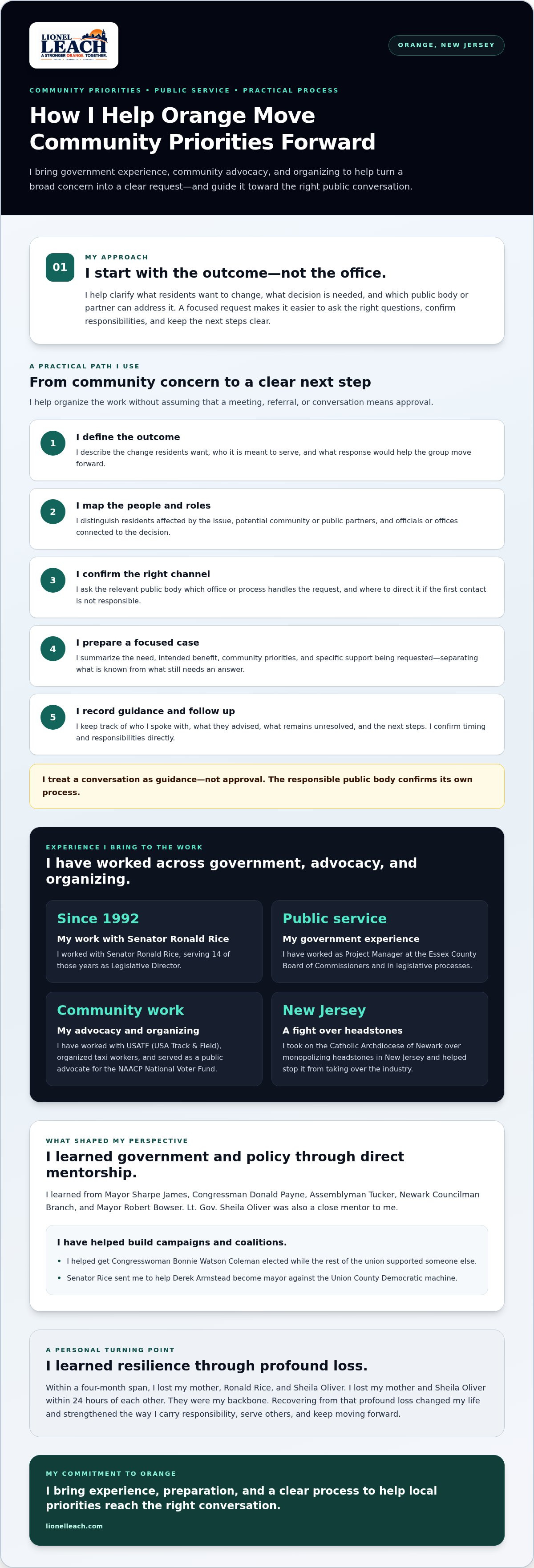
Define the outcome. Describe the change residents want, who would benefit, and how the group will know whether the request has been addressed.
Identify decision-makers. Separate residents and organizations affected by the issue from possible partners and officials who may have a role in the decision.
Confirm the right channel. Ask the relevant public body which office or process handles the request. If the first contact is not responsible, ask where to direct the inquiry.
Prepare the case. Summarize the need, intended benefit, community priorities, and specific support being requested. Distinguish confirmed information from questions that still need answers.
Keep a simple project record so that new participants can understand the issue without relying on memory. A useful record includes the project goal, the questions asked, the office contacted, the response received, and the next action. If several partners are involved, note which questions each partner can answer. Do not interpret a referral, meeting, or initial discussion as a decision, and confirm timing directly rather than assuming it.
How to map decision-makers and build useful working relationships
Start a stakeholder map with three groups: residents and community members whose priorities should shape the work, organizations or public partners that may contribute, and officials or offices connected to the decision being sought. Beside each name or role, note why that person or group is relevant and what you need to learn from them. This keeps the outreach focused and makes it easier to spot unanswered questions.
Before a meeting or call, prepare a short description of the issue and a few direct questions. Ask who is responsible, what information the office needs, and what the appropriate next step is. Afterward, send or keep a concise record of what you understood, and invite corrections where responsibilities or instructions remain unclear. In my work across county and state government, including as Project Manager at the Essex County Board of Commissioners and Legislative Director for State Senator Ronald L. Rice, I’ve seen the value of listening, preparation, and follow-through. I bring that perspective to community priorities in Orange, New Jersey. To learn more about my approach to community development strategy, explore my work and experience.
Applying the approach to community priorities in Orange, New Jersey
For Orange, this framework offers a way to organize residents’ priorities before bringing them to a public body or potential partner. Begin by listening to the people affected, then agree on the issue the group wants addressed. Identify what decision or support is being requested, and confirm which office or public process is relevant rather than assuming how the municipality handles it.
My professional background includes government, community advocacy, labor, and organizing. I served as Project Manager at the Essex County Board of Commissioners and as Legislative Director for State Senator Ronald L. Rice from 2008-2022. I have also held roles in voter outreach and community organizations. That experience informs my work on community development strategy and voter outreach programs, including efforts to help organizations clarify local priorities and coordinate with government partners.
What I bring to community-focused public work
My legislative and public-sector experience includes drafting 178 pieces of legislation signed into law by the Governor of New Jersey and securing $1 billion for recreational and infrastructure facilities in urban areas. That work informs my understanding of how community priorities can be organized and brought into policy discussions. For a local project, the practical starting point remains the same: define the need, identify the decision being sought, and confirm the right public channel.
In Orange, a community group can use this process to prepare for conversations about a local priority without assuming that a particular outcome or timetable is guaranteed. Community development strategy can help clarify the goal, the stakeholders, and the steps needed to approach government partners. If you’re considering a community priority, explore my community development strategy work as a starting point for a thoughtful conversation.
Turn a Community Priority into a Clear Next Step
A community project is easier to discuss when its intended outcome is clear, the relevant decision-makers have been identified, and questions and next steps are documented. Navigating bureaucracy for community projects is not about expecting an instant answer. It is about listening to residents, preparing a focused request, confirming responsibilities, and following up through the appropriate channel.
My experience includes serving as Project Manager at the Essex County Board of Commissioners, 2017-Present; Legislative Director for State Senator Ronald L. Rice, 2008-2022; and Regional and State Director of the NAACP National Voter Fund, 2001-2005. I draw on that background in government and community work to support thoughtful planning around priorities in Orange.
If you’re ready to organize a local priority and identify a practical next step, contact me about community development strategy. Clear goals and steady coordination can help bring Orange residents’ concerns into focused conversations.
Frequently Asked Questions
How can a community group navigate government bureaucracy for a local project?
Start by describing the community need, the intended benefit, and the decision or support being requested. Identify residents and potential partners who should be part of the discussion, then ask the relevant public body to confirm the correct contact and process. Keep a written record of questions, responses, and next steps. In Orange, this approach helps a group communicate its priorities without assuming approval or timing.
What should I do if I do not know which government office handles my community project?
Send a brief inquiry that explains the project and its goal, then ask which office or person handles that type of request. Confirm responsibilities directly rather than relying on assumptions. If the first contact cannot help, ask where to direct the inquiry and record the referral. This gives an Orange project a clearer route while the group establishes the appropriate channel.
Can community organizations work with local government to advance a project?
Community organizations can bring residents’ priorities, local knowledge, and a clear request into conversations with government partners. The appropriate roles and process depend on the project, so confirm them with the relevant public body. My work across government and community organizations has reinforced the value of clear communication and coordination. Those principles can support community-focused work in Orange, without guaranteeing a particular outcome.
How can community leaders build trust with government partners?
Build trust through preparation, honest communication, and consistent follow-through. Explain whose needs the project represents, distinguish confirmed information from open questions, and document commitments and next steps after conversations. My experience as Project Manager at the Essex County Board of Commissioners and in community advocacy has reinforced the importance of listening and coordination. For Orange leaders, respectful, sustained work is more useful than promises of instant results.



Comments