Labor Advocacy: How Worker Voices Shape Policy and Community Outcomes

What changes when workers’ concerns are heard not only at the bargaining table, but also in decisions shaping their neighborhoods? I’ve seen labor advacay connect worker voices with policy and community priorities. Workers often know what needs to change, but the path from a shared concern to a decision-maker can feel unclear, especially when advocacy, organizing, lobbying, and legal representation are treated as the same thing.
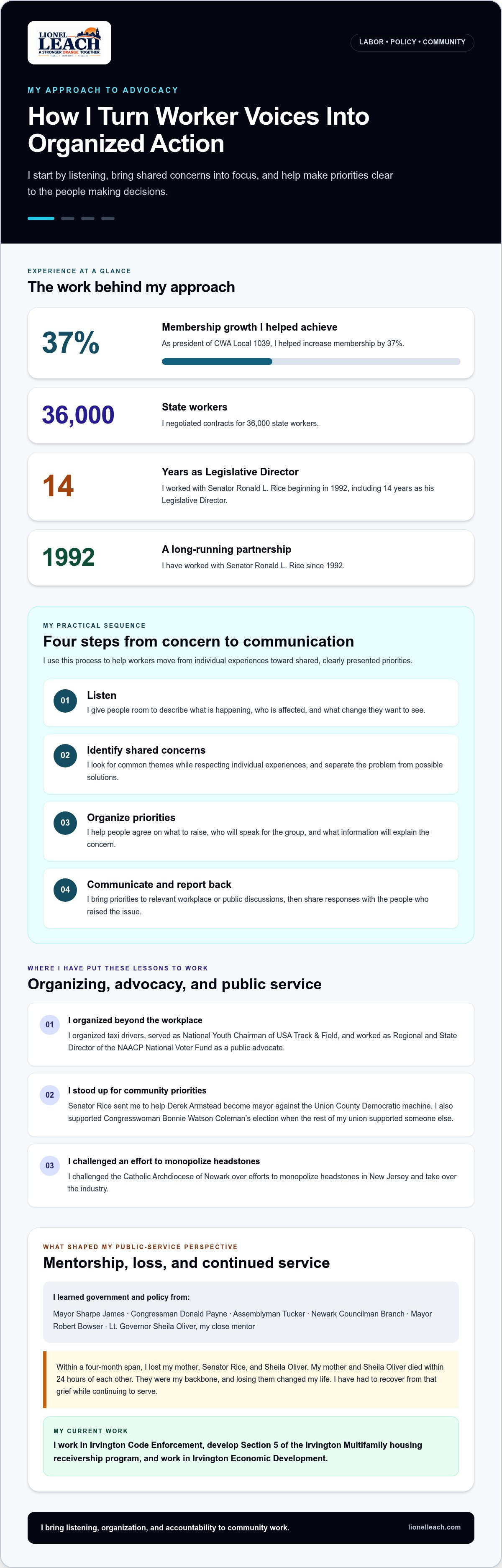
In this article, I’ll explain what labor advocacy can do and how workers’ experiences can inform public decisions in Orange, New Jersey. My perspective comes from serving as president of CWA Local 1039, increasing its membership by 37%, and working with Senator Ronald L. Rice since 1992, including 14 years as his Legislative Director. I’ll share practical ways to bring people together, set priorities, and make concerns clear to decision-makers. For me, lasting progress begins with listening and organizing with integrity.
Table of Contents
What Labor Advocacy Means for Workers and Their Communities
I believe workers need a meaningful voice in decisions that shape their jobs and communities. People doing the work often see where problems arise, but those concerns can be overlooked unless workers can raise them together and take part in the conversations that affect them. My experience in labor advacay has taught me that listening is the beginning. Organized, sustained engagement helps carry workers’ concerns forward.
Labor advocacy is the organized effort to bring workers’ concerns into negotiations, public discussions, and policy decisions. It can include identifying shared priorities, organizing members, bringing local perspectives into the conversation, and presenting concerns to decision-makers. This work is part of the wider history of the labor movement, where collective action has helped make workers’ common concerns visible.
To see how union action can influence society, watch this TED talk:
How labor advocacy differs from workplace legal representation
Advocacy and organizing bring people together around shared concerns and communicate priorities through engagement, negotiation, or policy work. Legal representation is different: it concerns assistance with an individual legal matter. My work focuses on advocacy and community development, not legal representation, and this article is not legal advice. Lobbying registration is a separate administrative matter, not the same as organizing workers or elevating their concerns.
My union experience showed me what organized participation can accomplish. As president of CWA Local 1039, I helped increase membership by 37% and negotiated contracts for 36,000 state workers. That experience informs how I approach community leadership in Orange: listen carefully, identify shared priorities, and make space for the people affected to take part in the discussion.
How Worker Concerns Become Organized Advocacy and Policy Action
I approach labor advacay as a deliberate process that starts with workers’ experiences, not assumptions about what they need. A practical sequence is to listen, identify shared concerns, agree on priorities, and communicate them clearly. Listening helps distinguish an individual concern from an issue others recognize. Organizing gives people a chance to decide what they want decision-makers to understand and how they want to present it.
Listen: Give workers room to describe the challenges they face. Ask what is happening, who is affected, and what change they want to see.
Identify: Look for common themes while respecting individual experiences. Separate the specific problem from possible solutions.
Organize: Agree on the priorities to raise, who will speak for the group, and what information will help explain the concern.
Communicate: Bring those priorities to the relevant workplace or public discussions, then share any response with the people who raised the issue.
Clear communication helps decision-makers understand how workplace concerns connect with broader community needs. Research and discussion can inform that work, including publications from the Harvard Law School Center for Labor and a Just Economy. Advocacy brings concerns into the conversation, but it cannot promise a particular policy decision or outcome.
What organizing and negotiation can contribute
Collective listening helps workers see where their concerns overlap. Negotiation creates space to present priorities, hear different perspectives, and work toward an agreement. There is no single formula for every workplace or issue. The practical value comes from clear representation, preparation, and steady communication.
My experience extends beyond union work. As president of CWA Local 1039, I helped increase membership by 37% and negotiated contracts for 36,000 state workers. I also served as National Youth Chairman of USA Track & Field and as Regional and State Director of the NAACP National Voter Fund, where I worked as a public advocate. These roles reinforced the importance of organization and listening. I bring those lessons to community-focused work in Orange, where a useful first step is to hear residents’ concerns, find common ground, and make priorities understandable to public decision-makers. To learn more about my approach, explore my community-focused work in Orange.
Applying Labor Advocacy Lessons to Community Leadership in Orange
I believe labor advocacy and community leadership both depend on listening, accountability, and making sure people’s concerns reach decision-makers. Organizing taxi drivers and working with Senator Ronald L. Rice since 1992, including 14 years as his Legislative Director, shaped that belief. Senator Rice sent me to help Derek Armstead become mayor against the Union County Democratic machine. That experience taught me that public service takes preparation, persistence, and a willingness to stand up for what I believe is right.
Bringing worker voice into broader community priorities
My advocacy has also included challenging the Catholic Archdiocese of Newark over efforts to monopolize headstones in New Jersey and supporting Congresswoman Bonnie Watson Coleman’s election when the rest of my union supported someone else. I learned about government and policy from Mayor Sharpe James, Congressman Donald Payne, Assemblyman Tucker, Newark Councilman Branch, Mayor Robert Bowser, and my close mentor, Lt. Governor Sheila Oliver.
Within a four-month span, I lost my mother, Senator Rice, and Sheila Oliver. My mother and Sheila Oliver died within 24 hours of each other. They were my backbone, and losing them changed my life. I have had to recover from that grief while continuing to serve. Today, I work in Irvington Code Enforcement, developing Section 5 of the Irvington Multifamily housing receivership program, and in Irvington Economic Development. I bring those experiences and lessons in accountability to the community development and public service work I believe matters in Orange.
I explore how public and community partners can work together in my guide to collaborative government partnerships. For more on my vision for political representation in Orange, I invite you to learn about my work.
Carry Worker Voices Into Orange’s Future
Workers’ concerns can become part of broader policy and community conversations when people listen, organize shared priorities, and communicate them clearly. That is the heart of labor advacay, and it is a lesson I believe matters in Orange, where community-focused leadership should begin with the experiences of the people it serves.
My perspective comes from putting those principles into practice. At CWA Local 1039, membership increased by 37%, and I negotiated contracts for 36,000 state workers. I also spent 14 years as Legislative Director for State Senator Ronald L. Rice. These experiences taught me to value preparation, representation, and accountability, while recognizing that good outcomes require ongoing work.
I believe Orange benefits when residents’ voices are heard and treated with respect. Learn about my community-focused work in Orange and my perspective on public service. Join me in building a community where people’s concerns have a place in the conversation and their voices help shape what comes next.
Frequently Asked Questions
What is labor advocacy?
I define labor advocacy as organized efforts to raise workers’ concerns through collective engagement, negotiation, and policy discussions. It can help workers bring shared workplace issues to unions, community groups, employers, or public decision-makers. In my experience, effective labor advacay starts with listening and representing workers’ concerns clearly. Advocacy can inform decisions, but it cannot guarantee a particular result.
How can workers get involved in labor advocacy?
Start by describing the issues you face and listening for concerns shared by colleagues. Discuss priorities with a union or worker group, help organize those priorities, and take part in conversations with relevant workplace or public decision-makers. In Orange, workers can also connect workplace concerns to community discussions, bringing firsthand knowledge into broader local priorities.
Can labor advocacy influence public policy?
Yes. Labor advocacy can bring workers’ concerns into public discussions and policy processes. I see its value in helping decision-makers understand how workplace issues connect with people’s everyday lives and community needs. Workers and groups can share priorities through organized communication and engagement. The relevant decision-makers make the final policy decisions, and advocacy does not guarantee a particular outcome.
How is labor advocacy different from lobbying?
I see labor advocacy as the broader effort to organize and communicate workers’ concerns. It can include listening, building shared priorities, negotiation, public education, and policy engagement. Lobbying generally refers to efforts directed at influencing government decisions. It may be one approach within advocacy, but advocacy also includes work among workers and communities. This is a plain-language distinction, not legal or registration advice.



Comments