How to Build Political Capital Through Trust, Service, and Follow-Through

What if the answer to how to build political capital isn’t more networking, but becoming someone people can count on?
I understand why the phrase can sound transactional. To me, political capital is credibility earned through listening, service, honest communication, and follow-through, then used responsibly to advance shared priorities. Residents need more than promises. They need a steady partner who can bring their concerns into public conversations and explain what happens next.
I’ve worked with Senator Ronald Rice since 1992, including 14 years as his Legislative Director. My experience also includes taxi organizing, public advocacy with the NAACP National Voter Fund, and leadership with USA Track & Field. Across those roles, I’ve seen durable influence grow when people work together around real needs.
In this article, I’ll share a practical, community-first approach and explain how I’d put it to work for Orange: listening to residents, connecting local priorities with government action, and staying accountable for what comes next.
Table of Contents
What Political Capital Means, and Why Trust Matters More Than Access
I define political capital as the trust and credibility that help people work together toward shared public goals. It gives a leader a basis for bringing residents, organizations, and decision-makers into a constructive conversation. That credibility has to be earned through service and accountability.
Political capital is sometimes described as a resource that can be saved or spent. I believe that metaphor is useful only if we remember where that resource comes from: people’s confidence that a leader will listen, speak honestly, and keep commitments. Access may open a door, but it does not, by itself, earn trust.
For a closer look at the skills involved in influence and building alliances, watch this video:
Is political capital the same as political influence?
I see influence as the capacity to affect a decision. Political capital is the credibility that helps make that influence constructive and lasting. Without trust, a person may have access to decision-makers but struggle to bring people along or sustain cooperation.
Working with Senator Ronald Rice since 1992, including 14 years as his Legislative Director, helped me understand that public work depends on more than being in the room. It means hearing people out, communicating honestly about what can be done, and following through. I drafted 178 pieces of legislation signed into law by the Governor of New Jersey, an experience that reinforced the value of understanding how community concerns move through government processes.
I understand why influence can sound transactional, as if relationships are built to trade favors or gain visibility. That isn’t how I approach it. For me, how to build political capital begins with accountability to the community: listen, act in service of shared priorities, and report back. That standard matters in Orange, where residents should be able to see whose needs guide public leadership.
How to Build Political Capital Through Listening, Service, and Follow-Through
For me, how to build political capital starts with a disciplined process, not a promise of quick results:
Listen: I hear residents’ concerns before deciding what action to pursue. I make space for people to explain how an issue affects them, rather than assuming I already know the answer.
Find shared priorities: I look for needs residents, organizations, and public partners can address together. Being clear about the common goal helps keep a conversation focused.
Build relationships: I bring community members and decision-makers into the conversation, with respect for their different roles and responsibilities.
Act and report back: I take responsible steps, communicate progress honestly, and explain what still needs attention. A useful update says what has happened, what remains unresolved, and what the next step is.
For a community issue, that means starting with the concern residents have raised, identifying who is affected and what shared outcome they want, then bringing the relevant people into the discussion. I would track the next steps and report back, including when progress takes time. That simple cycle turns a conversation into accountable public work.
I learned the importance of organizing through taxi driver representation, public advocacy with the NAACP National Voter Fund, and my work with USA Track & Field. Those experiences placed me in different settings, but the responsibility was consistent: engage people, understand the issue, and stay accountable to the work.
What actions turn relationships into lasting credibility?
My approach has also been shaped by mentorship from Mayor Sharpe James, Congressman Donald Payne, Assemblyman Tucker, Newark Councilman Branch, Mayor Robert Bowser, and Lt. Gov. Sheila Oliver. I carry forward the responsibility to listen carefully, act dependably, and communicate plainly rather than promise outcomes I can’t guarantee.
That kind of service can strengthen a community’s power and goodwill, helping people work together around shared priorities. In Orange, I would apply that same steady approach to community relationships and public problem-solving. My community development strategy is grounded in connecting people, priorities, and government partnerships with clear follow-through.
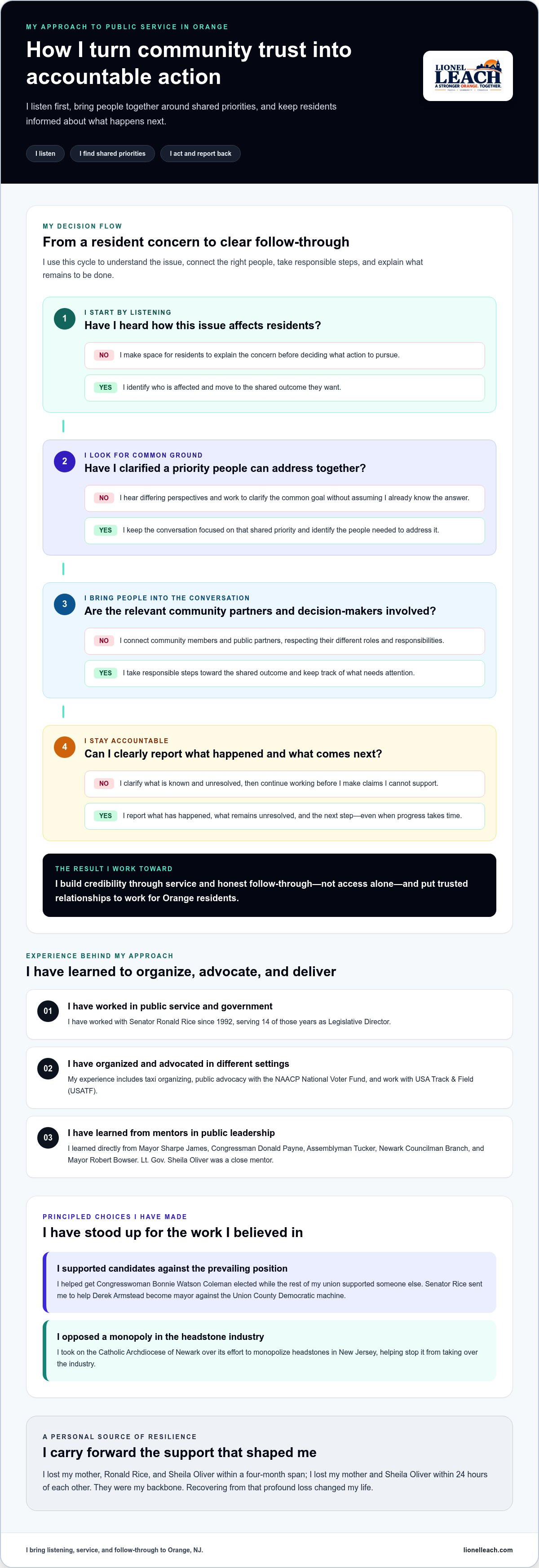
How I Would Put Political Capital to Work for Orange, NJ
In Orange, I would put trusted relationships to work by connecting residents’ priorities with community partners and government decision-makers. Political capital should help people be heard, support constructive collaboration, and keep local leadership responsive. I would judge it not by who has access, but by whether that access helps advance community needs with honesty and accountability.
How can public leadership turn credibility into community progress?
My experience has taught me that serving the public sometimes means standing by a principled choice, even when it differs from the prevailing position. I helped get Congresswoman Bonnie Watson Coleman elected while the rest of my union supported someone else. Senator Rice also sent me to help Derek Armstead become mayor against the Union County Democratic machine. Those experiences reflect my willingness to work toward a goal I believe in, not a promise that every effort will produce a particular outcome.
I also took on the Catholic Archdiocese of Newark over the headstone industry, opposing its effort to monopolize headstones in New Jersey and helping stop it from taking over the industry. For me, that advocacy reflects an important responsibility of public leadership: pay attention when community or industry concerns arise, and be prepared to speak up.
My commitment to public service has also been shaped by profound loss. Within a four-month span, I lost my mother, Ronald Rice, and Sheila Oliver. My mother and Sheila Oliver died within 24 hours of each other. They were my backbone, and recovering from that loss changed my life. It deepened my understanding of resilience, responsibility, and the importance of showing up for others.
That is the community-first approach I would bring to Orange: listen to residents, build partnerships around shared priorities, and stay accountable for the work. Explore my community-focused approach and my vision for the future of political representation in Orange.
Let’s Build Orange’s Future Through Trusted Partnerships
Knowing how to build political capital means earning credibility through listening, serving shared priorities, and following through. I believe that kind of influence should help connect Orange residents with constructive government partnerships, not serve as an end in itself.
My experience spans state, county, and local government, unions, and nonprofit organizations. I’ve worked with Senator Ronald Rice since 1992, including 14 years as his Legislative Director. That work shaped my belief that public leadership must pair strong relationships with honest communication and accountability.
As I seek public office in Orange, I’m ready to bring that community-first approach to the city: hear residents, bring people together, and stay committed to the work. Explore my community development strategy and join me in building a stronger future for Orange.
Frequently Asked Questions
What does it mean to build political capital?
I use political capital to mean the trust and credibility that help people work together on shared public goals. It isn’t simply access to decision-makers or public visibility. In Orange, I believe it means earning residents’ confidence through service, listening, honest communication, and dependable follow-through, then using that trust to help connect community priorities with government action.
How do you build political capital in a community?
I build it by listening to residents, identifying priorities we share, bringing people and decision-makers into constructive relationships, and acting responsibly. Then I report back, including when progress takes time or a goal hasn’t been reached. For anyone asking how to build political capital in Orange, I believe that consistent, transparent process matters more than making promises to gain short-term support.
Can political capital be built without holding public office?
Yes. I believe people can earn credibility through community involvement, advocacy, organizing, and service without holding elected office. In Orange, residents and community groups can build relationships around shared concerns, participate in public discussions, and follow through on commitments. Public office can create opportunities to serve, but trust grows from how consistently I listen and act, not from a title alone.
How can political capital be used responsibly?
I use political capital responsibly by directing relationships toward community priorities, communicating honestly, and remaining accountable to the people affected by decisions. I don’t view trust as a favor to trade or a personal asset to spend for its own sake. For Orange, its purpose should be to support constructive partnerships and responsive public service while respecting residents’ voices and expectations.



Comments