How to Build a Strategic Community Development Roadmap in NJ (2026)

What if the true catalyst for revitalizing Orange, New Jersey, isn't found in a sleek architectural rendering, but in the steady work of building legislative advocacy and civic trust? You likely recognize the exhaustion that comes from navigating complex state bureaucracy while trying to keep local residents engaged. It's difficult to align a local vision with shifting state priorities when the path forward feels obscured by red tape. This guide provides a professional, step-by-step framework to build a community development roadmap NJ leaders can use to secure sustainable growth. You'll learn how to master the 2026 legislative landscape and foster authentic participation. We'll examine how to translate local needs into state-level wins by leveraging the same strategic principles Lionel Leach used to organize taxi workers, register 36,000 voters with the NAACP, and pass 178 pieces of legislation under the mentorship of Senator Ronald L. Rice.
Table of Contents
The Strategic Landscape of Community Development in New Jersey
A successful community development roadmap NJ requires more than a list of capital projects; it's a living framework that balances physical infrastructure with legislative policy and deep civic engagement. In 2026, leaders face a complex environment where regulatory hurdles and evolving social mandates can stall even the best intentions. We've moved beyond the era of top-down administrative planning. Today, sustainable growth depends on a community-driven strategy that integrates technical geospatial data with human-centric advocacy to ensure no neighborhood is left behind.
To better understand the foundational stages of this process, watch this helpful video:
True progress relies on participatory community development, where the voices of residents shape the actual policy. This approach mirrors the grassroots organizing I've led, from mobilizing taxi workers to registering 36,000 new voters through the NAACP National Voter Fund. By grounding your vision in real-world needs and historical context, you build the public trust required for long-term impact and collective success.
Understanding the New Jersey Policy Ecosystem
Every local initiative exists within the broader New Jersey policy ecosystem. State-level mandates heavily influence local priorities, and the NJ State Legislature often holds the key to project authorization and funding. During my tenure as Legislative Director for Senator Ronald L. Rice, I saw how aligning local goals with state trends ensured projects remained a priority for appropriations. Drafting 178 pieces of legislation taught me that your community development roadmap NJ must speak the language of Trenton to secure the $1 billion in infrastructure support our urban areas deserve. Legislative advocacy and community growth serve as the essential engine for urban revitalization.
Essential Pillars of a Development Framework and Strategic Advocacy
Building a sustainable future in New Jersey requires a framework that balances technical data with political reality. You can't rely on a single project or a one-time grant to revitalize a neighborhood. Instead, you need a strategy that integrates every facet of the policy ecosystem. By focusing on these core pillars, local leaders can create a community development roadmap NJ that commands respect in both the boardroom and the community center.
The Four Pillars of Strategic Growth
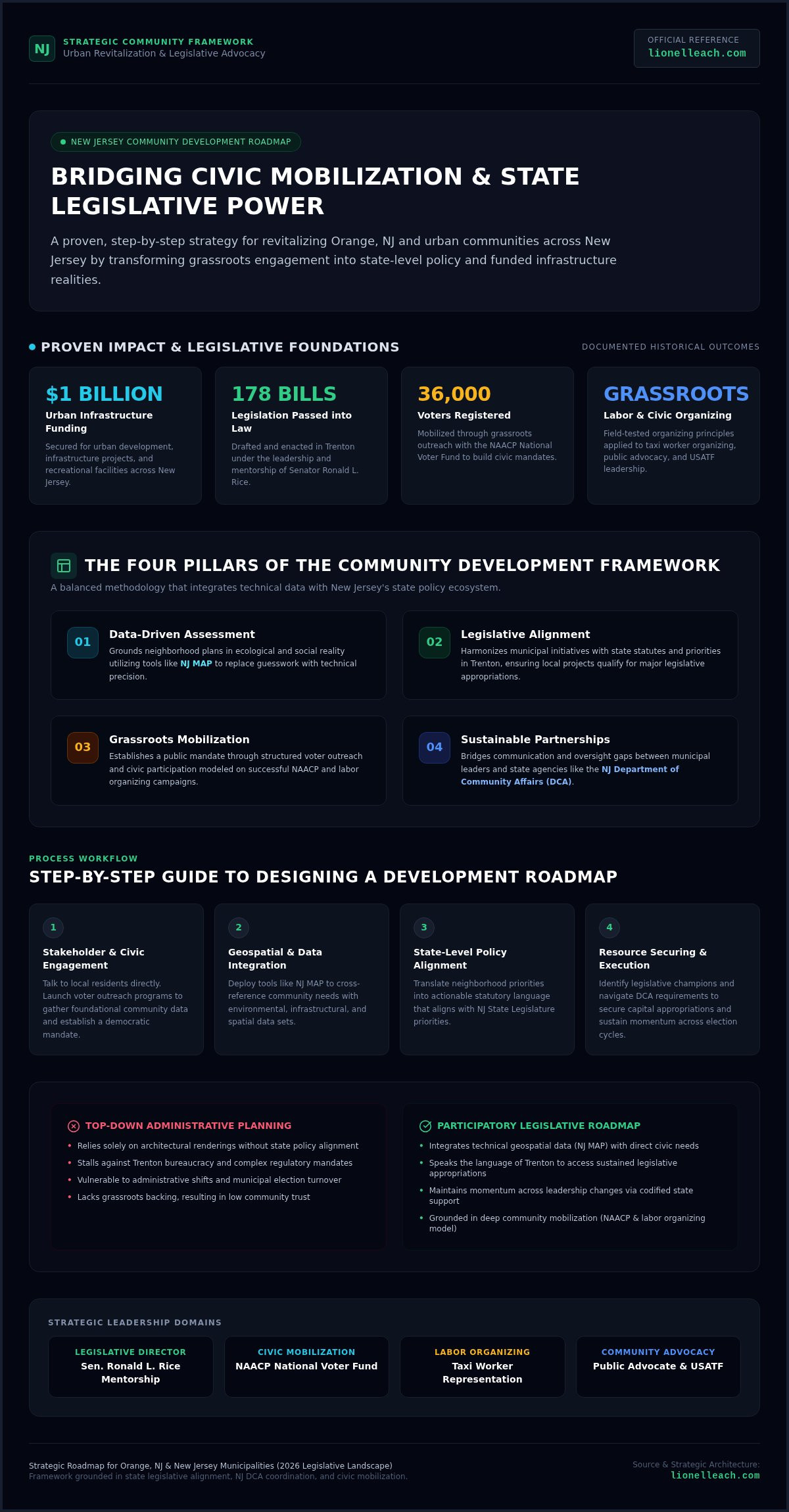
A robust framework rests on data-driven assessment and legislative alignment. Data serves as the first pillar, using tools like NJ MAP to ground plans in ecological and social truth. The second pillar ensures your goals harmonize with the legal frameworks governing our state. This alignment is what allowed me to help draft 178 pieces of legislation signed into law during my career, providing a stable foundation for local initiatives to thrive.
Grassroots and Partnership Models
The third pillar is grassroots mobilization. Building a mandate through voter outreach ensures local buy-in, much like when I helped register 36,000 voters with the NAACP. Finally, sustainable partnership models bridge the gap between state agencies and local stakeholders. These pillars ensure your community development roadmap NJ remains viable through administrative shifts and election cycles, maintaining momentum even as leadership changes.
Legislative Advocacy as a Growth Engine
Securing resources requires identifying legislative champions. My experience with Senator Ronald L. Rice helped us secure $1 billion for infrastructure and recreational facilities in urban areas. This success highlights the difference between tactical lobbying and strategic advocacy. Navigating the New Jersey Department of Community Affairs requires a mentor to bridge the gap between local groups and state officials. Developing a comprehensive community development strategy is the first step toward turning community ideas into funded realities.
A Step-by-Step Guide to Designing Your Development Roadmap
Transitioning from a vision to a tangible result requires a methodical approach. Your community development roadmap NJ begins with Stakeholder Identification and Civic Mobilization. Don't just look at maps; talk to the people. I've found that launching voter outreach programs provides the essential data needed to inform the initial roadmap. This creates a mandate for change that legislative leaders cannot ignore. It's the same principle I applied when registering 36,000 new voters; you build power from the ground up.
Once you have a mandate, move to Needs Assessment and Legislative Alignment. You must map the path from a local idea to a state grant or bill. Tactical Implementation follows, where you deploy advocacy to secure resources and navigate regulatory pitfalls. Finally, use Monitoring and Feedback loops. Continuous voter engagement ensures your strategy adjusts in real-time to the community's evolving needs. This keeps the project grounded in the human element of professional services.
Phase 1: Mobilization and Strategic Goal Setting
Integrating diverse voices into a cohesive vision is the only way to gain support from the State House. You must set "SMART" goals that align with the 2026 NJ legislative calendar for maximum impact. I use my 35 years of government affairs experience to help local leaders move from a reactive posture to a proactive development strategy. This involves ensuring your project fits within the State Development and Redevelopment Plan to align with smart growth frameworks. Whether I'm organizing taxi workers or directing 37 national championships for USATF, the goal is always the same: building a collective victory through disciplined planning.
Securing the Future of Orange Through Strategic Leadership
Building a successful community development roadmap NJ requires more than just good intentions; it demands a fusion of local vision and seasoned legislative strategy. We've explored how data-driven assessments must be paired with grassroots mobilization to build a mandate for change. True revitalization happens when you align your municipal goals with the legislative calendar in Trenton. With over 35 years of experience in government affairs, I've seen this process work firsthand. I've drafted 178 pieces of legislation signed into law and helped secure $1 billion for urban infrastructure and recreational facilities. This level of expertise ensures your community doesn't just plan for the future but actually builds it. Partner with Lionel Leach for your Strategic Community Development Roadmap today and lead your township toward lasting success. Your community's potential is limitless when guided by principled leadership.
Frequently Asked Questions
What is a community development roadmap and why is it important for NJ leaders?
A community development roadmap NJ leaders utilize is a strategic framework that aligns physical infrastructure with legislative policy and civic engagement. It's essential because it transforms reactive planning into a proactive vision. Without this structure, municipalities often struggle with New Jersey's dense regulatory environment. It ensures every project remains a priority in Trenton while addressing the human-centric needs of neighborhoods like Orange.
How does legislative advocacy differ from lobbying in New Jersey?
Legislative advocacy focuses on strategic guidance and policy development to achieve long-term community objectives. Unlike tactical lobbying, advocacy involves navigating government structures to build sustainable partnerships. My work drafting 178 pieces of legislation reflects this principled approach. It's about empowering local voices and ensuring they resonate within the state legislature to drive authentic, ethical revitalization while avoiding the sterile coldness of corporate consulting.
Can a community development roadmap help in securing state grants?
A comprehensive community development roadmap NJ provides the necessary alignment between local needs and state funding priorities. By mapping out specific goals, leaders can identify grant opportunities more effectively. This strategic preparation is how I helped secure $1 billion for recreational and infrastructure facilities in urban areas. A clear roadmap demonstrates to state agencies that your project is ready for immediate, impactful investment.
What role does voter outreach play in a development strategy?
Voter outreach creates the civic mandate required to sustain large-scale development projects. It ensures that a roadmap is built on authentic public consensus rather than top-down mandates. During my time with the NAACP National Voter Fund, we registered 36,000 new voters to amplify their voices. High civic participation rates provide the political leverage needed to secure legislative support and long-term project funding.



Comments