How to Build a Coalition: A Community Advocate's Guide

What if a coalition didn’t need everyone to agree on everything, only a clear purpose they could move forward together? Knowing how to build a coalition starts with that distinction. A shared concern may bring people into the same room, but trust, meaningful participation, and achievable next steps turn a meeting into sustained community action.
I’ve learned this through taxi organizing, public advocacy with the NAACP National Voter Fund, and work across government and community organizations. I worked with Senator Ronald L. Rice since 1992, including 14 years as his Legislative Director. These experiences taught me to listen carefully, respect different priorities, and include the residents most affected by a decision.
In this guide, I’ll share how I turn common concerns into coordinated action, with lessons relevant to Orange, New Jersey. I’ll cover how to define a shared purpose, bring residents and organizations into a credible process, choose realistic actions, and keep people accountable beyond the first meeting.
Table of Contents
How to Build a Coalition Starts with a Shared Community Purpose
I define a coalition as people and organizations coordinating around a shared concern and a goal they can pursue together. It’s more than a list of groups with similar interests. Members need a common direction and a willingness to act. For a broad overview, see What is a Coalition? In my union work, taxi organizing, and public advocacy, I’ve found that naming the purpose first makes it easier to discuss tactics.
A coalition’s common purpose is the work we agree to do together; each member’s individual priorities are the reasons they choose to do it. Those priorities can differ. An organization may focus on community participation, while residents may be concerned about how a decision affects daily life. Shared purpose doesn’t require identical motivations or complete agreement. It does require an honest commitment to a goal members can explain and support.
Choose a purpose that reflects the people most affected
Before inviting people to join, I make the concern specific. What issue are we addressing? Who experiences its effects directly? What would meaningful change look like to them? Clear answers help separate a coalition’s intended result from a broad aspiration and give people a sound basis for deciding whether to take part.
In Orange, NJ, I would begin by listening to affected residents, then bring relevant community organizations, advocates, and public decision-makers into the conversation. Each group may have a different role, but residents most affected by the issue need a meaningful part in shaping the goal, not just an invitation to endorse it. That keeps the coalition’s purpose connected to lived experience and practical possibility.
To test whether the purpose is clear enough to guide action, I’d ask each participant to describe the shared goal in their own words. If their answers point in different directions, I’d keep listening and refine the purpose with them. Before moving on, the group should be able to state what it wants to change, who the change is meant to benefit, and what progress would look like.
How to Build a Coalition: Organize the First Steps into Action
Once the shared purpose is clear, I move from agreement to practical coordination. How to build a coalition becomes easier to answer when people know why they’re being invited, what the group will do first, and who will carry each task forward. I use a simple sequence to turn interest into a working commitment.
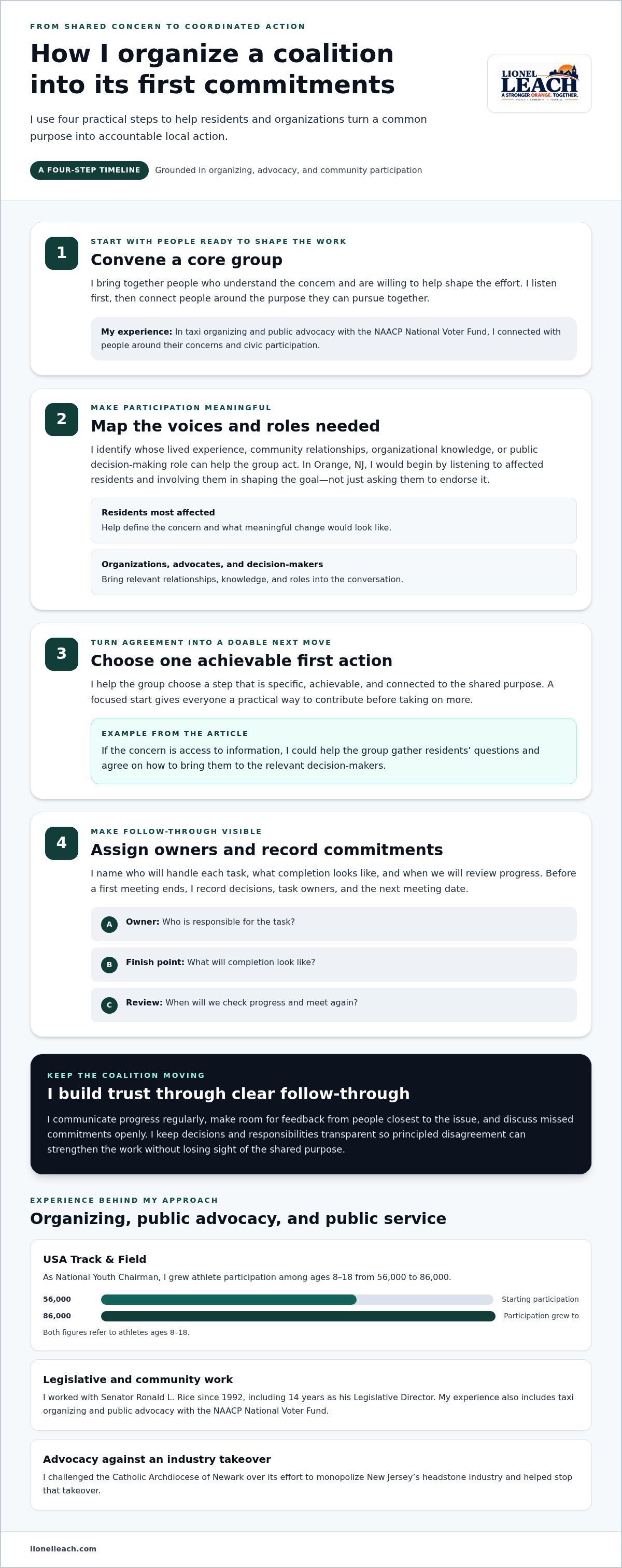
Convene a core group. Bring together people who understand the concern and are willing to help shape the work. In my public advocacy with the NAACP National Voter Fund, outreach meant connecting with people around civic participation. In taxi organizing, it meant listening to workers and bringing their concerns into a shared effort.
Map the participants you need. Identify whose lived experience, community relationships, organizational knowledge, or public decision-making role can help the coalition act. The Strategies for Community-Led Coalitions emphasizes broad engagement and shared decisions, principles I keep in view when planning invitations.
Agree on one first action. Choose a step that is specific, achievable, and connected to the shared purpose. For example, if the group’s concern is access to information, a first step might be to gather residents’ questions and agree on how to bring them to the relevant decision-makers. A focused start gives everyone a practical way to contribute before the coalition takes on more.
Assign owners. Name who will handle each task, what completion looks like, and when the group will review progress. If a task has no owner or a clear finish point, it can easily remain unfinished business.
Make the first meeting produce a shared commitment
I invite each participant with a clear reason for attending and explain the contribution they could make. I set an agenda that defines the issue, makes room for different perspectives, and ends with a decision about one achievable action. Before the meeting ends, I record decisions, task owners, and the next meeting date. In labor advocacy and worker representation and negotiation, I rely on the same discipline: listen, clarify, and make the next step concrete.
That approach can help Orange residents and organizations turn shared concerns into coordinated community development. I bring that perspective to community development strategy in Orange, grounded in advocacy and organizing experience.
How to Sustain a Coalition Through Trust, Accountability, and Local Action
A coalition lasts when participation leads to visible follow-through. I keep responsibilities clear, communicate progress regularly, and make room for feedback from the people closest to the issue. If a commitment slips, I believe the group should discuss it openly, adjust the plan when needed, and agree on the next step. Trust grows when people can see that their time and input matter.
Disagreement is part of collective work. Members may differ on tactics or priorities without abandoning the shared purpose. I encourage coalitions to explain how decisions are made, record commitments, and give members a fair chance to raise concerns. Transparency helps principled disagreement strengthen the work instead of quietly undermining it.
Apply lessons from my organizing and public-service experience
My work with USA Track & Field, taxi organizing, and public advocacy with the NAACP National Voter Fund taught me to connect people around a concern and keep listening. As National Youth Chairman of USA Track & Field, I grew athlete participation from 56,000 to 86,000 (ages 8-18). I also challenged the Catholic Archdiocese of Newark over its effort to monopolize New Jersey’s headstone industry and helped stop that takeover. I learned about government and policy directly from Mayor Sharpe James, Congressman Donald Payne, Assemblyman Tucker, Newark Councilman Branch, Mayor Robert Bowser, and my close mentor, Lt. Governor Sheila Oliver.
In voter outreach, I registered 36,000 new voters for the 2004 election cycle. I helped elect Congresswoman Bonnie Watson Coleman when the rest of my union supported someone else, and Senator Rice sent me to help Derek Armstead become mayor against the Union County Democratic machine. Governor James McGreevey appointed me to the Help America Vote Act (HAVA) Commission. Those experiences reinforced the importance of staying accountable to people, not just institutions.
I lost my mother and Sheila Oliver within 24 hours, then lost Senator Rice within the same four-month span. They were my backbone. Losing them changed my life, and I had to find a way to recover. Today, my work in Irvington Code Enforcement includes developing Section 5 of the Irvington Multifamily Housing receivership program, and I also work in Irvington Economic Development. That practical community development experience informs how I can help Orange build coalitions that sustain local action. For me, how to build a coalition also means staying present after the first agreement, listening, communicating, and following through.
Put a Shared Purpose to Work in Orange
The next step is to bring a real community concern into a conversation where people can shape what happens next. In Orange, I believe public leadership should make room for residents to influence decisions that affect their lives. A coalition can help create that path, but its strength comes from listening, earning trust, and staying accountable to the people it serves.
My perspective comes from 30+ years of work across government, unions, and nonprofit organizations, including legislative leadership, voter outreach, and community advocacy. That work has taught me that how to build a coalition is not only about bringing people together. It’s about helping a shared commitment become lasting, community-led progress.
If you’re considering how to move a local priority forward, explore my community development strategy work. I’m ready to keep working toward a stronger future for Orange, together.
Frequently Asked Questions
How do you build trust between coalition members with different priorities?
I build trust by making room for each member to explain what matters to them and what concerns they bring to the work. If you’re learning how to build a coalition, follow through on small commitments and give credit fairly. In Orange, that can mean listening to residents and organizations separately before asking them to make decisions together.
Can a coalition succeed if members disagree about tactics?
Yes. I look for agreement on the outcome and shared principles, not uniformity on every tactic. Members can discuss the likely benefits and trade-offs of different approaches, then choose a course they can support or agree to revisit. If consensus isn’t possible, I make the disagreement clear rather than presenting one position as everyone’s view.
How can a coalition measure whether its work is making progress?
I set a starting point and choose a few measures tied to the coalition’s goal. These might include whether residents report better access to information, whether a public concern receives a response, or whether a planned community activity reaches its intended audience. I review the measures with participants and adjust them if they don’t reflect meaningful change in Orange.
What should a coalition do when members stop participating?
I’d reach out privately and ask what has changed, without assuming someone has lost interest. Work, family responsibilities, disagreement, or an unclear role can all affect participation. I’d listen, offer a manageable way to rejoin if they want one, and make space for a pause when needed. A coalition stays credible by valuing people, not just attendance.



Comments