Grassroots Voter Outreach Guide for Civic Leaders

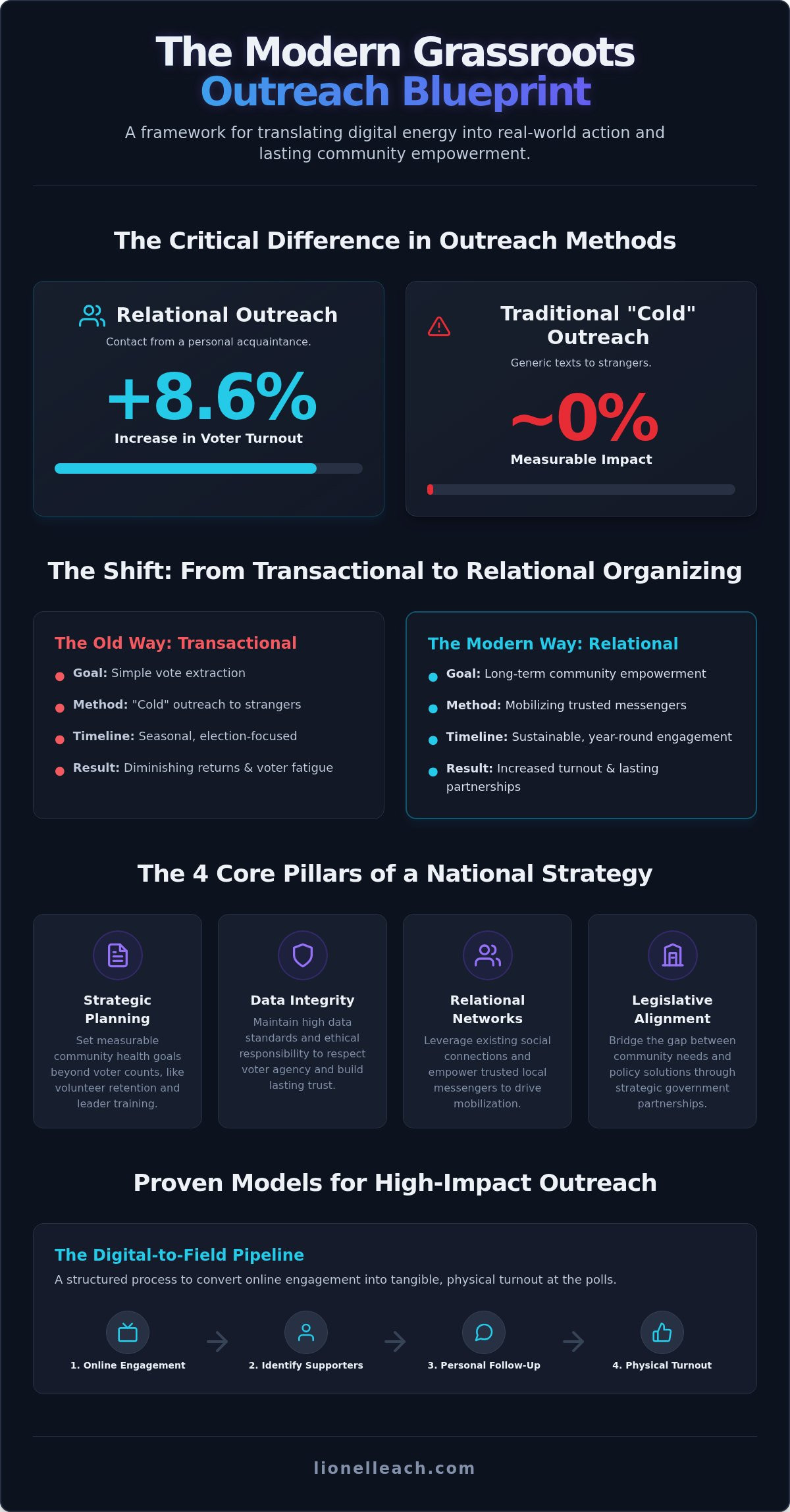
Voters who receive a text message from a personal acquaintance are 8.6% more likely to turn out, yet traditional peer-to-peer texting to strangers often yields no measurable impact at all. This stark reality underscores why effective grassroots voter outreach strategies must evolve beyond simple broadcast messaging and toward genuine relational organizing. Most civic leaders feel the exhaustion of seeing high digital engagement vanish when it's time to actually show up at the polls. It's frustrating to manage a budget that feels spread too thin while watching volunteer enthusiasm wane after the first meeting.
You deserve a framework that translates online energy into physical presence and builds a movement that lasts well beyond a single election cycle. This guide provides the proven frameworks and real-world examples you need to master sustainable outreach, increase turnout for community initiatives, and foster lasting partnerships between residents and leadership. We'll explore how to bridge the gap between digital advocacy and local action through the lens of seasoned, strategic leadership, ensuring your efforts drive the results your community needs for the 2026 midterms and beyond.
Table of Contents
Defining Modern Grassroots Outreach: Beyond Door-Knocking
A Grassroots movement is fundamentally a decentralized, people-powered effort to drive policy change from the bottom up. While many modern organizations view outreach as a logistical hurdle to clear before an election, seasoned leaders understand it as the lifeblood of sustainable civic engagement. Effective grassroots voter outreach strategies aren't just about collecting signatures or checking boxes. They are about building a human-centric foundation where leadership empowers residents to take ownership of their own political futures. This approach requires a shift in perspective; we must move away from the sterile, data-only models of corporate consulting and return to grounded, principled leadership that prioritizes human connection. This human-centric leadership is the necessary foundation for any successful national campaign, as it ensures that the movement remains rooted in the lived experiences of the people it seeks to represent.
To succeed, we must shift our mindset from viewing voter engagement as a seasonal task to seeing it as a form of community development. This perspective fundamentally changes the organizational goal. We aren't just looking for a one-time vote; we are looking to strengthen the social fabric of the neighborhoods we serve. When residents see that their involvement leads to tangible improvements in their daily lives, they move from being passive observers to active participants in the democratic process. This creates a synergy where legislative advocacy and local mobilization work in tandem to produce lasting results.
The Shift from Transactional to Relational Organizing
Traditional "cold" outreach is seeing sharply diminishing returns across the country. Voters have developed a high "spam filter" for generic political rhetoric and unsolicited contact from strangers. Relational organizing offers a more effective path forward for modern grassroots voter outreach strategies. It focuses on leveraging existing social networks to mobilize voters. Instead of a stranger knocking on a door, a trusted neighbor initiates the conversation. These trusted messengers are the key to overcoming voter apathy; they provide a layer of credibility and personal connection that no digital ad can replicate.
The Strategic Importance of Civic Participation Programs
Formal civic participation programs are essential for building a "bench" of future advocates and leaders. These programs provide a structured environment where residents can learn the nuances of legislative advocacy and community organization. By focusing on the human element, these initiatives transform individual voters into a collective force for change. Long-term engagement reduces the cost of voter acquisition by creating a self-sustaining cycle of participation that doesn't need to be rebuilt from scratch every two years. This synergy between community development and sustainable political influence ensures that your organization remains a powerful voice in government partnerships for decades to come.
The Core Pillars of a National Grassroots Strategy
Building a national movement requires more than passion; it demands a structured framework that balances digital tools with a deep-rooted community presence. Successful grassroots voter outreach strategies rest on four core pillars: Strategic Planning, Data Integrity, Relational Networks, and Legislative Alignment. While digital platforms offer unprecedented efficiency, they can never replace the gravitas of a principled leader standing in a local community center. Integrity and ethical responsibility are non-negotiable in this work. Leaders must ensure that every interaction respects the voter's agency and privacy, fostering a culture of trust that lasts long after the ballots are counted.
Aligning local goals with state or federal policy is where many organizations falter. This is where government partnership advisory becomes essential. It bridges the gap between what a neighborhood needs and what a legislative bill can actually deliver. By integrating these perspectives early, leaders can ensure their movement isn't just loud, but effective in creating systemic change. This deliberate approach transforms a collection of voices into a cohesive force for progress.
Strategic Planning for Community Leaders
Effective planning goes beyond a simple voter count. It requires setting measurable goals that reflect the health of the community, such as volunteer retention rates or the number of new local leaders trained. Integrating legislative objectives into the early stages of community mobilization ensures that every door knocked serves a larger policy purpose. A multi-year roadmap is far superior to a frantic 90-day campaign sprint. It allows for the deliberation and careful planning necessary to build lasting power. For those seeking to refine these long-term goals, professional strategic advisory can provide the seasoned perspective needed to navigate complex political cycles.
Data-Driven Insights with a Human Touch
Modern grassroots voter outreach strategies rely on using data to identify outreach deserts. These are areas where civic engagement has historically been low. However, data should illuminate the path, not replace the person. Building trust through transparency and privacy is paramount. When voters know their information is handled with integrity, they're more likely to engage. We must train volunteers to collect qualitative community feedback. A resident's story about local infrastructure is often more valuable than a yes or no on a canvassing app. These insights reflect the true sentiment of the electorate, which is a key component in 10 strategies to boost voter turnout and engagement in modern elections. By combining hard numbers with human stories, your strategy becomes both scalable and sincere.
Proven Examples of High-Impact Outreach Methods
High-impact grassroots voter outreach strategies succeed when they move beyond theory and into the practical application of community power. We've seen that the most effective models bridge the gap between local sentiment and national policy by empowering the people already present in the neighborhood. One such approach is the 'Digital-to-Field' pipeline. This strategy converts social media supporters into active legislative advocates. While text message volume from advocacy groups grew by 41.8% recently, action rates actually fell to 1.14%. This data suggests that digital noise isn't enough. We must move supporters from clicking a button to attending a town hall or participating in a community development strategy session.
The Relational Hub Model in Action
The Relational Hub model focuses on identifying and training 'super-volunteers' within existing community structures. These are the individuals people already turn to for advice, such as faith leaders or local organizers. To implement this, you first identify these natural nodes of influence. Training should move beyond rigid scripts. Instead, provide these leaders with the strategic guidance they need to remain autonomous yet aligned with the broader mission. This autonomy is a cornerstone of successful grassroots voter outreach strategies, as it fosters deep civic pride and significantly improves long-term voter retention. When a trusted neighbor leads the conversation, the engagement feels like a community service rather than a political intrusion.
Cross-Sector Coalition Building
Building a movement often requires aligning diverse groups, such as labor unions, non-profits, and local businesses, around a single policy objective. Navigating the hurdle of 'competing interests' is a delicate task that often requires professional advisory to find a common denominator. A unified voice is far more persuasive when engaging with federal government structures. For example, a broad coalition advocating for local infrastructure can present a more compelling case for national-level policy changes by demonstrating widespread economic impact across different sectors. This synergy between various community stakeholders creates a powerful, undeniable mandate for change.
Consider the archetype of a community-led initiative that successfully influenced national policy. By uniting local residents with government partnership advisory experts, a coalition can draft legislative proposals that address specific local grievances while fitting into a broader federal framework. This bottom-up approach ensures that the resulting policy is both practical and sustainable. It's a testament to the fact that when community members are treated as partners rather than just data points, the impact of their outreach can reach the highest levels of government.
Overcoming Strategic Hurdles in Voter Engagement
The most daunting obstacle in modern mobilization isn't a lack of technology; it's a profound lack of trust. Many residents feel the legislative process is a closed room where their voices are muffled by bureaucracy. Overcoming this requires a commitment to transparency that most seasonal campaigns ignore. When we implement grassroots voter outreach strategies, we must address the reality of voter fatigue. In a non-stop news cycle, people are overwhelmed by constant requests for attention. Successful leaders manage limited resources by prioritizing high-impact engagement windows rather than shouting into the void year-round. Most importantly, we must "close the loop." If a resident participates in a town hall or signs a petition, they must see the direct result of that action. Showing them how their participation led to a specific policy shift builds the credibility necessary for future engagement.
Building Trust in Government Systems
Demystifying the legislative process is a core responsibility of civic leadership. We use legislative advocacy as a tool for community education, breaking down complex procedures into actionable steps for the average citizen. This transparency transforms the government from an abstract entity into a partner for progress. Consistent community presence far outweighs the efficacy of seasonal campaign blitzes that disappear once the polls close. By remaining grounded in the neighborhood, we prove that our commitment is to the people, not just the ballot box. This steady leadership fosters a sense of security and encourages residents to take an active role in shaping their environment.
Scaling Outreach on a Limited Budget
Efficiency is paramount when outreach budgets are tight. Relational organizing offers a powerful "multiplier effect" that paid media simply cannot match. While digital advertising costs fluctuate, with Facebook CPMs typically falling between $7 and $15 as of 2026, the cost of empowering a volunteer to speak with their own social circle remains remarkably low. Data confirms that voters contacted by someone they know are 8.6 to 17.1 percentage points more likely to turn out. We prioritize geographic and demographic "swing" areas through strategic analysis, ensuring every hour of volunteer time is spent where it can do the most good. For organizations looking to maximize their impact, a voter outreach program designed by seasoned experts can turn a limited budget into a sustainable movement.
Scaling Your Impact through Strategic Advisory
Many grassroots organizations reach a plateau where their local energy fails to influence broader policy. This gap often exists because the group lacks a seasoned mentor who understands the nuances of both community organizing and high-level negotiation. While software can manage a mailing list, it cannot provide the strategic foresight needed to turn a collection of volunteers into a legislative powerhouse. Effective grassroots voter outreach strategies require a bridge between the immediate needs of a neighborhood and the complex mechanisms of government. Mastering these strategies involves more than just door-knocking; it's about aligning those front-line efforts with a cohesive legislative vision.
Lionel Leach brings over 35 years of experience in legislative advocacy and community development to this specific challenge. His background navigating federal, state, and local government levels allows him to provide a unique lens for national outreach programs. This isn't just about winning an election; it's about building a sustainable infrastructure of power that remains relevant long after the campaign signs are taken down. Transitioning from a volunteer group to a sophisticated advocate for change requires the steady hand of someone who has drafted successful legislative bills and understands how to facilitate government partnerships.
The Value of Seasoned Legislative Mentorship
An expert advisor identifies policy opportunities that grassroots leaders might miss in the heat of a campaign. For example, a local initiative regarding housing might have a direct path to federal funding through a specific legislative bill that isn't yet on the community's radar. Developing the gravitas needed to represent community interests at the federal level takes time and experience. A trusted advisor understands both the "streets" and the "boardroom," ensuring that the community's voice is not only heard but respected by policy makers. This dual perspective is essential for scaling impact without losing the authentic, human-centric heart of the movement.
Designing Your Custom Outreach Roadmap
The transition to a sophisticated advocacy force begins with a comprehensive audit. This process evaluates your current community development and voter outreach programs to identify strengths and strategic gaps. You should expect a roadmap that outlines clear, measurable milestones for growth and legislative alignment. Engaging professional advisory isn't about surrendering local control. It's about equipping your organization with the tools and mentorship required to navigate complex political cycles with confidence. If you're ready to elevate your organization's influence, you can contact Lionel Leach to design your strategic outreach program today. This collaborative approach ensures your movement is built on a foundation of integrity and long-term impact.
Empowering the Future of Community Leadership
Real impact in civic engagement isn't measured by a single election day turnout; it's defined by the strength of the relationships built along the way. By shifting from transactional canvassing to relational organizing and maintaining high data integrity, you create a foundation for lasting change. These grassroots voter outreach strategies succeed when they're rooted in authentic presence and a clear understanding of the legislative process.
Navigating the complexities of federal and state policy requires more than just enthusiasm. It demands the steady hand of a seasoned advocate who understands how to bridge the gap between local needs and government action. With 35 years of legislative experience as a nationally recognized community advocate, Lionel Leach provides the strategic mentorship needed to transform your organization into a legislative powerhouse. Partner with Lionel Leach for Strategic Outreach Advisory to design a program that delivers measurable results and sustainable growth. Your commitment to your community is the first step toward a more engaged and empowered future.
Frequently Asked Questions
What is the most effective way to reach young voters in 2026?
The most effective way to reach young voters in 2026 is through authentic, mobile-first content delivered by trusted social media creators. Traditional broadcast media often fails to resonate with Gen Z and Millennials, who prioritize sincerity over high production value. Utilizing short-form video and personalized text messaging allows for a more direct connection. It's essential to comply with 10DLC registration requirements for all automated texting to ensure messages reach their intended recipients without being filtered as spam.
How do grassroots strategies differ from traditional political campaigning?
Grassroots strategies prioritize a bottom-up, decentralized approach that empowers local residents to take ownership of policy change. Traditional political campaigning often relies on top-down, transactional methods like cold outreach and mass media buys. While traditional campaigns focus on immediate vote extraction, modern grassroots voter outreach strategies aim to build sustainable community power. This method fosters long-term civic engagement by treating voters as partners in the democratic process rather than just data points on a spreadsheet.
Can relational organizing be scaled to a national level?
Relational organizing can be scaled to a national level by implementing a Relational Hub model. This involves identifying and training local leaders who manage their own social networks. By providing these leaders with strategic guidance and digital tools, organizations can expand their reach across the country without losing the personal touch. This decentralized approach ensures that the message remains grounded in local reality while contributing to a unified, national movement for policy change.
What role does data play in a grassroots outreach strategy?
Data serves as a roadmap to identify geographic and demographic outreach deserts where civic engagement is historically low. It allows leaders to allocate limited resources more efficiently by prioritizing high-impact areas. However, data should never replace the human element of grassroots voter outreach strategies. We use data to inform who we speak to, but the focus remains on collecting qualitative feedback and building genuine trust through transparent and ethical information management.
How do you measure the success of a civic participation program?
Success is measured by metrics that go beyond a simple head count on election day. Effective programs track volunteer retention rates and the number of new community leaders who have been successfully trained for advocacy. We also evaluate the program's ability to align local mobilization with specific legislative goals. These programs aim to build a bench of future leaders, creating a self-sustaining cycle of civic participation that strengthens the community for the long term.
What is the difference between legislative advocacy and lobbying?
Legislative advocacy focuses on community education, strategic advisory, and mobilizing the public to participate in the democratic process. It aims to demystify government systems so residents can represent their own interests effectively. In contrast, lobbying often involves direct attempts to influence specific legislation on behalf of an organization. While advocacy empowers the collective to drive change, it doesn't include legal representation or lobbying registration services, which are distinct professional categories with their own regulatory requirements.
How can small non-profits compete with large-scale voter outreach programs?
Small non-profits can compete by leveraging the multiplier effect of relational organizing, which is often more effective than expensive paid media. While large-scale programs might have bigger budgets for digital ads, local organizations possess a higher level of community trust and trusted messengers. By focusing on deep, authentic engagement rather than broad broadcast messaging, smaller groups can achieve higher turnout rates. Strategic planning and professional advisory help these organizations maximize their impact by identifying high-value policy opportunities.
Why is government partnership advisory important for local community groups?
Government partnership advisory is vital because it bridges the gap between local community needs and the complex requirements of state or federal policy makers. This advisory ensures that grassroots energy is translated into practical legislative proposals that can actually be implemented. By facilitating these partnerships, local groups move from being outside protesters to becoming recognized stakeholders in the policy-making process. This strategic alignment is necessary for achieving the long-term, sustainable growth that community leaders desire.



Comments