Equity in Community Development: A Guide for Orange, NJ

What if a development decision could be measured not only by what gets built, but by whether the people most affected helped shape it? Ensuring equity in community development starts with listening, then carrying residents’ priorities into policy, public resources, and accountable action.
I know residents can feel shut out when plans for their neighborhoods move forward without meaningful input. In this guide, I’ll explain practical ways to include affected residents and connect community priorities with advocacy and government processes. I’ve worked with Senator Ronald L. Rice since 1992, including 14 years as his Legislative Director. I’ve also served as a public advocate for the NAACP National Voter Fund and organized taxi drivers. I draw on that experience, along with my current work in Irvington housing and economic development, to help advance community-led outcomes for Orange.
Table of Contents
What Ensuring Equity in Community Development Means for Orange, NJ
Orange residents deserve to know whose needs are shaping decisions about their neighborhoods. A plan can promise broad benefits and still leave people unheard if those affected have little chance to influence it. Ensuring equity in community development means making participation accessible, considering local needs, and holding decision-makers accountable for what happens next.
I see community development as more than changing places. It should connect residents’ priorities with public decisions and resources, while recognizing that people may face different barriers to being heard. The Community Development Principles offer background on the field’s goals and values.
For a further perspective on equity in community development, watch this video:
How is equity different from treating every community the same?
Equal treatment can mean offering everyone the same meeting time, information, or way to participate. Equity asks whether those choices give affected residents a fair chance to take part. People need a practical way to understand a proposal and share their views. Decision-makers should hear from people who will live with the outcome, not only from those already closest to the process.
Equitable development means letting affected residents help shape decisions, considering their differing needs, and being accountable for the results. That principle does not prescribe one solution for every Orange project. I would begin by identifying who is affected, what could make participation difficult, and how residents’ input can inform the decision. I would also make the follow-up clear: what was heard, what action followed, and what still needs attention. This is how community voice can become part of public action rather than a one-time conversation.
How I Would Put Equity into a Community Development Process
Meaningful participation needs a clear path from residents’ concerns to public decisions. My experience in labor advocacy, taxi organizing, and voter outreach has taught me to listen closely, recognize whose voices may be missing, and make next steps understandable. As a public advocate for the NAACP National Voter Fund, I worked to engage voters. Organizing taxi drivers also showed me the value of hearing directly from people whose work and livelihoods are affected by decisions.
I would use a practical sequence:
Identify affected voices. Consider who may experience the consequences of a proposed development decision, including residents and workers.
Listen and record concerns. Keep a clear record of what people say, including concerns that are less common or harder to address.
Clarify priorities. Separate shared concerns from differing needs so neither gets lost.
Connect priorities to policy. Identify which concerns can inform public decisions, advocacy, or discussions about resources.
Report back. Explain what advanced, what did not, why, and what happens next.
How can resident input become a transparent development priority?
I would organize feedback by issue, note which concerns recur and which reflect distinct needs, then explain how those priorities connect to the relevant public discussion or decision. This makes it possible to show residents how their input informed the conversation without promising that every request will be adopted. Follow-through matters: people deserve a plain account of decisions, constraints, and what remains unresolved.
Meaningful participation becomes credible when residents can see what happened to the input they shared. This is the standard I bring to community development and worker advocacy in Orange. My community development and labor advocacy work connects people’s concerns with public action.
How My Public-Service Experience Can Support Equitable Development in Orange
I bring experience in legislation, labor, voter outreach, and community development to questions about how public decisions affect people’s lives. In Orange, I can help connect residents’ priorities with policy discussions and keep attention on who benefits from development decisions. My current municipal work in Irvington gives me a practical perspective on housing and economic development that I can bring to conversations about Orange.
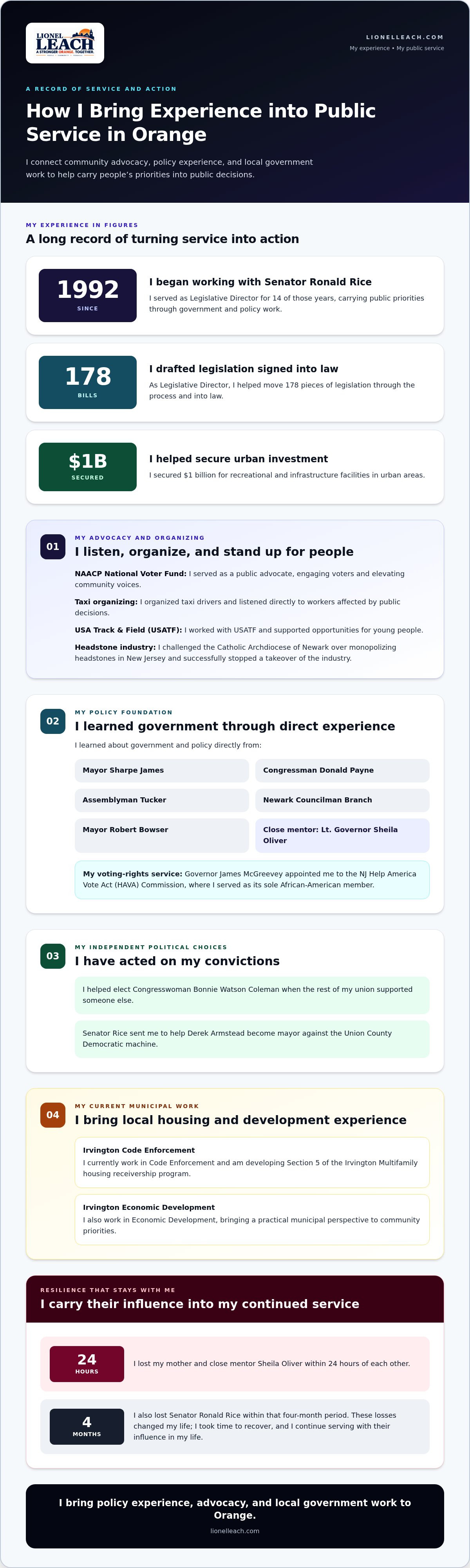
As Legislative Director for Senator Ronald L. Rice, I drafted 178 pieces of legislation signed into law by the Governor of New Jersey and secured $1 billion for recreational and infrastructure facilities in urban areas. I worked with Senator Rice since 1992. That experience taught me how to carry concerns through government processes and keep public priorities in view.
What experience shapes my approach to fair community outcomes?
Governor James McGreevey appointed me to the NJ Help America Vote Act Commission, where I served as its sole African-American member. My work with USA Track & Field showed me the value of creating opportunities for young people. I learned about government and policy from Mayor Sharpe James, Congressman Donald Payne, Assemblyman Tucker, Newark Councilman Branch, and Mayor Robert Bowser. Lieutenant Governor Sheila Oliver was a close mentor.
I’ve also made difficult political choices. I helped elect Congresswoman Bonnie Watson Coleman when the rest of my union supported someone else. Senator Rice sent me to help Derek Armstead become mayor against the Union County Democratic machine. Those experiences taught me to stay grounded in my convictions, even when taking an independent path.
My mother and Sheila Oliver, two people who were my backbone, died within 24 hours of each other. Senator Ronald Rice also died within that four-month period. Those losses changed my life, and recovering from them took time. I carry their influence with me as I continue serving. I currently work in Irvington Code Enforcement, developing Section 5 of its multifamily housing receivership program, and in Irvington Economic Development.
Carry Community Priorities into the Next Decision
In Orange, residents’ priorities need to stay part of the conversation as plans develop, not only when a proposal is first introduced. Ensuring equity in community development takes steady attention: identify who is affected, make room for their perspectives, and keep public discussion connected to decisions as they move forward.
My experience across government, labor, voter outreach, and community organizations informs how I approach this work. I can help Orange residents and community groups turn concerns into clear priorities that can be carried into public discussions and considered through policy processes. Progress takes partnership, patience, and engagement beyond a single meeting.
Explore my community development strategy and bring your priorities into the conversation about Orange’s future. I’m ready to work with residents and community groups to connect local concerns with public action.
Frequently Asked Questions
Is equity in community development the same as equality?
No. Equality focuses on offering the same treatment or opportunity, while equity considers whether people can use that opportunity and take part meaningfully. One meeting format may be open to everyone but still make participation difficult for some residents. In Orange, I would consider whether the ways to share input let affected people contribute and whether public decisions take their concerns into account.
Can community development equity be measured with one number?
No single number can capture the full picture. For an Orange project, I would look at separate indicators: whether residents can access project information, whose views appear in the record, and whether public explanations address those views. These indicators can reveal gaps, but they cannot prove fairness on their own. Ensuring equity in community development means explaining what each measure shows and what it leaves out.
What can residents do when their community input receives no response?
Residents can make concerns easier to track by noting the project they relate to, keeping copies of what they shared, and asking for a clear update through the relevant public process. I encourage people to coordinate with neighbors when they share related concerns. A response may not mean every request is adopted, but residents can ask decision-makers to explain what they considered and what happens next.



Comments