Effective Community Outreach Methods: A Strategic Framework for Impact

What if the traditional "louder is better" approach to community engagement is actually the primary reason your message isn't being heard? Many organizations find themselves trapped in a cycle of low engagement and rising skepticism, where traditional tactics fail to break through the noise. When you're facing deep-seated distrust from the public or struggling to turn conversations into legislative action, it's clear that standard tactics aren't enough. Mastering effective community outreach methods requires more than just a megaphone; it demands a principled, strategic framework that aligns community needs with institutional goals.
You likely understand that genuine connection is the foundation of any successful initiative, yet bridging the gap between a good idea and a policy win remains a complex challenge. We've designed this guide to help you navigate the nuances of mobilization, providing a clear roadmap for high-impact engagement that influences policy and drives growth. We'll examine how to cultivate stronger partnerships between stakeholders and government while ensuring your efforts translate into measurable results. By the end of this article, you'll have the tools to transform your outreach from a series of isolated events into a cohesive strategy for lasting civic change.
Table of Contents
Defining Strategic Community Outreach in the Modern Era
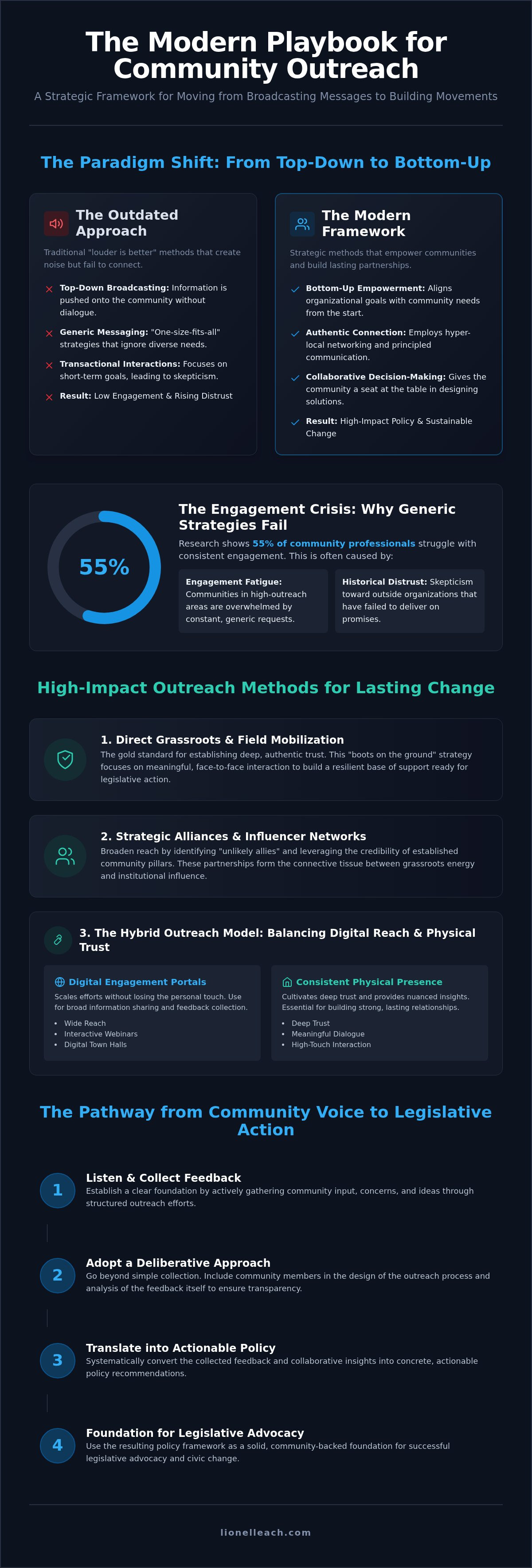
Strategic community outreach is the bridge between an organization's mission and the lived reality of the people it serves. It's no longer enough to simply broadcast a message; you must foster a genuine exchange. To understand What is Community Outreach? in a modern, professional context, one must view it as a purposeful process of connecting with a specific demographic to achieve shared goals. This represents a fundamental shift from "top-down" information sharing to "bottom-up" community empowerment. In 2026, traditional tactics like generic flyers or cold-calling are losing their effectiveness because they ignore the human element of trust. People don't want to be talked at; they want to be heard.
The Evolution from Information to Engagement
The distinction between passive awareness and active mobilization is the hallmark of effective community outreach methods. Passive awareness might inform the public, but mobilization inspires them to take ownership of a cause. Modern communities demand transparency and a seat at the table. They're looking for collaborative decision-making rather than being told what's best for them. This shift requires a leader who understands the human element of professional services. By utilizing mission-driven communication, an organization establishes authority while remaining grounded in service. This approach builds the sustainable civic participation needed to influence policy and drive long-term growth. It's about moving from being an outside observer to becoming a trusted partner within the community fabric.
Why Generic Outreach Strategies Fail
The "one-size-fits-all" trap is a common pitfall in diverse community landscapes. Research indicates that 55% of community professionals struggle with consistent engagement; this is often due to "engagement fatigue" in high-outreach areas. People are overwhelmed by noise and often harbor distrust toward outside organizations. Successful programs prioritize data-driven audience segmentation before launching. They understand that a message resonating with one group may alienate another. Without this deliberation, outreach efforts become sterile and transactional. True impact requires a nuanced understanding of negotiation and organizational dynamics. You must ensure that every interaction feels authentic and principled. By identifying specific community needs first, you can tailor your effective community outreach methods to provide real value rather than just another interruption in a busy day.
High-Impact Community Outreach Methods for 2026
Building on the foundational shift toward community empowerment, the most effective community outreach methods in 2026 prioritize depth over breadth. Impactful mobilization requires a sophisticated mix of traditional field work and modern digital dialogue. It's about creating a presence that is both felt and heard. To achieve this, organizations must move beyond simple visibility and focus on building layers of trust that can withstand the pressures of complex policy negotiations.
Direct Grassroots and Field Mobilization
Direct field mobilization remains the gold standard for establishing trust. A successful "boots on the ground" strategy focuses on meaningful face-to-face interaction. Training local advocates to serve as trusted messengers is vital; they bridge the gap between organizational goals and community concerns. Through systematic canvassing and meetings, you build a resilient base of support that's ready to act when legislative opportunities arise. This high-touch approach ensures your message is actually received and understood by the people who matter most.
Strategic Alliances and Influencer Networks
Broadening your reach requires identifying "unlikely allies" who share a common interest in community well-being. By leveraging the credibility of established community pillars, you validate your message and bypass skepticism. Developing a comprehensive community development strategy involves creating collaborative government partnerships. These alliances serve as the connective tissue between grassroots energy and institutional influence, ensuring that local voices are reflected in final policy decisions.
While physical presence is essential, digital town halls and interactive webinars allow you to scale your efforts without losing the personal touch. Research indicates that 76.9% of community professionals believe events drive the most meaningful participation. These digital platforms should be conversational, moving away from one-way broadcasting. Integrating these tools into broader programs helps increase long-term civic literacy. When community members understand the mechanics of participation, they're more likely to engage consistently. This holistic approach ensures your effective community outreach methods aren't just a temporary campaign, but a sustainable movement toward collective progress.
Voter outreach programs play a critical role in this framework by fostering long-term civic habits. It's not just about a single election or policy vote; it's about helping community members understand how to navigate government systems effectively. When people feel equipped with knowledge, their participation becomes a steady contribution rather than a one-time event. This sustained engagement is what eventually leads to the drafting of successful legislative bills and lasting community impact. By investing in the education of the community, you're building a foundation for future advocacy that is both informed and resilient.
Evaluating Outreach Channels: Digital vs. Physical Models
Choosing between digital and physical outreach isn't a binary decision; it's a strategic calculation. The most effective community outreach methods today utilize a hybrid model that marries the expansive scale of digital tools with the deep, visceral trust of physical presence. While digital channels can disseminate information to thousands in seconds, physical interactions remain the primary vehicle for changing hearts and minds. Large-scale programs often fail when they rely too heavily on one or the other. A balanced approach ensures you're meeting community members where they are, whether that's on their smartphones or in a neighborhood community center.
Leveraging Digital Platforms for Civic Engagement
Digital outreach has evolved beyond simple social media posts. Dedicated engagement portals now offer structured ways for citizens to participate in policy discussions. This is particularly effective for reaching younger demographics. For example, 73% of Gen Z discovers new content through social media, making a mobile-first strategy essential for capturing their attention. Member participation in online communities climbed 40% in 2025, suggesting that people are increasingly comfortable with digital-first civic participation. However, digital success requires more than just visibility. You must use targeted messaging to reach specific demographic segments while maintaining rigorous data privacy standards. Protecting community data isn't just a legal requirement; it's a foundational element of organizational trust.
The Power of In-Person Community Forums
Despite the rise of digital tools, the psychological impact of physical presence cannot be overstated. Traditional town halls and community forums remain indispensable because they offer a "safe space" for genuine dialogue. When leaders show up in person, it signals respect. It demonstrates a willingness to listen to objections. Designing these forums to encourage two-way conversation rather than scripted presentations is key to building long-term loyalty. Physical forums allow for the nuanced negotiation and human connection that digital screens often filter out. This grounded approach ensures that your advocacy feels authentic rather than transactional.
Analyzing Channel Efficiency
A professional cost-benefit analysis reveals that while digital channels have a lower cost-per-contact, physical outreach often yields a higher rate of meaningful participation. Digital platforms are excellent for top-of-funnel awareness and data collection. Conversely, in-person methods are superior for converting that awareness into sustained civic action. By integrating traditional approaches like mailers with digital channels like webinars, you create a multi-touchpoint journey. This ensures your effective community outreach methods are both fiscally responsible and strategically sound, leading to stronger partnerships between stakeholders and government.
Building a Sustainable Framework for Community Trust
Trust isn't bought. It's earned through consistent, principled action. While the right channels are necessary, they're merely vessels for the relationship you build with the public. To implement effective community outreach methods that last, you must address the historical friction and systemic barriers that often keep people at a distance. This requires a shift from vanity metrics, such as attendance numbers or social media impressions, toward impact-based KPIs that measure actual policy influence and community sentiment. Sustainable trust is built when community members see that their input leads to tangible changes in their daily lives.
A deliberative approach is essential for this level of depth. Rather than presenting a finished plan, involve the community in the design phase of the outreach itself. This creates a sense of shared ownership and ensures the program is culturally and linguistically relevant. When people feel like partners instead of targets, their engagement becomes more resilient and meaningful. For those looking to scale their impact, a comprehensive community development strategy provides the necessary structure to turn this trust into tangible results.
Removing Barriers to Participation
Inclusive outreach demands a proactive effort to identify and neutralize hurdles before they stifle engagement. This involves offering materials in multiple languages, ensuring all meeting spaces are physically accessible, and providing childcare or transportation when necessary. Simplifying complex bureaucratic processes is equally important; civic entry should be intuitive, not exhausting. Barrier removal is the intentional practice of identifying and neutralizing the social, physical, and linguistic obstacles that prevent marginalized voices from engaging in civic life. By lowering these hurdles, you invite a broader spectrum of the community to participate in the democratic process.
Establishing Professional Gravitas and Integrity
Principled leadership is the magnet that attracts long-term community partners. In the complex world of effective community outreach methods, your integrity is your most valuable asset. This means maintaining ethical responsibility even when negotiations between community groups and government stakeholders become difficult. A seasoned mentor understands that negotiation is not about winning a single point; it's about preserving access and influence for the collective good. Steady, transparent leadership ensures that your organization remains a trusted advisor through shifting political climates. When you prioritize the human element of professional services, you build a reputation that opens doors and simplifies future mobilization efforts.
Connecting Community Voice to Legislative Advocacy
The true measure of effective community outreach methods is their ability to transform raw public sentiment into lasting policy change. Outreach shouldn't be viewed as an isolated activity; it's the essential foundation of a successful legislative advocacy strategy. When an organization successfully mobilizes a community, it creates more than just noise. It generates the political capital and data-backed evidence needed to influence decision-makers at every level of government. By bridging the gap between what people need and what the law allows, you move from simple engagement to systemic impact.
From Grassroots Feedback to Policy Design
Translating a thousand individual voices into a single, unified legislative agenda requires a disciplined approach to synthesis. You must identify the common threads within community feedback and weave them into a coherent policy framework. This process ensures that your proposals aren't just theoretically sound but are deeply rooted in the lived experience of the people they affect. When decision-makers see a community-driven framework, they recognize it as a mandate rather than a mere suggestion. Community mobilization translates raw public sentiment into the specific, data-backed evidence required to inform and justify the formal drafting of legislative bills. This alignment ensures that the resulting policy is both practical and politically resilient.
Strategic Advisory: Scaling Your Outreach Impact
There comes a point where self-managed outreach reaches its limit, and professional government partnership advisory becomes necessary to scale your impact. Navigating the complex structures of federal, state, and local government requires a seasoned mentor who understands the nuances of negotiation. A strategic advisor helps you identify the right windows of opportunity to present community findings to legislators. This high-level guidance ensures that the energy generated at the grassroots level isn't wasted on procedural hurdles. It's about moving with deliberation and purpose to ensure your community's voice is heard in the rooms where decisions are made.
Closing the loop is the final, critical step in maintaining the trust you've worked so hard to build. Once a legislative win is secured, you must report that victory back to the community with transparency. Explain how their participation led to specific changes in the law or local policy. This reinforcement proves that their time and effort were not in vain, creating a cycle of sustained civic participation. By demonstrating that effective community outreach methods lead to real-world results, you solidify your role as a trusted leader and prepare the community for the next challenge. This steady, principled approach turns a single campaign into a sustainable movement for growth.
Transforming Engagement into Lasting Policy Change
Mastering a hybrid approach that combines digital scale with the deep trust of physical presence is no longer optional. It's the foundation of sustainable impact. By removing systemic barriers and adopting a deliberative framework, you ensure that every community voice is not only heard but valued. These effective community outreach methods serve as the essential bridge between grassroots energy and the formal halls of government, turning raw public sentiment into actionable policy and measurable growth.
Navigating these complexities requires a steady hand and a deep understanding of organizational dynamics. With over 35 years of leadership in government affairs, Lionel Leach provides the strategic advisory needed to scale your impact. From navigating complex government structures to building proven voter outreach programs, his expertise helps you translate community needs into successful legislative bills. Partner with Lionel Leach for your Strategic Community Development and Advocacy needs to ensure your mission achieves its full potential. Your dedication to the collective good deserves a strategy that delivers results. Let's build a stronger, more engaged future together.
Frequently Asked Questions
What is the most effective method for reaching a community with high distrust?
The most effective way to engage a community where distrust is high is through direct, face-to-face grassroots mobilization. You should prioritize identifying and training trusted local messengers who already possess the community's confidence. This "boots on the ground" approach focuses on listening first rather than broadcasting a message. By utilizing these effective community outreach methods, you demonstrate respect for local concerns and build a foundation of sincerity that digital-only campaigns often fail to establish.
How do you measure the success of a community outreach program?
Measuring success requires moving beyond vanity metrics like social media impressions or event attendance. You should focus on impact-based KPIs such as increased civic participation, the formation of new stakeholder partnerships, and tangible progress in legislative advocacy. Successful programs track how community feedback directly informs policy recommendations. By analyzing these deeper shifts in engagement and influence, you can determine if your efforts are driving sustainable growth or simply generating temporary noise.
What is the difference between community outreach and public relations?
While public relations often focuses on managing an organization's image through one-way communication, community outreach is a purposeful, two-way process. Outreach aims to achieve shared goals through active collaboration and community empowerment. It involves a deeper level of engagement where the community participates in the design of the initiatives themselves. This principled approach prioritizes long-term relationships and ethical responsibility over the fleeting trends often associated with traditional corporate marketing or PR tactics.
Can community outreach influence state or federal legislation?
Community outreach is the essential foundation for influencing state and federal legislation. Effective mobilization creates the political capital and data-backed evidence that strategic advocates need to negotiate with decision-makers. When you translate raw public sentiment into unified policy frameworks, you provide legislators with a clear mandate for change. This strategic intersection of outreach and advocacy is how successful legislative bills are drafted and eventually passed into law through steady, principled leadership.
How much time should be allocated to the planning phase of outreach?
A significant portion of your timeline, often 30% to 40%, should be dedicated to the planning and deliberation phase. This period is critical for conducting data-driven audience segmentation and identifying systemic barriers like language or accessibility. Rushing into the field without a clear roadmap often leads to engagement fatigue and wasted resources. Taking the necessary time to plan ensures your effective community outreach methods are culturally relevant and strategically aligned with your long-term goals.
What are the most common mistakes in community engagement strategies?
The most common mistake is adopting a "one-size-fits-all" strategy that ignores the unique nuances of diverse community landscapes. Organizations often fail when they treat outreach as a transactional broadcast rather than a conversational relationship. Other frequent errors include neglecting to remove barriers to participation and failing to report wins back to the community. Without consistent follow-through and transparency, you risk alienating the very people you aim to empower, leading to a permanent loss of trust.
How do you identify the most influential leaders within a community?
Identifying influential leaders requires hyper-local networking and a keen eye for "unlikely allies." These individuals are often the community pillars who manage local organizations or lead informal neighborhood networks. They aren't always the most vocal people in the room, but they are the ones others turn to for guidance. Engaging these leaders requires a sophisticated understanding of negotiation and a commitment to collaborative growth, ensuring that their validation of your mission is rooted in mutual respect.
Is digital outreach more effective than traditional methods in 2026?
In 2026, the most successful strategies utilize a hybrid model rather than choosing one over the other. Digital platforms are incredibly effective for scaling your reach and reaching younger demographics, with member participation in online communities climbing 40% in 2025. However, traditional physical methods remain superior for building deep, visceral trust. By combining the broad reach of digital portals with the professional gravitas of in-person forums, you create a resilient engagement framework that maximizes both scale and sincerity.



Comments