Effective Communication with Policymakers: A Strategic Legislative Guide

Passion brings our communities to the statehouse steps, but passion alone has never passed a single bill. Mastering effective communication with policymakers isn't about shouting the loudest; it's about translating lived community struggles into precise, undeniable statutory language. If you've ever felt ignored by your representatives, you know how demoralizing it is when urgent neighborhood concerns get lost in political noise.
You don't need insider connections to deliver real results. Drawing from over 30 years in public service and 178 pieces of legislation I drafted that became New Jersey law, I'll show you how to turn community pain into enforceable policy. You'll learn how to capture a lawmaker's attention in minutes, structure persuasive policy briefs, and build the disciplined advocacy required to uplift neighborhoods like Orange.
Table of Contents
Defining Effective Communication with Policymakers in Practical Terms
Many advocates enter a statehouse believing that emotional testimony alone moves votes. It doesn't. True, effective communication with policymakers is the disciplined practice of aligning real constituent pain with precise statutory language. Having drafted 178 pieces of legislation signed into New Jersey law during my career, I know firsthand that legislators quickly tune out unfocused venting. They need clear answers that solve systemic problems.
While traditional forms of civic lobbying often focus heavily on access, genuine community impact relies on structured clarity. To master the discipline of presenting ideas that persuade decision-makers, watch this helpful video:
The Essential Components of a Policymaker Briefing
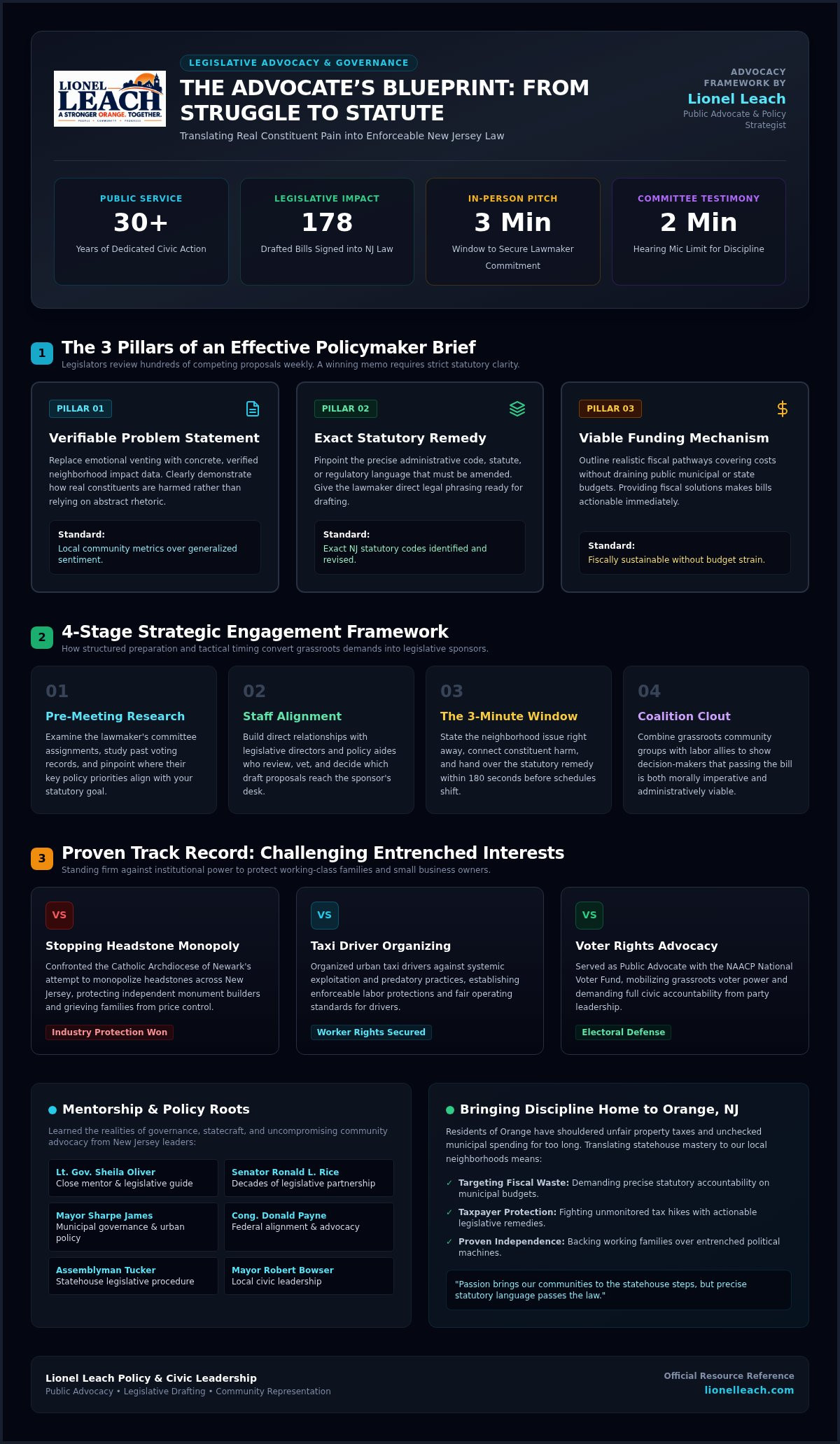
Legislative offices and policy aides review hundreds of competing proposals each week. If your memo is rambling, it gets set aside. Every persuasive brief must center on three core pillars:
A clear problem statement: Grounded in verifiable neighborhood impact data rather than general rhetoric.
The statutory remedy: Pointing directly to the exact administrative code or statute that requires amending.
A viable funding mechanism: Identifying how the state or municipality covers the cost without straining public coffers.
When you present an elected official with a practical way to pay for a reform, your brief immediately rises above competing demands. That focused structure turns local struggles into permanent, enforceable statutes.
Strategic Framework: How to Present Your Cause to Lawmakers
Before you step into any legislative office, preparation dictates your outcome. You must examine the lawmaker's committee assignments, study their past voting patterns, and determine where their policy priorities sit. During an in-person meeting, you have roughly three minutes to secure their buy-in before their schedule takes over. State the neighborhood issue immediately, share the constituent impact, and present the statutory remedy. As detailed in our overview of Lionel Leach and Senator Ronald L. Rice: Decades of Legislative Impact, we evaluated every proposal by how quickly an advocate delivered real substance.
Navigating Committee Hearings and Legislative Aides
Elected officials depend heavily on their staff to analyze policy details. Establishing professional relationships with legislative directors and policy aides is vital, as they decide which drafts reach the sponsor's desk. When a bill reaches a public committee hearing, time shrinks even further. You often have only two minutes at the microphone, so every sentence must be disciplined, concise, and focused on community outcomes.
Sustained legislative wins also require broad coalitions. By building collaborative government partnerships with local organizers and labor allies, you demonstrate that your issue cannot be dismissed. True effective communication with policymakers shows decision-makers that advancing your bill is both morally right and administratively sound. If you are working to build grassroots momentum for our communities, explore our initiatives at lionelleach.com to see how structured advocacy creates lasting change.
Overcoming Entrenched Interests to Deliver Local Results in Orange
True policy advocacy isn't polite consensus; it requires standing firm when entrenched powers attempt to steamroll working families. I proved this when I took on the Catholic Archdiocese of Newark to stop them from monopolizing the headstone industry across New Jersey, protecting local monument builders and grieving families. Whether organizing taxi drivers against exploitation or challenging party bosses, I learned early on never to back down from a necessary fight. My understanding of governance was shaped by mentors like Mayor Sharpe James, Congressman Donald Payne, and Lieutenant Governor Sheila Oliver, who taught me how to turn principled conviction into practical policy.
Applying Proven Legislative Advocacy to Serve Orange, NJ
Bringing these lessons home to Orange, New Jersey requires the same uncompromising resolve. For too long, our residents have shouldered unfair property taxes and unchecked municipal spending. Effective communication with policymakers must happen at our council meetings just as rigorously as it does in Trenton. My 30+ years of legislative experience drafting state laws and managing public budgets belong right here, working directly for our neighborhoods.
Accountable municipal government begins when residents organize, present clear facts, and demand transparency from city hall. Whether we are fighting for stable taxes, safer streets, or honest public development, our community cannot settle for empty promises. When we bring disciplined legislative advocacy to our local struggles, we can build an Orange that answers directly to the people.
Transforming Community Voice into Lasting Legislative Action
Real policy reform is never an accident. It demands meticulous preparation, disciplined messaging, and the courage to challenge entrenched power. Across my 30+ years in public service, serving as Legislative Director to State Senator Ronald L. Rice and drafting 178 pieces of legislation signed into New Jersey law, I have seen that effective communication with policymakers happens only when advocates pair lived community truths with concrete statutory solutions.
Our families in Orange deserve that exact caliber of tested, unyielding leadership. When we bring structured strategy to our municipal struggles, we can hold leaders accountable, stabilize property taxes, and revitalize our neighborhoods. Connect with Lionel Leach to discuss community advocacy and responsive leadership for Orange, and let's work together to build the responsive government our city deserves.
Frequently Asked Questions
What is the most effective way to communicate with a policymaker?
The most effective way is presenting a concise brief that pairs a specific community issue with an exact statutory remedy and funding source. Lawmakers hear endless complaints, but they act on practical answers. By mastering effective communication with policymakers, you demonstrate how a reform directly helps working families and fits within existing state or municipal budget constraints.
How do you prepare for a meeting with an elected official?
Start by researching the lawmaker's committee assignments, recent voting history, and core public priorities. Never enter an office unprepared. Structure your core argument so you can articulate the community issue, constituent data, and proposed fix within the first three minutes. Always bring a concise, one-page leave-behind memo that summarizes your proposed language without creating clutter.
Why is engaging legislative staff just as important as meeting the lawmaker?
Legislative directors and policy aides control which bills advance to the sponsor's desk. They perform the detailed statutory analysis, vet proposals, and coordinate committee agendas. When you build trusted professional relationships with staff by providing accurate data and reliable research, you ensure your community's concerns stay at the top of the legislative calendar.
How does Lionel Leach use his legislative experience to advocate for Orange, NJ?
I bring over 30 years of public service and a proven record of drafting 178 state laws directly to Orange. That background allows me to champion effective communication with policymakers at City Hall. I focus on stabilizing local property taxes, demanding transparent municipal budgets, and ensuring local ordinances protect working families across our wards.



Comments