Civic Participation in NJ: Community Engagement Guide

What if the barrier to community change isn't a lack of passion, but a lack of a professional roadmap? Many residents feel that individual participation rarely leads to actual policy shifts, especially when faced with the dense layers of state government. Understanding the diverse landscape of civic participation programs NJ supports is the first step toward moving from a passive observer to a strategic advocate. It's natural to feel overwhelmed by complex legislative structures, yet these systems offer the most reliable paths for sustainable progress when approached with the right expertise.
We know you want more than just a seat at the table; you want to influence the conversation. This guide reveals the frameworks and strategies behind New Jersey’s most effective civic participation programs to drive meaningful community and legislative impact. You'll gain a clear understanding of the state's evolving civic landscape, from the New Voter Empowerment Act to the institutional funding of local journalism. We'll provide professional frameworks for voter outreach and actionable strategies for community development that turn individual conviction into collective success.
Table of Contents
Understanding the Landscape of Civic Participation Programs in NJ
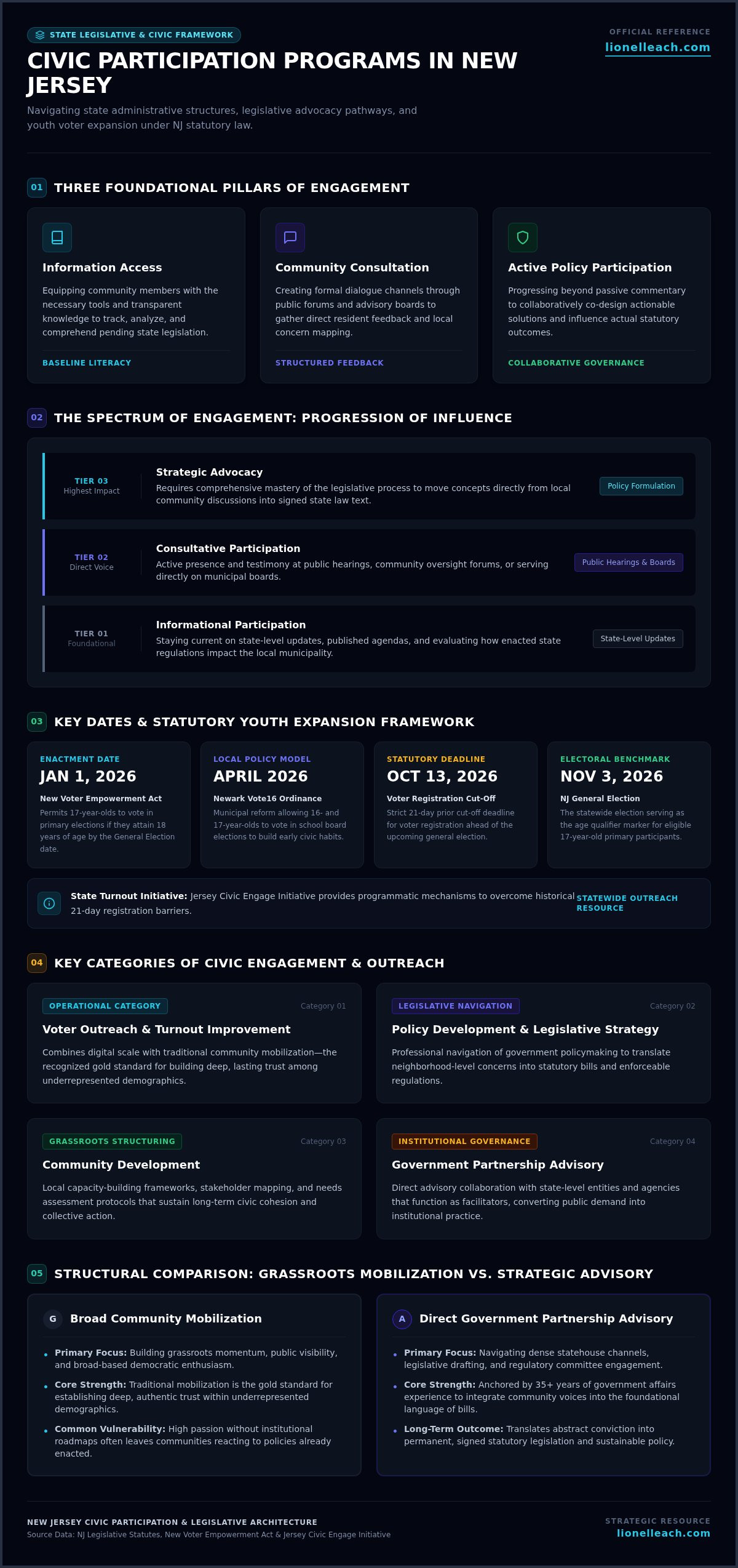
Civic participation programs NJ are more than just bureaucratic checklists; they are the structured frameworks that empower residents to influence the laws and policies governing their lives. At their core, these programs are structured initiatives designed to increase public involvement in government and policy. They exist to bridge the distance between the statehouse and the neighborhood. By establishing formal channels for public involvement, the state ensures that governance remains a collaborative effort rather than a top-down mandate. Effective engagement relies on established civic engagement principles that prioritize transparency and collective responsibility.
Success rests on three strategic pillars. Information access ensures that every community member has the tools to understand pending legislation. Community consultation provides a platform for residents to voice concerns through public forums and advisory boards. Active policy participation moves beyond feedback, allowing stakeholders to co-design solutions. In New Jersey, where legislative cycles move quickly and administrative structures are dense, understanding these pillars is essential for any organization utilizing civic participation programs NJ to drive community-driven growth. State-level agencies play a vital role here, acting as facilitators that translate local needs into actionable government initiatives.
The Spectrum of Engagement: From Voting to Advocacy
Engagement is not a singular act but a progression of influence. At the first level, informational participation involves staying current on state-level updates and understanding how new regulations impact your local area. Moving to the second level, consultative participation, involves active presence at public hearings or serving on municipal boards. The highest tier is strategic advocacy. This level requires a deep understanding of the legislative process to move an idea from a community meeting into the text of a state law. It's where the most significant, long-term impacts are achieved.
Why Professional Strategy Matters for Local Leaders
Relying on reactive participation often leaves communities struggling to catch up with decisions already made. Proactive leadership requires a professional strategy that builds long-term credibility with government entities. When you understand the mechanics of government, you can participate effectively in the drafting of successful legislative bills. This strategic approach ensures that community voices aren't just heard but are integrated into the foundational language of policy. With over 35 years of experience in government affairs, we've seen that the difference between a failed initiative and a signed bill often lies in the precision of the advocacy framework used.
Key Categories of Civic Engagement and Outreach
Meaningful change in New Jersey requires more than just enthusiasm; it demands a structured approach across several distinct categories. While grassroots energy is vital, the most successful civic participation programs NJ offers are those that integrate voter mobilization with high-level advisory and long-term planning. By categorizing engagement into voter outreach, legislative advocacy, community development, and government partnership advisory, organizations can build a more resilient foundation for influence. Each of these categories serves a specific function in the broader ecosystem of public service and policy change.
Voter Outreach and Turnout Improvement
Increasing turnout is a cornerstone of a healthy democracy. As of January 1, 2026, New Jersey has expanded its electorate through the New Voter Empowerment Act. This law permits 17-year-olds to vote in primary elections if they'll be 18 by the General Election. For the upcoming November 3, 2026 General Election, the registration deadline is October 13. Effective programs must address historical barriers, such as the 21-day registration cut-off, by utilizing resources like the Jersey Civic Engage initiative. In Newark, for instance, the municipal Vote16 ordinance allowed 16 and 17-year-olds to participate in the April 2026 school board elections, modeling how local policy can foster early civic habits. While digital outreach offers scale, traditional community mobilization remains the gold standard for building deep, lasting trust among underrepresented demographics.
Policy Development and Legislative Strategy
Legislative advocacy is the professional navigation of policy-making to serve community interests. It's not enough to have a good idea; you must understand the mechanics of how that idea moves through committee structures and legislative leadership. Community-driven policy strategy can reshape state priorities when it's backed by professional expertise and a clear roadmap. Successful advocates know how to align local needs with the specific agendas of state agencies and lawmakers. If you're looking to move beyond basic participation, exploring a community development strategy can help align your goals with legislative realities.
Sustainable growth requires planning for infrastructure and economic health that serves the collective good. Government partnership advisory facilitates essential collaboration between public sectors and private stakeholders. These partnerships ensure that large-scale projects are grounded in community needs while leveraging the resources of state government. Facilitating this dialogue is critical for achieving long-term, ethical impact within the broader landscape of civic participation programs NJ. By focusing on these core categories, leaders can move from reactive responses to proactive, strategic influence.
Strategic Frameworks vs. Grassroots Mobilization
Effective change requires more than a single rally or a solitary petition. It demands a sophisticated understanding of how bottom-up grassroots efforts can align with top-down strategic advisory. While grassroots mobilization creates the public pressure needed for visibility, professional frameworks for civic participation programs NJ provide the technical roadmap to translate that energy into state statute. The synergy between community development and policy advocacy is where sustainable impact lives. Without a structured framework, community passion can dissipate before it reaches the legislative floor.
Organizations like the Eagleton Institute of Politics provide essential research that grounds these strategies in reality. For example, the New Jersey Civic Information Consortium has distributed $13 million in grants since 2021 to support local journalism across 19 counties. This initiative represents a professionalized partnership between media advocates and state legislators that transcends simple activism. It proves that when community needs are paired with a strategic legislative roadmap, the results are both funded and institutionalized.
Choosing the Right Approach for Your Goal
Selecting the correct method depends on the specific outcome desired. If the goal is broad social awareness, public mobilization is the primary tool. However, if the objective is a specific legislative win, direct consultation is indispensable. Data and research serve as the backbone of this professional advocacy. They provide the evidence-based arguments that command respect in a statehouse committee room. Balancing raw community passion with seasoned strategic planning ensures that your efforts aren't just loud, but effective.
The Role of Government Partnership Advisory
Government partnership advisory acts as a bridge between community groups and state agencies. It establishes formal channels for an ongoing policy dialogue that lasts beyond a single election cycle. A successful partnership might involve participation in programs like AmeriCorps New Jersey, which offers an annualized living allowance of up to $20,400 for members in the 2026–2027 cycle. These formal structures ensure that community voices remain central to the implementation of civic participation programs NJ at the state level. By building these channels, organizations move from reactive responses to a state of permanent, strategic influence.
How to Evaluate and Lead Participation Programs
Leading an initiative requires more than just following state-issued updates. It demands a deliberate evaluation of your organization's mission and the specific barriers your community faces. When you lead civic participation programs NJ, you're responsible for creating a structure that can withstand the pressures of the legislative cycle. This process begins with a clear assessment of needs and a strategic map of the people who hold the power to address them. Success isn't found in a single event, but in a sustained effort that builds trust and delivers measurable results.
Assessment and Stakeholder Mapping
Identifying the right legislative influencers in the NJ State House is a precise skill. You must look beyond just your local representatives to find the committee chairs and agency heads who oversee your specific area of interest. Conducting a community audit helps determine where participation gaps exist, such as low turnout in specific demographics or a lack of representation in public hearings. Building a coalition of partners isn't just about numbers; it's about adding the specific advocacy weight needed to be taken seriously in Trenton. A well-mapped network ensures that your message reaches the right ears at the right time.
Implementation and Mobilization
Effective outreach methods move past generic messaging to address the human element of policy change. Utilizing professional advisory helps you avoid common bureaucratic pitfalls, such as missing statutory deadlines or failing to follow proper testimony protocols. Tracking progress is vital for long-term credibility. You should measure success through concrete data points, such as the number of community members engaged in consultations or the successful inclusion of specific language in a drafted bill. These metrics prove to stakeholders that your program is achieving its intended impact.
Scaling your engagement from local interest to state-level influence is the ultimate test of a program's design. A local victory can serve as a powerful proof of concept for broader state-wide policy. By establishing a measurable and repeatable framework, you ensure that your community’s voice isn't just a one-time event but a permanent fixture in the legislative process. If you're ready to move from basic involvement to high-level influence, our government partnership advisory can help you navigate these complex structures and drive lasting change.
Navigating the Future of Civic Leadership in NJ
The landscape of civic participation programs NJ is undergoing a significant transformation. As technology evolves, it offers new ways to track legislative progress and mobilize communities with greater speed. Digital platforms have lowered the barrier to entry, but they haven't replaced the need for deep, human-centric leadership. Preparing the next generation of community and legislative leaders involves more than teaching them how to use a dashboard; it requires instilling the principled conviction and steady leadership that has always defined successful advocacy. Technology is a tool, but seasoned mentorship remains the engine of real progress.
Building a Legacy of Engagement
True success is measured by the ability to move from temporary, reactive campaigns to a permanent community infrastructure. This transition ensures that engagement isn't just a response to a crisis but a core component of how a community functions. Drawing on 35+ years of experience allows us to predict legislative trends with a level of accuracy that only comes from navigating the nuances of government affairs over decades. Strategic planning serves as the foundation for this long-term empowerment, turning fleeting moments of passion into a lasting legacy of influence. We prioritize long-term impact over fleeting trends because we understand that sustainable change takes time and deliberation.
Next Steps for Strategic Impact
Power in the legislative arena is not granted; it's built through deliberation and careful planning. Seasoned mentorship provides the quiet confidence needed to navigate complex organizational dynamics and high-level negotiations. By utilizing strategic advisory services, organizations can transform basic participation into genuine power. This transformation requires identifying an advisory partner who understands both the human element of service and the mechanical realities of the statehouse. It's about moving from asking for change to being the architect of it.
To move your organization toward sustainable success, you must integrate professional advocacy into your core mission. You can Partner with Lionel Leach for Strategic Legislative Advisory to begin building a roadmap that aligns your community's goals with the realities of the legislative process. Taking this step ensures that your voice is not just part of the noise, but a driving force behind the policies that shape New Jersey’s future. We are dedicated to guiding you through these complex challenges with the integrity and expertise your mission deserves.
Transforming Participation into Lasting Impact
Effective community change is not the result of chance; it is the outcome of deliberate strategy and seasoned leadership. We have seen that a professional roadmap is the essential bridge between local grassroots energy and formal legislative results. By mastering the mechanics of the statehouse and understanding the diverse civic participation programs NJ supports, you move from a passive observer to a strategic advocate who shapes the future of our state. It's about ensuring your efforts are not just heard, but institutionalized.
True influence requires a partner who understands the nuances of negotiation and the weight of ethical responsibility. As a seasoned mentor for community development with 35+ years of government affairs expertise, we offer a proven track record in legislative leadership to guide your organization toward sustainable success. It's time to elevate your mission beyond basic involvement and into the realm of proactive, strategic power. We are here to navigate the complexities of government so you can focus on the human impact of your work.
Secure Strategic Advisory for Your Community Initiatives to begin building a legacy of meaningful impact. Together, we can ensure your community’s voice remains a permanent and influential fixture in the halls of government.
Frequently Asked Questions
What are the most effective civic participation programs in NJ for 2026?
The most effective programs in 2026 include the New Voter Empowerment Act, which allows 17-year-olds to vote in primaries, and the NJ Civic Information Consortium. These initiatives provide structured ways for residents to engage with state government. Effective participation also involves utilizing the Jersey Civic Engage initiative to stay informed on registration deadlines. These programs bridge the gap between community interest and formal legislative action by institutionalizing public involvement.
How can an organization start a legislative advocacy program in New Jersey?
Starting a program requires a clear identification of policy goals and a detailed map of relevant stakeholders in the State House. You should establish a strategic framework that aligns community needs with the legislative calendar. Professional advisory services help you navigate these dense structures without falling into common bureaucratic traps. It's about building a credible presence that lawmakers respect during the drafting of successful bills and long-term policy development.
What is the difference between civic engagement and political campaigning?
Civic engagement focuses on long-term community health and the ongoing influence of public policy. It involves activities like voter education and legislative advocacy that serve the collective good. Political campaigning is a time-bound effort centered on electing specific candidates to office. While engagement builds permanent community infrastructure, campaigning is focused on immediate electoral outcomes. Our work prioritizes the sustainable success of the collective through strategic engagement rather than short-term election cycles.
How do I find information on upcoming NJ legislative hearings?
You can access information on upcoming hearings through the official New Jersey Legislature website. This portal provides committee meeting schedules, bill tracking tools, and live-streamed sessions. Staying informed on these updates is a foundational step for any organization participating in civic participation programs NJ. Monitoring these schedules allows your leadership to prepare testimony and align your advocacy efforts with the actual pace and mechanics of state government.
Can community development strategies help improve voter turnout?
Yes, community development strategies are vital for increasing turnout. When residents see tangible improvements in their infrastructure and services, they're more likely to believe their participation leads to change. These strategies build the trust necessary for effective voter mobilization. By connecting individual concerns to broader policy frameworks, you can turn local interest into a powerful, state-wide movement for growth. This approach demonstrates that policy change has a direct impact on daily life.
What role does a government partnership advisory play in civic participation?
Government partnership advisory facilitates essential collaboration between the public and private sectors. It ensures that community initiatives have a formal channel for dialogue with state agencies. This role involves translating local needs into a language that government officials understand and act upon. By bridging this gap, advisory services help organizations navigate federal and state structures to achieve specific policy goals. This professional guidance ensures that community objectives are met with sustainable success.
How can I strategically influence state-level policy as a community leader?
Strategic influence requires moving beyond public hearings to direct involvement in the policy-making process. You must align your community’s mission with the agendas of relevant state committees and legislative leaders. Using data-driven research and professional frameworks allows you to present evidence-based arguments that command respect. This approach transforms your community from a group of concerned residents into a recognized stakeholder. It's about understanding the nuances of negotiation and organizational dynamics to achieve real results.
What are the common mistakes organizations make in civic outreach?
Organizations often fail by missing statutory deadlines or neglecting to build long-term relationships with government stakeholders. Another mistake is relying on raw passion without a data-backed strategic framework. Without a clear roadmap, community energy can dissipate before it reaches the legislative floor. Effective civic outreach requires a balanced approach that pairs community mobilization with a deep understanding of how state government functions. Avoiding these pitfalls requires deliberation and careful planning to ensure lasting impact.



Comments