Choosing a Community Development Strategy Consultant: A Comprehensive Buying Guide

What if the greatest obstacle to your community’s growth isn't a lack of funding, but a disconnect between the halls of government and the streets of your neighborhood? It’s a frustration many leaders feel when complex federal structures and stalled legislative efforts keep vital projects from moving forward. You know that real progress requires more than just a plan; it needs a voice that resonates in the boardroom and the town square alike. Finding the right community development strategy consultant is the first step toward turning those stalled projects into sustainable realities.
Selecting a partner who understands the nuances of both policy and people is often the difference between a report that sits on a shelf and a community that thrives. You’ve likely experienced the friction of ineffective communication between government partners and local residents, or the exhaustion of moving through red tape without a clear map. This guide provides a comprehensive roadmap for identifying a consultant who acts as a strategic advocate, ensuring your development goals align with legislative opportunities. We will examine how to evaluate expertise in civic engagement and legislative advocacy, helping you build a foundation for long-term, ethical growth.
Table of Contents
What is a Community Development Strategy Consultant?
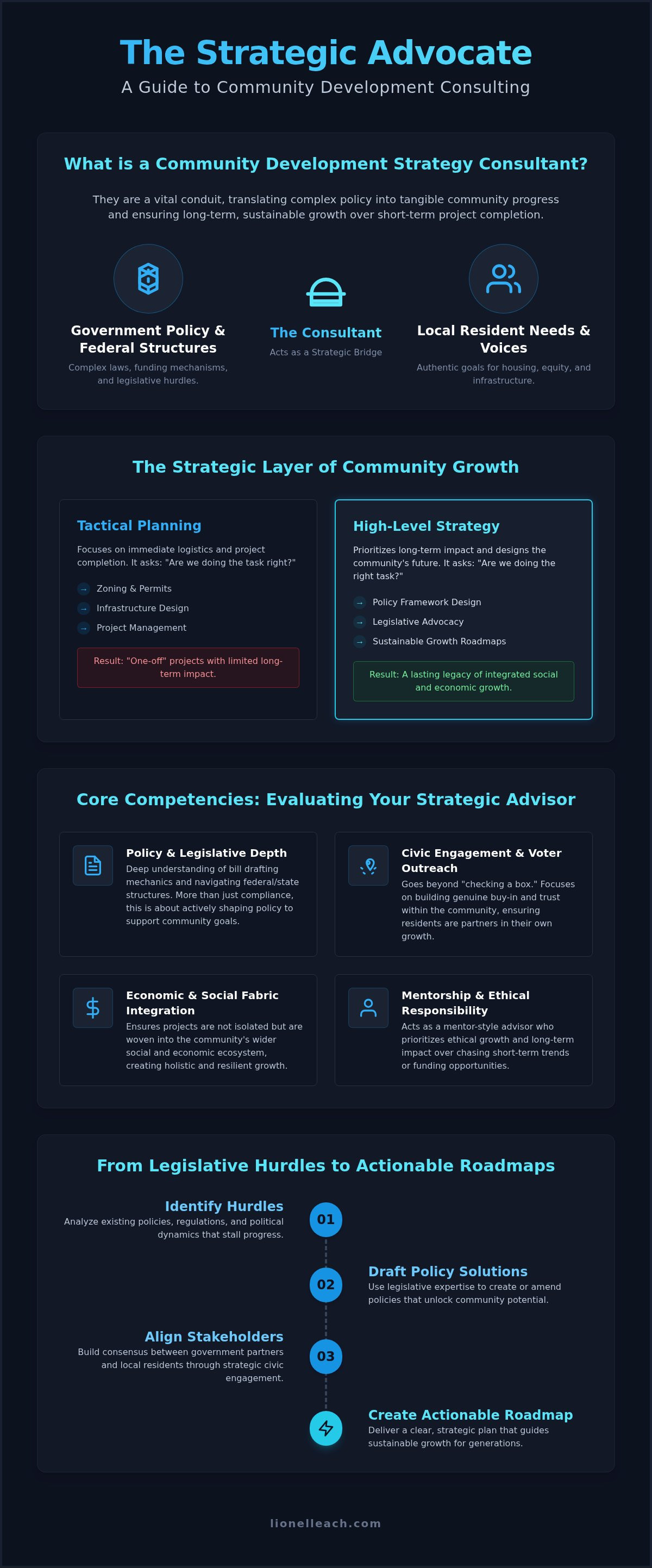
A community development strategy consultant acts as the essential conduit between complex government policy, legislative structures, and the tangible needs of local residents. While many firms focus strictly on capital raising or tax credits, a strategic advocate looks at the broader ecosystem of Community development. This role serves a diverse range of stakeholders who share a common goal: they seek more than just a finished building. They want a thriving, resilient environment that can sustain itself for generations. These sectors typically include:
Government entities seeking to modernize local infrastructure or policy.
Non-profit organizations dedicated to social equity and sustainable housing.
Community leaders looking to amplify the voices of their constituents in the halls of power.
There's a significant difference between tactical urban planning and high-level strategy. Tactical planning deals with the immediate logistics of zoning, permits, or infrastructure design. High-level strategy, however, prioritizes long-term impact over the simple completion of a project. It ensures that every initiative contributes to a lasting legacy of growth. This approach prevents the common pitfall of "one-off" projects that look good on paper but fail to integrate with the community's wider social and economic fabric.
The Strategic Layer of Community Growth
Strategy is far more than just efficient project management. It's the deliberate design of a community’s future. Project management ensures a task is completed on time, but strategy ensures the task was the right choice to begin with. This involves a deep commitment to policy framework design, creating a roadmap that guides sustainable growth through changing political climates. For this level of work, real-world government experience is non-negotiable. A consultant needs to understand the nuances of negotiation and organizational dynamics that only come from years of direct involvement in public service. It’s about having the vision to see how a single policy change can unlock years of potential.
Legislative Advocacy as a Development Tool
Local growth is inextricably linked to state and federal policy. When a consultant has a track record of drafting successful legislation, they provide a unique advantage to their clients. They don't just react to the law; they understand how to work within it to create a foundation for progress. Legislative advocacy is the strategic navigation of policy structures to achieve community goals. By aligning local development with broader legislative trends, a consultant ensures that community projects are both legally supported and positioned for long-term success. This method turns policy from a hurdle into a powerful tool for civic empowerment and sustainable expansion.
Core Competencies: Evaluating Your Strategic Advisor
Selecting a community development strategy consultant requires looking beyond technical certifications or simple project management skills. While technical compliance is necessary, it isn't sufficient for long-term growth. You need an advisor who possesses a deep understanding of how power moves through government systems and how to translate that power into local progress. This involves a rare blend of legislative expertise, civic mobilization, and the ability to facilitate trust between disparate stakeholders who may have conflicting priorities.
Policy and Legislative Depth
A consultant's track record in government affairs serves as the most reliable predictor of their future success. You should look for an advocate who understands the "mechanics" of bill drafting. This isn't merely about knowing the law; it's about knowing how to shape it. Navigating the layers of federal and state structures requires a seasoned advocate who understands the nuances of negotiation and organizational dynamics. When an advisor has decades of experience drafting successful bills, they bring a level of insight that generalist consultants simply can't match. This depth ensures your projects aren't just legally compliant but are actively supported by the policy environment. If you're seeking this level of seasoned expertise, a government partnership advisory can provide the principled leadership your project deserves.
Civic Engagement and Voter Outreach
True community growth depends on genuine buy-in from the people who live there. Many firms treat outreach as a "box to be checked" during a project's implementation phase. A strategic advocate, however, views engagement as a foundational element of a Successful Community Development Initiative. Designing comprehensive voter outreach programs is about more than holding a few public meetings. It’s about mobilizing a community to take ownership of its future. You can measure the effectiveness of these initiatives through increased participation rates and the long-term sustainability of local partnerships. Genuine mobilization creates a sense of collective responsibility, ensuring that development projects aren't seen as external impositions but as community-led achievements.
The most effective consultants prioritize principled, mission-driven outcomes over short-term wins. They act as mentors, facilitating trust between government entities, non-profits, and the public. This ethical leadership ensures that development isn't just profitable or efficient, but also equitable and sustainable. By focusing on the human element of professional services, a consultant helps build resilient communities that can weather future challenges with confidence.
The Strategic Process: How a Consultant Drives Impact
A community development strategy consultant doesn't simply hand over a list of recommendations and walk away. They implement a methodical, deliberate process that transforms a broad vision into a sustainable reality. This work begins with a rigorous initial assessment. We must identify the legislative hurdles that might stall progress while simultaneously listening to the genuine needs of the community. It isn't enough to look at what a neighborhood wants; one must also understand the regulatory environment that dictates what's possible. This dual focus ensures that the foundation of the project is both legally sound and socially relevant.
Once the landscape is clear, the focus shifts to framework design. This involves creating a comprehensive roadmap for policy and growth. This isn't a static document meant for a shelf. It’s a living strategy that aligns the interests of government officials with the aspirations of local residents. Bridging this gap is often the most challenging part of the work. A strategic advocate thrives here, using their experience to find common ground where others only see conflict. This alignment is what allows a project to move from a concept to a completed initiative with broad support.
Navigating Complex Government Structures
Success in this field requires the ability to approach federal, state, and local levels simultaneously. You can't treat these government tiers as silos. A change in federal housing policy might create a ripple effect that requires a local legislative adjustment. Identifying these key policy levers allows a consultant to influence development outcomes effectively. The goal is to build collaborative government partnerships that last. These relationships ensure your project has the political support it needs to survive election cycles and administrative shifts. It's about creating a steady path forward through a landscape that is often prone to change.
Building Sustainable Participation Models
Sustainable development relies on more than just construction. It requires a human-centric approach that empowers local members to take part in their own future. Following the Principles of Community Development, a consultant designs frameworks that prioritize active, meaningful participation. There's a direct link between voter engagement and the long-term success of development projects. When residents feel they have a stake in the process, they become the strongest advocates for the project’s success. This model ensures that civic participation continues well beyond the initial project phase. It creates a culture of engagement that serves the community for decades to come.
The final stage is execution. This is where strategic advocacy and outreach come together in a tangible way. It's the moment when policy drafting meets grassroots mobilization. A consultant with over 35 years of experience understands that execution isn't a single event. It’s a series of deliberate actions that build momentum and trust. By maintaining a focus on ethical responsibility and long-term impact, the strategic process delivers more than just a finished project. It delivers a stronger, more connected community.
Selection Criteria: Finding the Right Professional Fit
Choosing a community development strategy consultant is a decision that defines the trajectory of your project for years to come. It’s not merely about checking credentials or looking at a firm’s size. You need an advisor who brings at least 30 years of real-world experience in government affairs to the table. This level of seasoning ensures they’ve seen how policy shifts across multiple administrations. You should prioritize a consultant who offers a seamless blend of legislative advocacy and community strategy. This dual focus ensures your growth isn't just a plan on paper but a politically viable and socially supported reality.
Principled leadership is a vital component of this selection process. An ethical advisor will be transparent about the boundaries of their work. For example, they should explicitly exclude legal representation and lobbying registration services. This clarity prevents conflicts of interest and ensures the focus remains entirely on strategic advocacy and community growth. By maintaining this professional distinction, a consultant protects the integrity of your mission while providing the steady leadership necessary to navigate complex public systems.
Seasoned Mentor vs. Technical Firm
There is a profound difference between a large technical firm and a seasoned mentor. While a corporate firm might offer a rotating team of staff, a mentor-style advisor provides a consistent, authoritative presence. They understand the nuances of negotiation that only come from decades of direct experience. This mission-driven approach leads to better community outcomes because it’s rooted in conviction rather than just billable hours. When you evaluate an advisor, look for a sense of gravitas and reliability. You want a partner who feels like a trusted steward of your community’s future, someone who prioritizes long-term impact over fleeting trends.
The Importance of Strategic Alignment
Strategic alignment is the synchronization of organizational mission with legislative reality. Without this alignment, even the most well-funded projects can stall due to policy friction. You must vet a consultant’s history of legislative success by looking for evidence of actual impact. Have they drafted successful bills? Do they understand how to bridge the gap between local needs and state-level priorities? Ensuring the consultant’s vision matches your organizational goals is the only way to achieve sustainable success. If you are ready to secure a partner who understands these dynamics, exploring professional legislative advocacy can provide the strategic direction your project needs.
Ultimately, the right fit comes down to a blend of experience, ethics, and a deep commitment to the collective success of the community. A consultant who acts as a strategic advocate doesn't just offer advice; they provide a roadmap for progress built on a foundation of integrity and proven results. This ensures that your development goals aren't just met, but are surpassed through careful planning and expert execution.
Achieving Growth with Lionel Leach Strategic Advisory
Lionel Leach brings more than 35 years of experience to the table. This isn't just about advisory; it’s about a career spent in the trenches of government affairs. When you work with a community development strategy consultant who has drafted successful bills, you aren't just getting a plan. You're gaining a strategic advocate who knows how to move the needle at federal, state, and local levels. This seasoned approach ensures that your community development strategy is grounded in reality and backed by a history of legislative leadership. We understand that sustainable growth requires a balance of financial viability and political alignment.
Our work prioritizes the human element. We bridge the gap between high-level policy frameworks and the grassroots needs of the people you serve. This mission-driven guidance focuses on long-term impact rather than fleeting trends. It’s a grounded, sincere way to lead that respects the ethical responsibility we have to the collective. By focusing on empowerment and collaboration, we help you build a foundation that can weather administrative shifts and economic changes.
A Trusted Advisor for Community Leaders
Lionel Leach applies a sense of seasoned authority to every project. He doesn't just offer advice; he acts as a mentor for community leaders who face complex organizational challenges. We facilitate effective civic engagement through proven programs that go beyond surface-level participation. By designing sustainable voter outreach models, we ensure that community members feel empowered and heard. Navigating the complexities of government partnerships requires confidence and a deep understanding of negotiation dynamics. We provide that steady hand, ensuring your partnerships are built on trust and shared goals. This approach avoids the sterile coldness of corporate consulting, favoring instead a warmth that feels authentic in a community setting.
Next Steps for Your Development Strategy
The advisory process begins with a deliberate conversation about your vision. We help you define the scope of your legislative and community goals, identifying the specific policy levers that will drive growth. This methodical approach ensures that every action we take is persuasive and builds upon the last. Whether you're looking for a community development strategy consultant or a specialist in government partnership advisory, we're here to guide you toward success. It's time to move past the friction of ineffective communication and start building a sustainable future. You can Partner with Lionel Leach to refine your community development strategy today and begin the journey toward meaningful, lasting impact.
Building a Legacy of Sustainable Growth
Building a sustainable community is a long-term commitment that requires a blend of professional gravitas and grassroots sincerity. You've seen that the right community development strategy consultant doesn't just manage projects; they act as a strategic advocate who bridges the gap between policy and people. By prioritizing legislative depth and designing authentic participation models, you can transform complex government structures into engines for local growth.
Success depends on finding a partner who values integrity as much as results. With over 35 years of government affairs experience and a proven track record in legislative advocacy, Lionel Leach offers the seasoned strategic mentorship necessary to navigate these challenges. It's about moving from a vision of growth to a reality of lasting impact. Each step forward should be deliberate, principled, and focused on the collective success of the community.
If you're ready to align your organizational goals with a roadmap for sustainable development, now is the time to take the next step. Refine Your Community Strategy with Lionel Leach and build a foundation that serves your constituents for generations to come. Your community's future is a collective journey, and with the right guidance, that journey leads to meaningful success.
Frequently Asked Questions
What does a community development strategy consultant actually do?
A community development strategy consultant acts as a vital bridge between high-level government policy and the practical needs of local residents. They design comprehensive roadmaps that align legislative opportunities with community growth goals. This work involves identifying policy hurdles, facilitating stakeholder trust, and creating sustainable models for civic participation. Unlike a general advisor, they use deep experience to ensure that development projects are both politically viable and socially impactful for the long term.
How does legislative advocacy differ from traditional lobbying?
Legislative advocacy focuses on the strategic navigation of policy structures and the drafting of bills to achieve community goals, whereas traditional lobbying often involves specific registration services that this consultancy does not provide. Advocacy is about guidance, mentorship, and building long-term partnerships between government entities and the public. It prioritizes the "mechanics" of how policy is shaped to create a foundation for growth rather than just seeking immediate influence on a specific vote.
Why is voter outreach important for community development projects?
Voter outreach is the foundation of genuine community buy-in and project sustainability. It ensures that development isn't just an external imposition but a community-led achievement. Effective outreach programs mobilize residents to take ownership of their future, which increases participation rates and builds resilient local partnerships. When people feel they have a meaningful stake in the process, they become the strongest advocates for a project's success, ensuring it thrives long after the initial construction phase.
Can a consultant help with government partnership advisory at the federal level?
Yes, a consultant provides government partnership advisory across all levels, including federal, state, and local structures. Navigating federal systems requires a deep understanding of complex regulatory environments and the ability to identify key policy levers. A seasoned advisor helps organizations build collaborative partnerships that can survive administrative shifts. This multi-level approach ensures that local community projects stay aligned with broader national trends and federal funding opportunities for maximum impact.
What is the difference between a policy development consultant and a project manager?
A policy development consultant focuses on high-level strategy and long-term impact, while a project manager typically handles tactical logistics and immediate task completion. While a project manager ensures a building is constructed on time, a strategy consultant ensures that the building serves a larger, sustainable purpose within the community's social and economic fabric. Strategy involves designing the overarching framework that guides development through changing political climates, prioritizing principled leadership over simple project checklists.
How do I know if my organization needs a community development roadmap?
Your organization likely needs a community development roadmap if you are struggling with stalled projects, ineffective communication with government partners, or a lack of genuine civic participation. If you find yourself navigating red tape without a clear direction, a roadmap provides the necessary strategic alignment. It synchronizes your mission with legislative reality, turning obstacles into opportunities for growth. This structured approach helps ensure that your resources are used efficiently to achieve lasting, mission-driven outcomes.
Does a community development consultant provide legal representation?
No, a community development strategy consultant does not provide legal representation or lobbying registration services. This professional distinction is essential to avoid conflicts of interest and maintain a focus on strategic advocacy and community growth. While the consultant may have extensive experience drafting successful bills and navigating policy, their role is that of a strategic mentor and advocate. For any matters requiring formal legal counsel or courtroom representation, organizations should consult with a licensed attorney.
How much experience should a strategic advisor have in government affairs?
A strategic advisor should ideally possess at least 30 years of "real-world" experience in government affairs to offer meaningful guidance. Lionel Leach, for instance, leverages over 35 years of leadership to help clients navigate complex public systems. This depth of experience is necessary because it provides a nuanced understanding of negotiation and organizational dynamics that only comes from decades of public service. Seasoned authority ensures your consultant can anticipate policy shifts and build stable partnerships.



Comments