Building Trust in Local Government: Debunking Myths and Restoring Civic Faith

Posting meeting minutes on a website isn't true transparency; it's often just digital noise that masks a deeper disconnect between policy and the people it serves. You likely feel the weight of rising public skepticism and the frustration of low voter turnout, even when your team works tirelessly to be open. It's a common struggle for leaders committed to building trust in local government who find their message lost in communication channels that fail to reach a diverse population.
This article explores why traditional methods fail and how strategic community engagement can rebuild that vital bond. We'll provide a framework for authentic outreach and strategies to prove government effectiveness through tangible results. By bridging the gap between policy and the public, you can restore civic faith and lead your community toward a more collaborative and sustainable future.
Table of Contents
Myth vs. Reality: Why Distrust in Local Government is Not Permanent
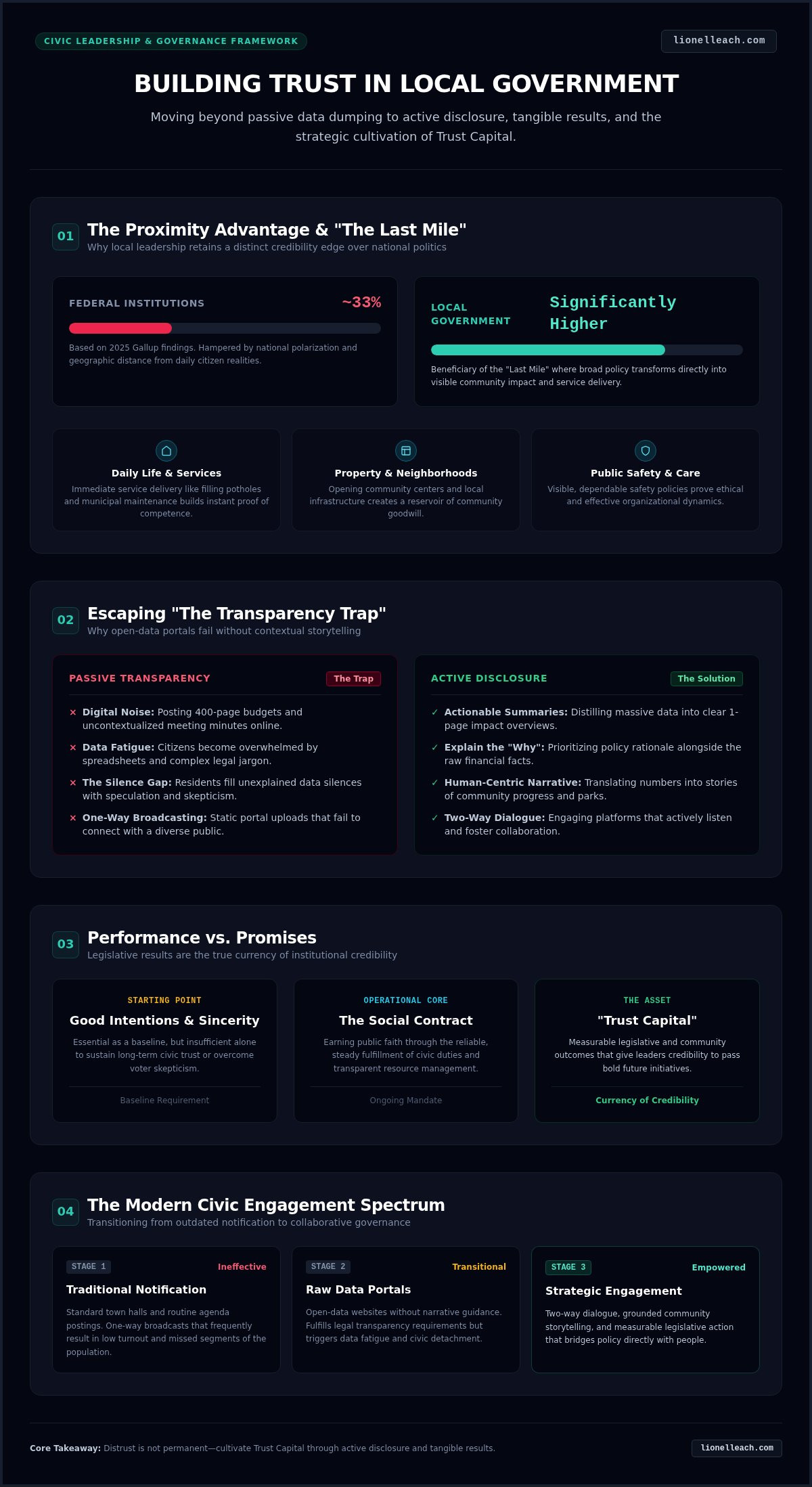
A common misconception suggests that national political polarization has poisoned all levels of public office. However, data tells a different story. According to a 2025 Gallup finding, trust in local government remains significantly higher than trust in federal institutions, which sits at approximately 33%. This gap exists because local government operates on the "Last Mile" theory. This is the space where broad policy becomes personal, directly affecting a citizen's daily life, property, and safety. Successfully building trust in local government requires cultivating "Trust Capital," which is the foundational asset of credibility that allows a leader to implement bold initiatives with community support.
The Distinction Between Federal and Local Distrust
Citizens often separate their frustration with national politics from their views on the local council. This proximity advantage allows leaders to build credibility through visibility and immediate service delivery. When a resident sees a pothole filled or a new community center opened, it serves as tangible proof of competence. These interactions create a reservoir of goodwill that federal agencies, hampered by distance, simply cannot replicate. It's much harder to stay cynical when you see the direct results of your tax dollars in your own neighborhood.
Why "Good Government" is a Moving Target
Public expectations have shifted in the mid-2020s. Residents no longer just demand ethical leaders; they demand effective ones who can navigate complex organizational dynamics. This evolution requires a modern approach to civic engagement that prioritizes collaboration over simple notification. Building trust in local government today isn't about avoiding mistakes. It's about demonstrating a steady, principled commitment to the collective success of the community through a results-driven framework that bridges the gap between policy and people.
The Transparency Trap: Why Posting Data Alone Fails to Build Trust
Many leaders assume that launching an open-data portal is the final step in building trust in local government. They believe that if the books are open, the public will feel secure. However, decades of data on public trust in government show that transparency alone doesn't bridge the divide. Instead, it often leads to "Data Fatigue," where citizens feel overwhelmed by spreadsheets and legal jargon. Without context, raw data can actually fuel conspiracy theories. People fill the silence between the numbers with their own assumptions, often assuming the worst about government motives.
Moving from Passive Transparency to Active Disclosure
Passive transparency is simply making data available. Active disclosure involves making it understandable. It's the difference between posting a 400-page budget and creating a one-page summary that explains how tax dollars improve local parks. We need to move toward a model of authentic communication where the "why" behind a policy is just as prominent as the "what." This requires using digital platforms for two-way dialogue rather than one-way broadcasting.
Bridging the Perception Gap in Government Communication
The 2025 gap between official records and public perception highlights a persistent missing link in policy. Even when a policy is effective, a lack of human-centric messaging can leave residents feeling disconnected. Reliability is built through consistent, grounded storytelling that resonates with diverse populations. Building trust in local government requires more than a portal; it requires a mentor's touch to guide the narrative. If you want to move beyond the transparency trap, consider how a community development strategy can help you translate complex data into a narrative of progress and integrity.
Performance vs. Promises: Results as the Currency of Credibility
Good intentions are a vital starting point, but they're never a final destination. While sincerity matters, it isn't enough to sustain public support over the long haul. Citizens today seek tangible proof of a leader's commitment through measurable outcomes. decades of public trust research indicates that institutional faith is earned through the reliable fulfillment of the social contract. For those focused on building trust in local government, legislative results serve as the primary currency of credibility.
The Strategic Value of Legislative Advocacy
Drafting effective policy is a practical trust-building tool. It moves a community's vision from a concept to an enforceable law. Navigating complex government structures requires more than passion; it demands the seasoned experience of a strategic advisor who understands how to bridge the gap between intent and action. When leaders deliver specific, successful legislation, they provide the proof residents need to believe in the system again. This tactical execution ensures that community initiatives don't stall in committee but instead become part of the local legal framework.
Community Development as a Trust-Building Exercise
Visible improvements in local infrastructure signal government competence more clearly than any public statement. Aligning a community development strategy with the actual needs of residents ensures that growth is both sustainable and inclusive. To maintain this momentum, leaders should establish clear benchmarks that the public can track:
Publicly accessible project completion timelines for neighborhood upgrades.
Transparent budget allocation reports that show exactly where funds are spent.
Regular impact assessments that measure the effectiveness of local service delivery.
This level of accountability encourages higher civic participation. When residents see that building trust in local government leads to physical, lasting change in their own streets, they're more likely to re-engage with the democratic process and support future initiatives.
Beyond the Town Hall: Modern Strategies for Civic Engagement
Traditional town halls often fail because they create a theater for grievances rather than a forum for solutions. Relying solely on these meetings is a mistake that limits the scope of public participation. Building trust in local government requires a shift toward the "Engagement Spectrum," where the goal moves from merely informing residents to actively empowering them. This transformation demands a year-round effort. Strategic voter outreach shouldn't be reserved for election cycles; it must be a continuous dialogue that reinforces the bond between the people and their representatives, ensuring every resident feels valued throughout the entire legislative process.
Designing a Comprehensive Voter Outreach Program
Effective outreach requires a methodical approach to reach those who usually stay silent. You can't expect a diverse population to come to you; you must go to them. Consider these steps for a more inclusive strategy:
Identify underrepresented voices by analyzing participation data across different neighborhoods and demographics.
Utilize multi-channel communication strategies, including mobile-friendly digital platforms and localized community events, to meet people where they live.
Create feedback loops that explicitly show citizens how their specific input changed a policy outcome or project design.
Building Collaborative Government Partnerships
No government entity can solve complex modern challenges in isolation. True success depends on collaborative partnerships between public agencies, private sectors, and community groups. By utilizing a government partnership advisory, leaders can align these diverse stakeholder interests toward a unified mission. This alignment is the essential catalyst for civic mobilization that leads to sustainable community growth. When these groups work in tandem, they create a resilient foundation for building trust in local government through shared responsibility and visible, long-term progress.
The Path Forward: Strategic Advisory for Community Growth
Navigating the complexities of modern governance requires more than just a firm grasp of policy; it requires the wisdom to understand the human element behind every decision. While systems provide the structure, relationships provide the soul of a community. Building trust in local government is a marathon, not a sprint. It demands a long-term, principled approach to civic engagement that prioritizes the collective success of the community over short-term political wins. A strategic advisor serves as the vital bridge, translating diverse community needs into actionable policy that resonates with the public.
The Role of Seasoned Mentorship in Local Leadership
Seasoned mentorship provides the "real-world" perspective needed to handle today's nuanced organizational dynamics. With over 35 years of experience in government affairs and legislative leadership, a trusted advisor offers more than just technical advice; they provide a blueprint for steady, ethical leadership. This quiet confidence and methodical planning are essential when navigating the friction of policy development. Principled leadership is the ultimate antidote to public cynicism. It shows residents that their leaders are dedicated to a mission larger than themselves, fostering a culture of integrity that trickles down through every department.
Implementing Your Community Development Roadmap
Rebuilding trust starts with a clear, actionable roadmap tailored to your community's unique challenges. Leaders must move beyond reactive management and embrace a proactive strategy that includes:
Committing to a year-round voter outreach program that values every voice.
Setting measurable benchmarks for community development that the public can track.
Leveraging professional advisory to navigate complex legislative structures.
Seeking expert guidance ensures your outreach and advocacy goals are met with precision and purpose. Building trust in local government requires a commitment to excellence that is both visible and verifiable. Discover how strategic advisory can transform your community engagement and help you restore the vital bond between your government and the people you serve.
Leading Your Community Toward Lasting Restoration
Restoring the vital bond between government and the public isn't an overnight task; it's a deliberate journey rooted in principled action. We've explored how true credibility relies on delivering tangible results and maintaining a year-round dialogue with the people you serve. Moving beyond passive data sharing allows you to prove that your leadership is both effective and accessible to every resident. Building trust in local government requires a roadmap that combines strategic policy with a deep respect for the human element of governance.
With over 35 years of experience in government affairs and a proven track record in community mobilization, I specialize in navigating complex structures to deliver results. Partner with Lionel Leach for Strategic Community Advisory to strengthen your outreach and advocacy. You don't have to navigate these challenges alone. Together, we can turn public skepticism into a foundation for sustainable civic growth.
Frequently Asked Questions
Why is trust in local government higher than trust in the federal government?
Local trust is higher because residents see the direct impact of municipal services on their daily lives. While federal policy often feels distant, local actions like park upgrades or public safety initiatives provide tangible proof of competence. This proximity allows for face-to-face interactions that build personal credibility, making the government feel like a neighbor rather than a distant bureaucracy.
Does transparency automatically lead to increased public trust?
Transparency alone isn't enough. Simply posting raw data can lead to information overload, where citizens feel overwhelmed rather than informed. Without clear context that explains the "why" behind the numbers, transparency can actually fuel skepticism. Building trust in local government requires active disclosure, where data is translated into understandable stories of progress and accountability that resonate with the public.
How can local leaders in Orange, NJ improve voter outreach without a massive budget?
Effective outreach in Orange, NJ doesn't require huge budgets; it requires strategic presence. Leaders can leverage existing community networks and localized events to reach residents. Meeting people where they already gather, such as neighborhood centers or local markets, allows for meaningful dialogue. Consistent, human-centric messaging across these low-cost channels often resonates more deeply than expensive, impersonal advertising campaigns.
What are the most common mistakes governments make when trying to build trust?
One common mistake is relying on one-way broadcasting instead of two-way dialogue. Governments also fail when they prioritize "good intentions" over measurable legislative results. Ignoring underrepresented voices or failing to show how public input influenced a decision also erodes faith. Rebuilding trust requires a methodical, principled approach that values every community member and delivers on the promises made to the collective.
Can strategic community development really change public perception?
Strategic community development changes public perception by providing visible proof of government effectiveness. When residents see physical improvements in their infrastructure, it signals that their tax dollars are managed with integrity. Aligning these projects with the actual needs of the people proves that the government is listening. This strengthens the social contract and is a vital part of building trust in local government.
What role does legislative advocacy play in local government trust?
Legislative advocacy is the tool that turns community needs into enforceable policy. It provides the tactical execution necessary to move beyond promises and deliver results. By navigating complex government structures, leaders can ensure that local initiatives receive the support they need to succeed. This process shows residents that their leaders have the seasoned experience to make the system work for the community.
How do we measure if our trust-building efforts are actually working?
Measuring success requires tracking both participation rates and the effectiveness of feedback loops. Increased voter turnout and higher attendance at community workshops are strong indicators of progress. Additionally, leaders should monitor how many residents feel that their input directly impacted a policy outcome. Setting clear, public benchmarks for project completion also allows the community to verify that trust-building efforts are yielding tangible results.
Is it possible to rebuild trust in a highly polarized community like Orange, NJ?
Rebuilding trust in a polarized environment like Orange, NJ is possible by focusing on shared local goals rather than national political divides. Principled leadership that prioritizes the human element of policy development can bridge many gaps. By using a government partnership advisory to align diverse interests, leaders can foster collaboration. This methodical approach demonstrates that the collective success of the community outweighs individual political differences.



Comments