Building Consensus Among Stakeholders: A Community-First Approach

What if consensus isn’t about getting everyone to agree, but making sure no one’s real concern gets pushed aside? In Orange, building consensus among stakeholders means bringing people with different priorities and levels of influence into a process where community concerns can shape practical action. I know meetings can produce plenty of discussion without creating shared direction, follow-through, or trust in what comes next.
In my public-service and organizing work, I’ve learned that progress starts with listening and making room for different perspectives. I’ve worked with Senator Ronald Rice since 1992, including 14 years as his Legislative Director, and I’ve organized taxi drivers and advocated through the NAACP National Voter Fund. In this article, I’ll share how I approach fair discussion, identify common objectives, and turn conversation into clear next steps. I’ll also explain how a community-first process can build trust and sustain participation in Orange.
Table of Contents
Why Building Consensus Among Stakeholders Starts with Listening
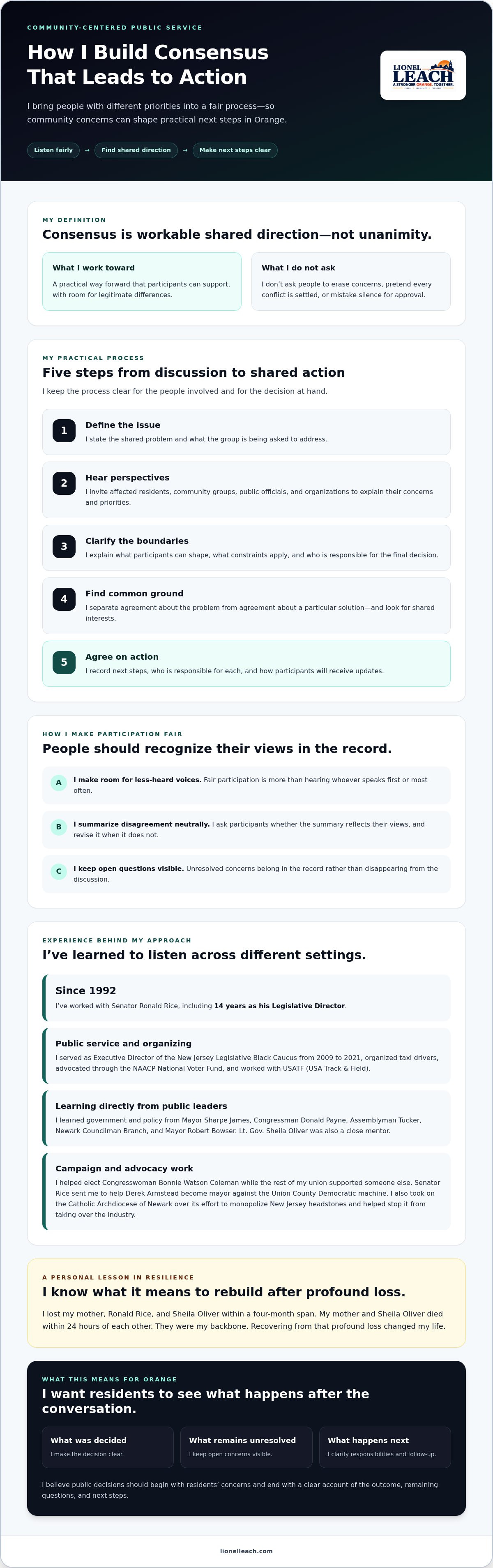
I define consensus as workable shared direction that participants can support, even when they still disagree about parts of the issue. It isn’t unanimous agreement, and it doesn’t require setting aside legitimate differences. As the overview of Consensus decision-making explains, this approach emphasizes collaboration and participation rather than relying only on a vote.
In my work as Executive Director of the New Jersey Legislative Black Caucus from 2009 to 2021, I saw why listening must begin before a decision is nearly settled. I first make the decision boundaries clear: what participants can shape, what constraints apply, and who is responsible for the final decision. When those boundaries are understood, people can contribute more meaningfully. Fair participation also means making space for voices that may carry less influence, not simply hearing from whoever speaks first or most often.
How do I identify what stakeholders need from the process?
I start by mapping the residents, community groups, public officials, and organizations affected by the decision. I don’t assume they share priorities. I ask each group what it needs from the process, what concerns it holds, and what information would help it take part meaningfully.
Then I separate shared interests from proposed solutions. People may want the same outcome while favoring different paths to reach it. Naming that distinction can open a more useful discussion than treating disagreement as a dead end. I use clear, respectful communication to make concerns and requests understandable, a principle I explore further in my guide to effective communication with policymakers. Listening doesn’t guarantee agreement, but it gives me a sounder basis for identifying where practical common ground may exist.
A Practical Process for Building Consensus Among Stakeholders
I use a clear sequence to turn discussion into shared action. The tools for consensus building from the U.S. Environmental Protection Agency offer additional guidance for public participation. My process keeps the focus on both the people involved and the decision at hand:
Define the issue: I state the shared problem and what the group is being asked to address.
Hear perspectives: I invite affected participants to explain their concerns and priorities.
Clarify constraints: I identify what can be changed, what cannot, and who holds decision-making responsibility.
Find common ground: I separate agreement on the problem from agreement on a particular solution.
Agree on action: I record the next steps, who is responsible for each, and how participants will receive updates.
A facilitator can help by summarizing points of agreement and disagreement in neutral language, then asking participants whether the summary reflects their views. If it doesn’t, I revise it rather than treating silence as approval. I also record open questions honestly, so unresolved concerns don’t disappear from the discussion.
How can a group move from disagreement to a workable decision?
I look first for shared understanding of the problem, not instant agreement on every proposed solution. My experience across government, unions, voter outreach, and USATF has shown me that each setting has its own people, priorities, and constraints. I don’t assume one approach fits every group. For more on policy navigation across sectors, see my guide to collaborative government partnerships.
In Orange, I believe accountable public service means making next steps clear and following up in a way participants can see. Readers can learn more about my work and priorities for Orange.
Applying Consensus-Building Lessons to Public Service in Orange, NJ
In Orange, I believe public decisions should begin with residents’ concerns and end with a clear account of what was decided, what remains unresolved, and what happens next. Building consensus among stakeholders can help people move toward shared action, but it doesn’t erase every conflict or require anyone to pretend their concerns have been settled.
What does experienced, community-centered leadership look like in practice?
I’ve worked with Senator Ronald Rice since 1992, including 14 years as his Legislative Director. I learned from mentors including Mayor Sharpe James, Congressman Donald Payne, Assemblyman Tucker, Newark Councilman Branch, Mayor Robert Bowser, and Lt. Gov. Sheila Oliver. My experience organizing taxi drivers and advocating for the NAACP National Voter Fund has taught me to listen carefully and understand people’s concerns before speaking on their behalf.
I opposed the Catholic Archdiocese of Newark’s effort to monopolize New Jersey’s headstone industry and worked to stop it from taking over the industry. I also helped elect Congresswoman Bonnie Watson Coleman when the rest of my union supported someone else. Senator Rice sent me to help Derek Armstead become mayor against the Union County Democratic machine. These experiences involved different people and circumstances. They taught me that coalition-building requires conviction and accountability, while recognizing that not every disagreement disappears.
Within a four-month span, I lost my mother, Ronald Rice, and Sheila Oliver. My mother and Sheila Oliver passed within 24 hours of each other. They were my backbone. Recovering from that profound loss changed my life and deepened my commitment to serving with care.
I invite Orange residents to learn about my work and public-service priorities and read more about Lionel Leach for Orange.
Put Community Voices at the Center of What Comes Next
Building consensus among stakeholders starts with listening, making room for legitimate differences, and being clear about the decisions a group can shape. It moves forward when people can identify common ground, understand the next steps, and see who is responsible for following through.
I bring more than 30 years of experience across state, county, and local government, unions, and nonprofit organizations. I worked with Senator Ronald L. Rice from 1992 and served as his Legislative Director from 2008 to 2022. That experience informs how I think about responsible public service: hear people’s concerns, explain decisions clearly, and stay accountable to the community.
Orange deserves a public process where residents can participate with confidence and where their perspectives help shape practical action. Learn about my community-focused public-service work, and join me in working toward a stronger, more responsive future for Orange.
Frequently Asked Questions
What does building consensus among stakeholders mean?
Building consensus among stakeholders means developing a shared, workable direction among people affected by a decision. I don’t treat it as unanimous agreement or expect participants to set aside legitimate differences. A credible process makes concerns visible, identifies common ground, and clarifies how decisions will be made and what next steps will follow, including who is responsible for carrying them forward.
How do you build consensus when stakeholders disagree?
I start by defining the shared issue, then listen to each perspective and distinguish underlying interests from preferred solutions. I summarize disagreements fairly, check that participants recognize their views, and identify areas where agreement may be possible. I also record unresolved concerns honestly. The group can then agree on a realistic next step and who is responsible, without requiring everyone to endorse the outcome.
Why is stakeholder engagement important in local government?
In Orange, New Jersey, residents and community organizations can help identify needs that decision-makers might otherwise miss. Their participation can also bring trade-offs and constraints into the open. I believe engagement is most useful when residents understand what decision is being considered, how their input will be considered, and how the public will learn about next steps. Participation doesn’t guarantee every request will be adopted.
Can stakeholders reach consensus without agreeing on everything?
Yes. A group can agree on a shared objective, a fair process, or a practical next step while holding different views on the details. I encourage participants to document unresolved issues and explain how decisions will be made. That keeps the record honest and helps prevent workable agreement from being mistaken for unanimous support. Progress can begin without pretending every difference has disappeared.



Comments