Advocating for Infrastructure Projects: A New Jersey Case Study

How does a neighborhood concern become a government priority? Residents often know which parks, streets, and community facilities need attention, but they may not know how to bring those needs to the people making public decisions. Advocating for infrastructure projects means turning a local concern into a clear, shared priority and keeping community voices part of the conversation.
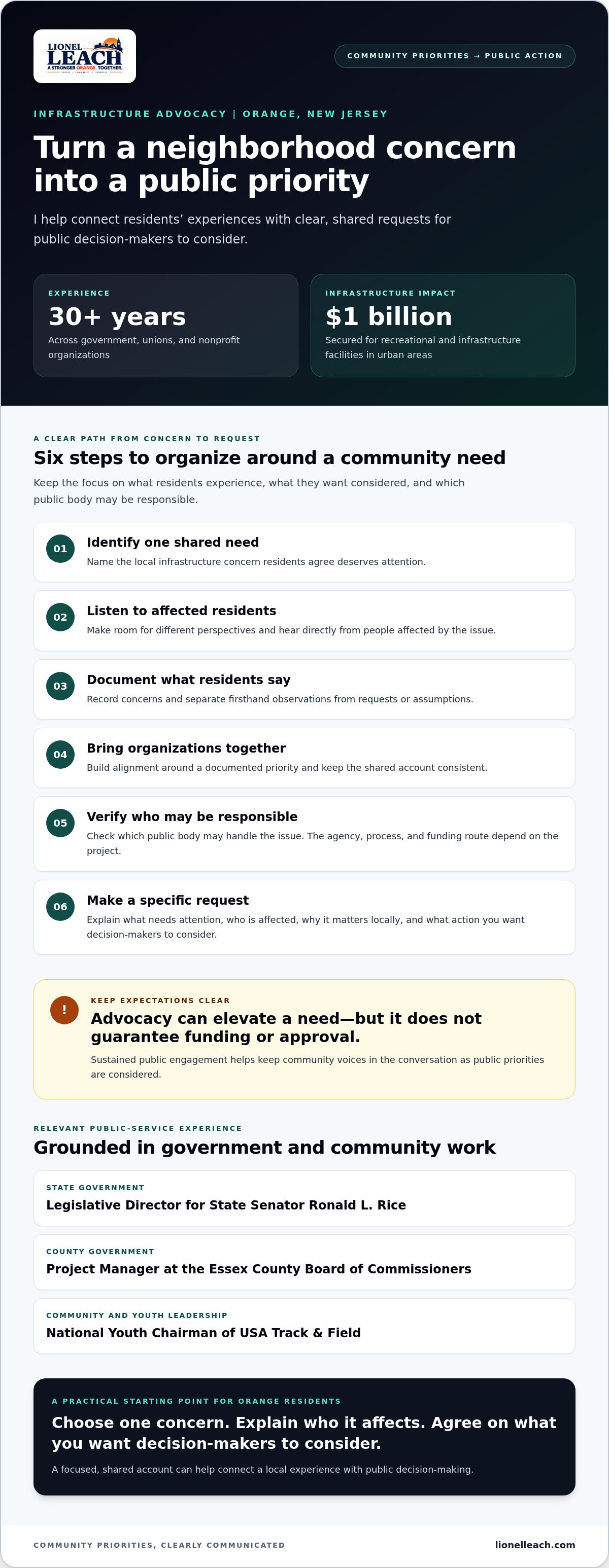
I bring more than 30 years of experience across government, unions, and nonprofit organizations, including my work as Legislative Director for State Senator Ronald L. Rice and Project Manager at the Essex County Board of Commissioners. I secured $1 billion for recreational and infrastructure facilities in urban areas. In this New Jersey case study, I’ll share how that experience informs my approach, outline practical ways to organize around a community need, and suggest how Orange residents can take a clear next step to help shape local priorities.
Table of Contents
Why advocating for infrastructure projects starts with community priorities
A community’s infrastructure needs can go unheard when they aren’t made visible to decision-makers. Residents understand how local facilities affect daily life, but public leaders need a clear account of the need and the action residents want considered. Advocating for infrastructure projects begins by connecting those points.
In my work across state, county, and local government, I secured $1 billion for recreational and infrastructure facilities in urban areas. I see infrastructure advocacy as an organized effort to bring a public need to government attention and seek action. It can clarify a community’s priorities, but it does not guarantee funding or approval.
This video offers another perspective on advocacy and analysis:
What infrastructure advocacy can do for a community
A clearly stated priority gives residents and advocates a concrete focus for conversations with public decision-makers. Rather than raising a concern in general terms, explain what needs attention, who is affected, why it matters locally, and what response the community wants considered. This keeps the discussion tied to residents’ experiences.
Advocacy can bring community voices and government strategy into the same conversation, without guaranteeing a particular outcome. Municipal governments also represent local needs. The National League of Cities advocates on issues affecting municipalities, including infrastructure. For communities connecting immediate concerns with longer-term goals, my strategic community development planning guide offers a related perspective.
How to advocate for infrastructure projects through clear priorities and partnerships
Effective advocacy turns a shared concern into a focused request. Start by identifying the need residents share. Then explain who it affects and why it matters. Finally, state what action you want decision-makers to consider. Before making the request, verify which public body may be responsible for the issue. The relevant agency, process, and funding route depend on the project, so don’t assume they are the same for every concern.
Listening comes first. Speak with residents directly affected, make space for different perspectives, and record the concerns they raise. Separate firsthand observations from requests or assumptions. Then bring relevant community organizations together around the documented priority. A shared, factual account can help keep the request consistent as advocates engage with public decision-makers. The U.S. Environmental Protection Agency’s community engagement best practices also underscore the value of involving the community in decisions.
How community advocates can communicate a project need
Keep the message specific: who is affected, what need they identify, and why it matters to the community. Distinguish what residents have observed from what they are asking government to do. Use the same clear facts in conversations and written materials, and update them if new information emerges. As Legislative Director for State Senator Ronald L. Rice and Project Manager at the Essex County Board of Commissioners, I learned the value of understanding public priorities and communicating them clearly. For more guidance, read my effective communication with policymakers guide.
Advocating for infrastructure projects requires sustained public engagement, not a guarantee of approval or funding. Orange residents organizing around a local need can explore my community development strategy as a starting point for connecting community priorities with public-sector conversations.
What my infrastructure advocacy experience can teach Orange, New Jersey
My work in public service and community advocacy has taught me to listen, build relationships, and keep community needs visible. I served as Project Manager at the Essex County Board of Commissioners and Legislative Director for State Senator Ronald L. Rice. I also served as National Youth Chairman of USA Track & Field and Regional and State Director of the NAACP National Voter Fund, and I have worked in taxi driver representation. These roles span different fields, but each has involved engaging with the concerns of the people and communities involved.
I secured $1 billion for recreational and infrastructure facilities in urban areas. That experience informs my perspective, but it does not guarantee funding or approval for a particular project. Effective engagement starts with understanding local priorities, a principle also reflected in the U.S. Environmental Protection Agency’s community engagement best practices.
Applying the lessons to community priorities in Orange
In Orange, begin by defining a local need and listening to residents affected by it. Then agree on what public action to request and which decision-makers need to hear the concern. Each project has its own context, and advocacy cannot promise a particular outcome. Residents and organizations can use community development strategy to keep priorities clear and grounded in community experience.
To learn more about my work for Orange, visit my page and consider how your community’s priorities can help shape its future.
Help Move Orange’s Priorities Forward
Advocating for infrastructure projects starts with a clear community priority, meaningful input from residents, and a focused request to public decision-makers. The right approach depends on the project, and advocacy cannot guarantee funding or approval. It can help make local needs clear and bring them into public conversations.
My perspective comes from more than 30 years of work across state, county, and local government, unions, and nonprofit organizations. I also secured $1 billion for recreational and infrastructure facilities in urban areas. These experiences inform how I help Orange residents and organizations build a thoughtful case around the needs that matter to them.
To explore my community development strategy and public service experience, learn more about my work. Start with one local priority, listen to the people affected, and agree on a clear request. Orange’s future can be shaped by residents who organize and speak up.
Frequently Asked Questions
What does advocating for infrastructure projects involve?
Advocating for infrastructure projects means organizing residents and community organizations to make a public need clear to relevant decision-makers. Advocates can describe the issue, explain who is affected, and seek engagement about possible action. This work brings community concerns into public conversations, but it does not guarantee that a project will receive funding or approval.
How can a community advocate for an infrastructure project?
Start by identifying a need shared by residents. Gather perspectives from people affected, clarify why the issue matters, and agree on a specific request to communicate to relevant public decision-makers. Keep the information factual and consistent, and check which public body is relevant before deciding how to raise the request. The appropriate approach depends on the project and its local context.
Can local residents influence infrastructure priorities?
Residents can communicate local needs, share their experiences, and participate in advocacy, helping decision-makers understand what matters to the community. They cannot guarantee that officials will adopt a proposal, but clear, factual communication and sustained engagement can keep an issue visible. In Orange, residents can begin by describing a shared concern and explaining its community impact.
What experience do you bring to infrastructure advocacy?
I secured $1 billion for recreational and infrastructure facilities in urban areas. I serve as Project Manager at the Essex County Board of Commissioners, a role I’ve held since 2017, and previously served as Legislative Director for State Senator Ronald L. Rice from 2008 to 2022. I bring this county and legislative experience to conversations about community priorities in Orange, New Jersey.



Comments